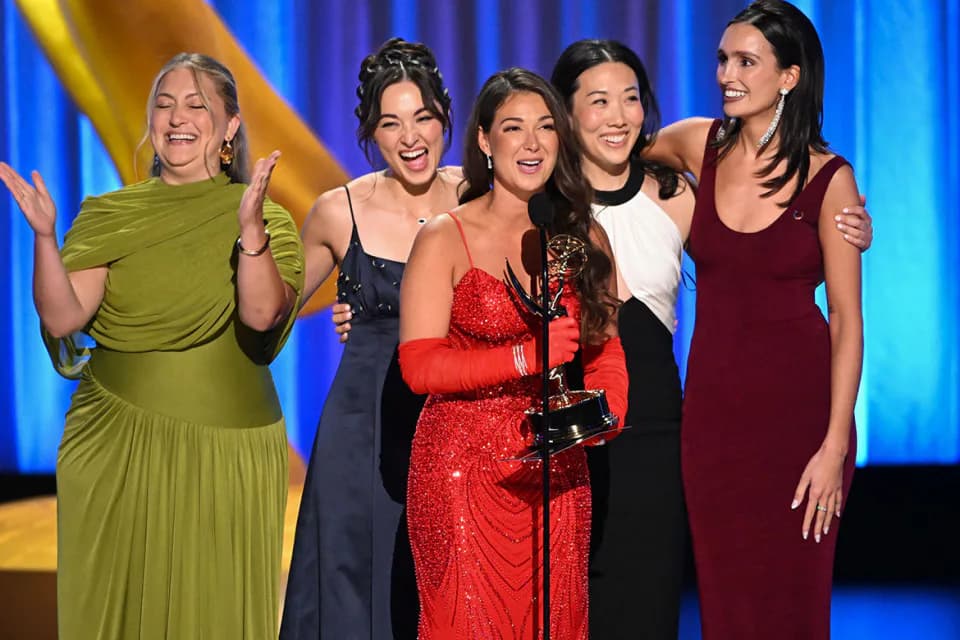
On Monday, September 14th, the 78th Primetime Emmy Awards ceremony took place at the Peacock Theater in Los Angeles.
As Milton students and faculty braced for the upcoming school year, Mariska Hargitay, a television icon and the first woman in fifteen years to solo-host the Emmys, hosted the ceremony. The pre-event nominations were led by the drama series The Pitt with 25 nominations, followed by Hacks, Widow’s Bay, Pluribus, and Beef. The Emmys had 120 categories, 101 of which were presented at the Creative Arts Emmys on September 5-6, and the other nineteen at the Primetime Emmys, broadcast by NBC. The classic red carpet was swapped out for a vibrant, peacock blue in honor of NBC’s 100th anniversary. Celebrities like Zendaya, Nicole Kidman, and Oscar Isaac arrived in curated outfits, with looks styled by Prada and Vivienne Westwood, among others. One fashion highlight came from Meg Stalter, an actress in Hacks who came dressed and body-painted as a shimmering golden Emmy statue.
Widow’s Bay, a comedy-horror television series entered late into the competition, won fourteen total awards, the most ever for a comedy series—eight at the Creative Arts Emmys and six statuettes on Monday. Matthew Rhys made history as the first person to win two lead actor Emmys in a single night, one in Widow’s Bay and one in the psychological thriller The Beast In Me. Amid applause for Rhys’ win, Martin Short, nominated for Only Murders In The Building, ripped a paper conjectured to be his acceptance speech into pieces. Widow’s Bay’s other awards included Outstanding Comedy Series and Outstanding Writing. Additionally, director and executive producer Hiro Murai was the first Asian to win in the comedy directing category. Supporting actress Kate O’Flynn and actor Stephen Root both received their first Emmy. Root, 74, was the oldest to ever win in Outstanding Supporting Actor in a Comedy Series.
Despite earning 25 nominations, The Pitt won only six Emmys. When accepting The Pitt’s award for Best Drama Series, R. Scott Gemmill spoke about the importance of The Pitt’s work: “we’ve always tried to be really authentic and tell stories about the real-life heroes of the emergency department who are there for us day in, day out, and we just want to…shine the light on them.” American actress Rhea Seehorn, famously overlooked for her raw, complex role in Better Call Saul, won Best Lead Actress in a Drama Series for Pluribus. Seehorn accepted the award while tearing up, quoting journalist Gloria Steinem as she described the women of the television industry as “linked, not ranked."
Despite the memorable winners, many internet users have noticed that none of the twelve lead and supporting acting awards went to actors of color. Though the Creative Arts Emmys awarded a few actors of color like Ernest Harden Jr., Variety summarized that “actors of color were largely shut out of the Emmys this year.” April Reign, media strategist and activist, said in a USA Today article, "When every winner across all twelve lead and supporting acting categories is white, in the same year that followed the industry's loudest promises about equity, the pattern is the story, not any single ceremony." In addition, the Emmys stage is a large, powerful platform for activism. This year, the Emmys seemed to prioritize “caution over conviction, playing it safe when the moment ultimately called for more,” according to HuffPost journalist Njera Perkins.
However, some actors still used the stage to advocate for the arts. Sally Field, who won her fourth Emmy for Remarkably Bright Creatures and became the oldest actress ever to win Outstanding Lead Actress in a Limited or Anthology Series or Movie for the film Remarkably Bright Creatures, later spoke about her late co-star Dolly Parton. After Field’s words, Reba McEntire sang a cover of Parton’s song “Appalachian Memories.”
Michael J. Fox, actor and activist, received the Bob Hope Humanitarian Award for his work fighting Parkinson’s disease. Fox founded the Michael J. Fox Foundation for Parkinson’s Research. The annual In Memoriam honored stars who have died recently through a montage. This segment was complemented by Noah Kahan’s soulful rendition of Simon & Garfunkel’s “Bridge Over Troubled Water.” Actors like Tim Curry, Rob Reiner, and Catherine O’Hara were mentioned, but the Emmys faced backlash for excluding other stars such as Chuck Norris, Peter Cullen, James Ransone, and Daveigh Chase. Jamie McPhee, wife of Ransone, criticized the Emmys publicly on Instagram, saying, “I am incredibly disappointed @televisionacad… @Jamesransone was an incredibly gifted actor, and it simply is not right to not acknowledge him and his work.”
While the Emmys sparked controversy among some viewers, the night ultimately served as a celebration of the arts. As actress Sally Field said in her acceptance speech, “we’re the arts! We matter, our voices matter… we can’t let those voices be silenced or compromised or merged.”