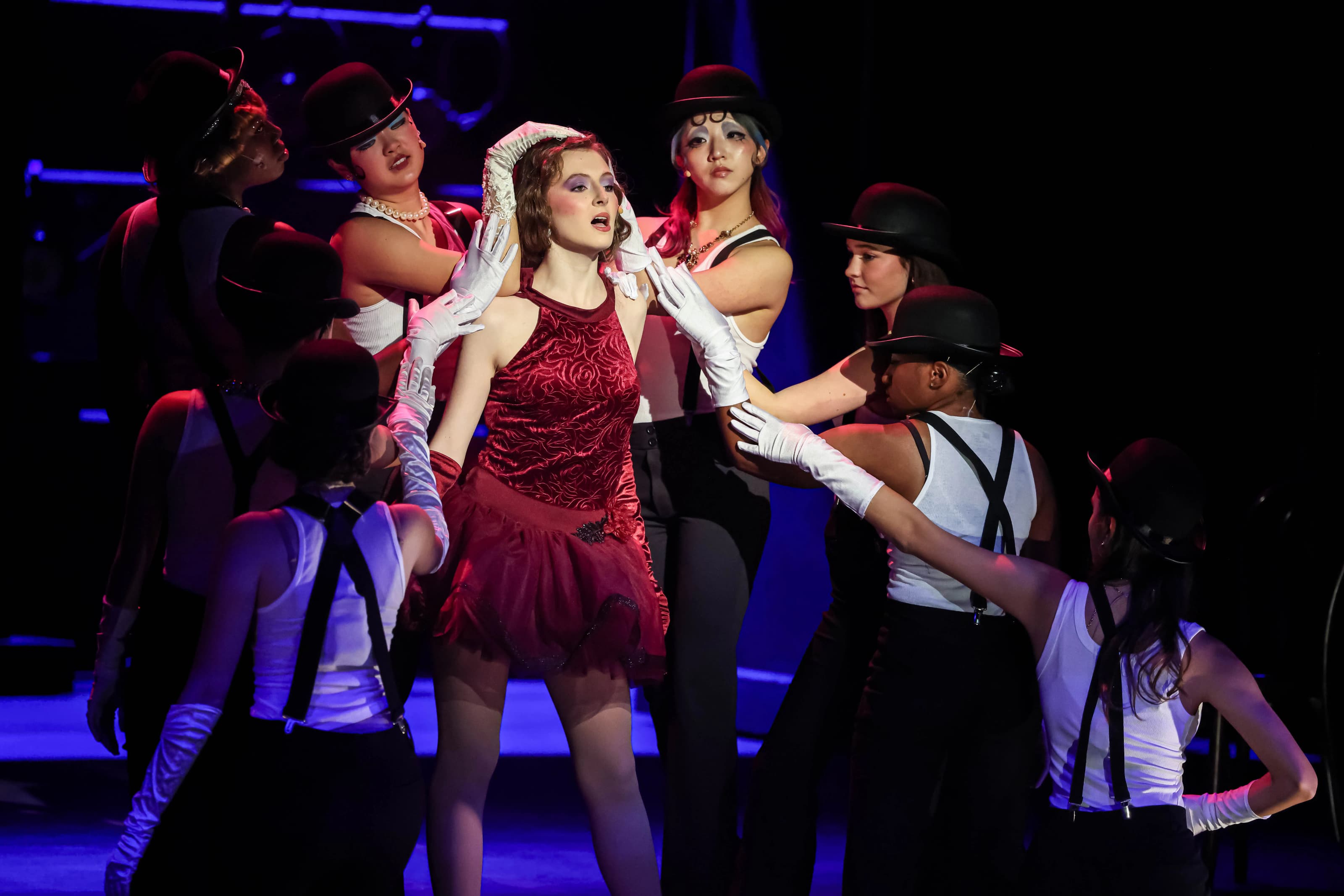
From Thursday, November 12, to Saturday, November 14, students put on a captivating performance of this year’s musical, Cabaret, held in King Theater. The much-anticipated performance, featuring some of Milton’s most talented singers and performers, brought excitement and entertainment to many attendees. Set between 1929 and 1930 in Berlin, Cabaret follows Cliff Bradshaw, an American writer played by Al Ptaszek ’27, and his love interest Sally Bowles, a nightclub performer played by Ailie Bell ’27. The joy of their love story is contrasted by the simultaneous rise to power of the Nazi Party.
Audiences were thrilled by lively performances of songs including “Willkommen” and “Maybe This Time,” as well as touching scenes between musical numbers. In addition to the cast’s performance, the gorgeous costumes, moving live music, and powerful lighting delighted audiences across all three performances.
The cast and directors created Cabaret’s alluring performance through a slightly unconventional approach. Director and Choreographer Kelli Edwards, who returned to directing musicals at Milton with Cabaret after a 20-year hiatus, said cast members learned “the music and dances first” as opposed to the blocking, so they could leave time to focus on the scenes. Edwards chose this approach because there was “a lot of story in the show… probably more than other musicals.” Edwards noted that doing both “big jobs” of directing and choreography allowed her to “focus on the vision for the show.” Additionally, she stated that the rehearsal process was “very collaborative,” one of her favorite parts of the production. Abe Laznik ’29, a member of the cast, agreed with Edwards that inverting the typical order of the rehearsal process made the production “special and unique.”
Finley Simonson ’29, who attended the Friday performance, explained that between the bold performances, charming set, and striking costumes “it seemed like all the different parts of the musical came together really well.” Another attendee, Isabella Vander Elst ’28, “loved seeing the musical,” and felt that the school made “a great decision to change the schedule so [upperclassmen] could watch [it].”
Cabaret is set in Berlin, Germany, between 1929 and 1930, so the musical carries difficult themes. The production’s program issued a warning about the “images and rhetorical Antisemitism, satirical images of Hitler, the image of a Swastika and a Nazi salute” depicted in the musical. Additionally, the musical covered topics such as abortion and unplanned pregnancy. Edwards said that while the performing arts department had wanted to put on Cabaret “for a while,” they chose to do so now because “the themes really reflect what's happening in the world.”
However, tackling difficult themes can come with challenges. Edwards stated that “[the challenging themes] were made even more challenging by the fact that there were teenagers telling the story.” Laznik further described this difficulty, noting that actors were cautious to avoid seeming to have “mal-intent” in the way they presented themselves. However, the cast and crew proved they could handle the responsibility that came with representing these topics. Edwards noted that “The cast has done amazing work [on a] difficult show to pull off.” Vander Elst described the musical as “a great way to express and revisit important themes that can be uncomfortable to talk about at school.” Echoing this sentiment, Zarak Ahmad ’27 reflected on how “extremism and division is sort of a very relevant topic to today in our current political system,” and that “the point of art is to make people reflect on real world issues.”
Cabaret produced a musical Vander Elst described as “worth remembering.” The costumes, set design, and lighting also contributed to the production's lasting impression on students. What Laznik describes as a “complex musical” touched and entertained audiences through collaboration and powerful execution of a shared vision. Students filled the seats for all three performances, and Vander Elst said that “all the cast members did a great job and the musical was a success.”