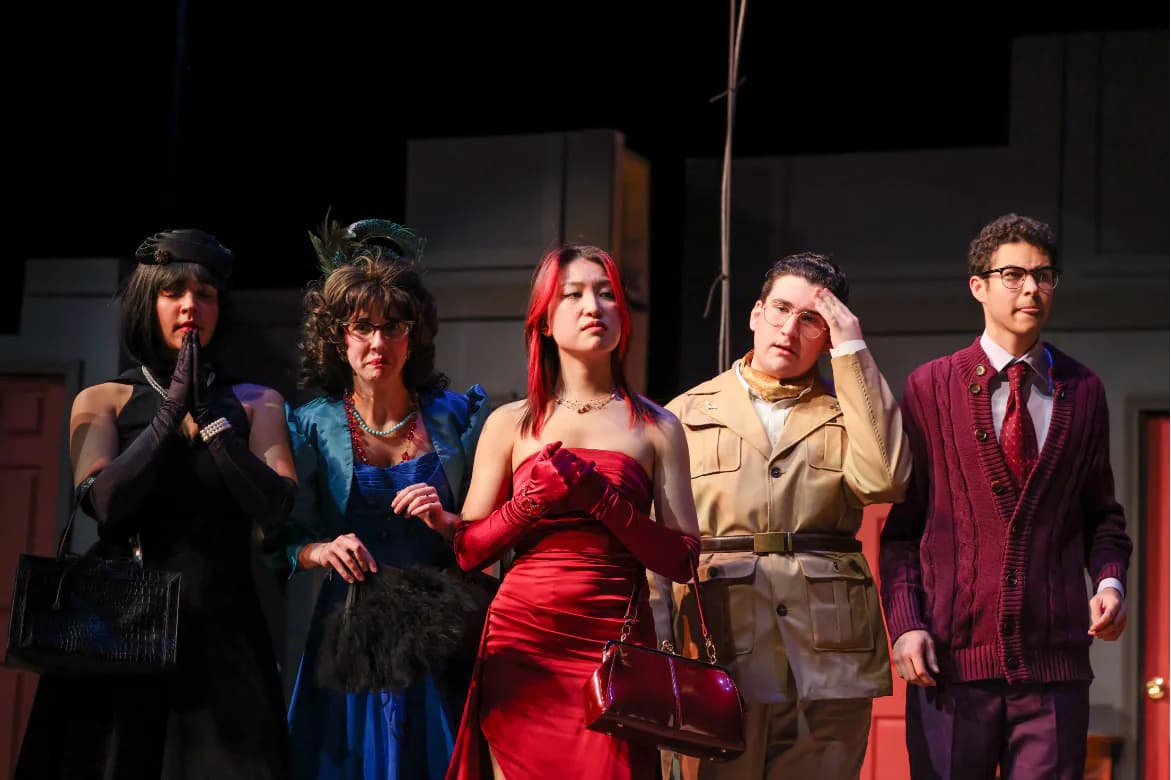
On February 11–13, Clue: On Stage (High School Edition)—often called Clue—left students in awe in Milton Academy’s King Theatre. Each night, from 7:00–8:30 p.m., the theater buzzed with the energy of the cast and rang with laughter. “It was pretty good, I can’t even lie,” said Matthew Ngure ‘29. “The part where the chef fell on the man really got me laughing.”
Based on the 1980s cult-classic film Clue, the stage adaptation brought the fast-paced comedic mystery to life with exaggerated physical comedy and sharp timing. One of the largest productions of the winter season, the show was led by Performing Arts Teacher Shane Fuller, who served as both director and set designer.
“The director is sort of the storyteller,” said Fuller, who has over 30 years of experience in directing and design. He explained that “diversity in storytelling” fuels his passion for the work. This diversity, he explained, could be explicit, with different genres or types of productions, or implicit, in the way each performance evolves with new actors and a new audience. “You’re always telling a new story,” Fuller said.
Fuller said that casting is central to that process, estimating that 80% of directing success lies in casting. He also worked closely with the technical team to create the intricate set and ensure the revolving spaces worked.
During rehearsals, Fuller avoided rigid structures. The actors had the freedom to implement their own ideas in scenes. He then refined those choices, “cleaning it up” as needed.
Fuller also commended the crew and cast for their diligence and ability to overcome barriers. Clue didn’t get its full run crew until the week of the show because many were occupied with sports and other after-school activities, yet the crew were able to adapt to the set changes. He encouraged students who had never done theater before and were “remotely interested…to try it at least once.”
For some of Clue’s cast members, this was their very first time performing, including Alexander Landis-Arnold ‘26 in the role of Professor Plum, who’d had this experience on his senior bucket list. Landis-Arnold shared that during the rehearsals, which were from 3:00–5:00 p.m. every weekday, the cast dynamic was natural from the beginning. Lyla Tanzi ‘26, who played Mrs. Peacock, agreed that “after the first week or so, [the cast was] very close-knit.”
Landis-Arnold often used his script as a journal. He explained, “[When] I wasn’t talking—when other people’s characters were talking—I would write out stuff that my character might be feeling or thinking at the time.” This habit helped him imagine how his character would feel at every moment. Landis-Arnold shared that he felt relieved after each show, yet he also had to focus on the next performance—deciding where he wished to improve.
Another actor notable for an energetic performance was Eli Berk ‘26, who demonstrated his adaptability in the final night of Clue when something unexpected happened: Berk accidentally shattered a vase during a scene. He shared “there’s nothing I can do about [the shattering], but luckily there was a maid character.” The maid grabbed a broom and swept up the mess, saving the scene.
Beyond acting, a crucial aspect of theater is the crew—who are less frequently under the spotlight. Jimmy Koudoya ‘29, for example, who worked on moving sets, explained that “it's kind of hard to be recognized adequately” as a crew member. Even though he acknowledges that people praise the set, he feels like “people don’t really see what we actually do behind the scenes.” Victoria Kirkham ‘26 shared “the fact that crew gets a short bow at the end is much more acknowledgment than any other organizations.” Still, she acknowledged the crew usually flies under the radar. She explained that many people don’t know the crew works five hours each night of tech week.
Tanzi felt that Clue bolstered her affinity for theater, saying “it definitely encouraged me to continue doing theater in the future.” She summarized, “if anything else, it reminded me how much I love it.”