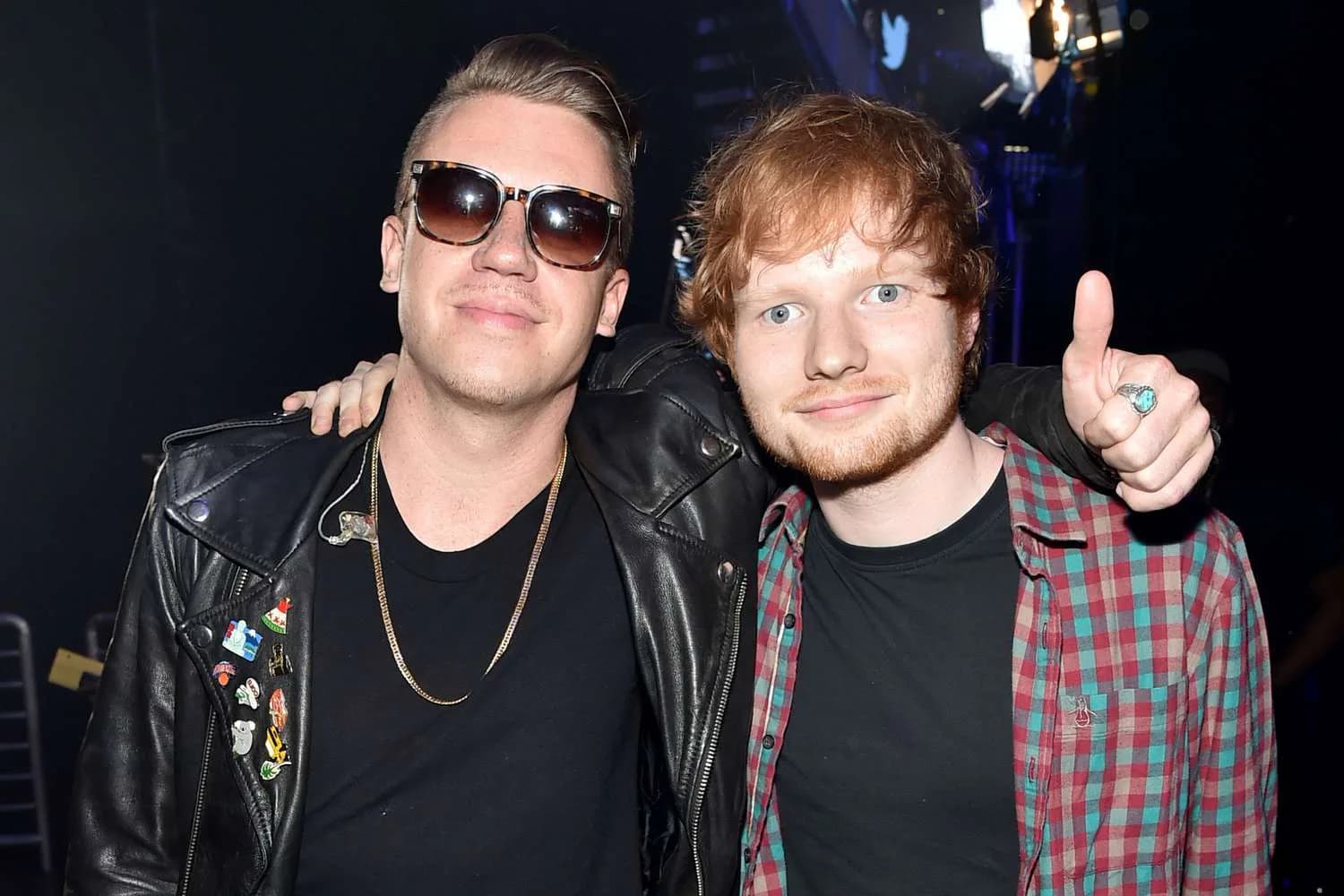
American rapper Benjamin Hammond Haggerty, better known as Macklemore, was removed from the remainder of English artist Ed Sheeran's Loop Tour on September 14, 2026, after saying “Free Palestine” onstage and performing the protest song “Hind’s Hall” at both of Sheeran’s New Jersey shows. The decision to remove Macklemore as Sheeran's opener sparked backlash and ongoing drama. In the first few days after Macklemore’s removal, it was unclear who made the decision, confusion that sparked even more public discussion.
At MetLife Stadium in East Rutherford, New Jersey, on September 4 and 5, Macklemore performed “Hind’s Hall,” a song in support of Palestinians, released in May 2024. The song is named after Hamilton Hall, a Columbia University building that student protestors occupied, and renamed “Hind’s Hall” after Hind Rajab, a six-year-old Palestinian girl killed in Gaza in January 2024.
Robert Kraft, owner of the New England Patriots, is at the center of the dispute. His company, the Kraft Group, owns Gillette Stadium, where Sheeran was scheduled to play on September 25 and 26. Kraft, who is Jewish and a supporter of Israel, acknowledged in a statement shared with ESPN that he had decided Macklemore could not perform there, citing the New Jersey shows and what he called a “broader history of antisemitic rhetoric and imagery.” In the same statement, Kraft said that his decision was not meant to diminish the suffering of Palestinians or to deny anyone’s right to speak up for them. Macklemore, for his part, has argued that criticizing Israel is not the same as criticizing Jewish people. The situation became more controversial when Macklemore claimed Sheeran told him Kraft had rallied other stadium owners to boycott Sheeran’s shows; Kraft did not dispute that account in his statement.
Furthermore, Sheeran said his promoter, Messina Touring Group, decided to remove Macklemore from the tour, rather than Sheeran himself. Some critics were unconvinced: children’s entertainer Ms. Rachel wrote on Instagram that Sheeran had “caved to people who refuse to accept what the world knows,” while comedian Kathy Griffin told Queerty that he could have refused Kraft and played for “250,000 people” in Brazil instead. Such criticism has fueled speculation about whether Sheeran and Messina made the decision together or whether it was completely out of Sheeran’s hands. Other artists on the tour responded more forcefully: on September 15, all four of Sheeran’s remaining supporting acts—Finneas, Lukas Graham, Aaron Rowe, and Beoga, an Irish folk band that had performed with Sheeran during part of his set—quit the tour in protest.
Macklemore responded on Instagram and said he would donate the $1 million he made from Sheeran's Loop Tour to Palestinian aid organizations. Additionally, Macklemore announced his “Free Palestine” tour, with shows in Dublin, Paris, and London on October 26, 29, and 30. All proceeds will go to organizations supporting Palestinians, and although IBTimes UK reported that some users on X dismissed the tour as “so performative,” Macklemore said all three shows sold out almost immediately.
Commentators, meanwhile, have focused both on who decides what can be said onstage and on what Macklemore actually said. Speaking to NPR, music journalist Zach Schonfeld argued that the episode reveals that billionaire venue owners like Robert Kraft “[hold] a lot of power to dictate who is allowed to perform in his venue and what these artists are allowed to say,” noting that Sheeran’s mainstream reach makes this the “most high-profile” case of its kind so far. Aaron Terr of the Foundation for Individual Rights and Expression (FIRE) told GBH News that the First Amendment does not bind a privately owned venue like Gillette Stadium, but that publicly owned stadiums, such as those in Indianapolis and Tampa, cannot cancel a performance simply because they disagree with an artist’s views.
Weeks after the two shows in New Jersey, the dispute continues and raises questions about what can and cannot be said onstage during a live performance. Additionally, this dispute has made the public, specifically artists, musicians, and pop stars, aware of how a single moment onstage can put everyone’s work at risk. Terr added that happenings like this can “ultimately be very corrosive to artistic expression,” highlighting the dangers of censorship. Whether artists like Macklemore respond with caution or with defiant authority, their choices may shape what future stages look like for artists and their performances.