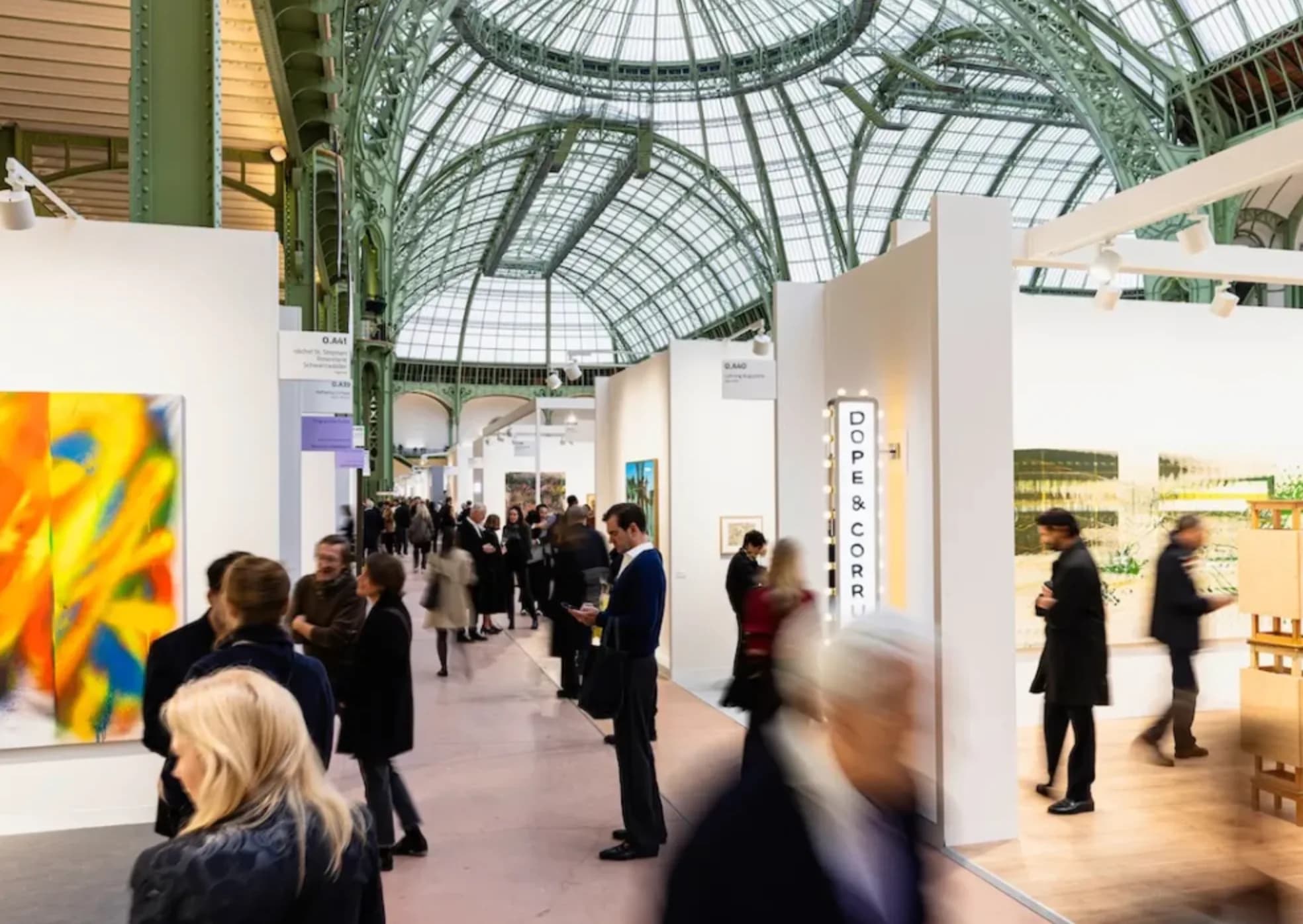
Art Basel Paris, this year’s annual celebration of contemporary art, was held at the Grand Palais in Paris, but ended two days early on October 23 because of massive ongoing protests erupting across France.
The protests started on September 17, when teachers, students, and parents at the Antoine de Saint-Exupéry High School in Créteil went on strike to draw attention to staff shortages. Since then, French protesters, driven primarily by students, have demonstrated against the state of the education system and rising living costs in the country. Protesters blockaded schools, and tens of thousands of law enforcement officers were deployed as nationwide strikes ruptured France’s economy. The initially peaceful protests reached a violent turning point when, on October 17, a mass of over 500,000 people descended into some of the most aggressive riots France had seen in years. Law enforcement, charging and using tear gas, detained over 800 people countrywide by October 24.
Days before the VIP preview, Karim Crippa, the fair’s director; Carly Murphy, its global head of collector and institutional relations; and Nora Orallo, its senior manager for VIP relations, sent a letter detailing extensive safety measures, including “anti-ram barriers” and “24-hours-a-day” surveillance.
The fair was scheduled to run through October 23 to 25. However, because of protests allegedly specifically targeting Art Basel—including a viral manifesto published by advocacy collective Documentations urging the public to “take the Grand Palais”—the event closed after its first day open to the public.
Art Basel was structured across three main exhibit sectors: Galeries, for the full breadth of an exhibitor’s program; Emergence, for emerging galleries and artists; and Premise, for highly singular curatorial proposals. This year’s 2026 collection includes artists such as abstract and photorealistic artist Gerhard Richter, as well as German painter and sculptor Georg Baselitz.
When asked about Art Basel Paris, Joe Jia ’27 stated that he felt that “Art Basel Paris is completely tone deaf towards most Parisians and seeks to romanticize rebellion within the insulated bubble of extreme wealth.” Jia’s perspective closely mirrors that of art critic Louise Darblay, who wrote in the international contemporary art magazine ArtReview that the people of France are protesting so that the government will fund their education systems and address income inequality, but the very same collectors who claim to love rebellious art are “happily profiting from the very inequalities they seek to challenge.”
Darblay feels that Art Basel Paris, an event celebrating modern art, has become a symbol of “the concentration of wealth and power against which so many are protesting.” Jia emphasizes that “the modern art market sorely misses” the true power of personal interpretation and showcases “political…[and] class indifference” by placing hefty price tags on highly publicized and coveted pieces. Not only is the event itself catered to those who can afford high-end art, but the traditional five dinner invitations every night are a luxury only the wealthy can afford. Darblay writes in her article “Liberté, Égalité, Absurdité”—a play on France’s motto Liberté, Égalité, Fraternité—that it is precisely these out-of-touch modern art fairs that tell the public exactly where the money is “hiding.”
Directors within the art community have also spoken. The local Galerie Chantal Crousel director, James Michael Shaeffer, urged those attending Art Basel Paris to “focus on the demands of the students as opposed to the footage of fires and property damage circulating on social media,” highlighting, “these kids literally are asking for working toilets among many other things!” Shaeffer believes the slight inconveniences the participants of Art Basel faced were more of a reason to help the students advocate for better school conditions. He “[guarantees] the rest of the week will be business as usual.”
As contemporary art continues to reflect the ongoing riots and upcoming election, the government will have to make a decision about the rapidly escalating protests. The rebellious modern art that collectors attending Art Basel Paris hope to see may in fact be happening on the streets around them.