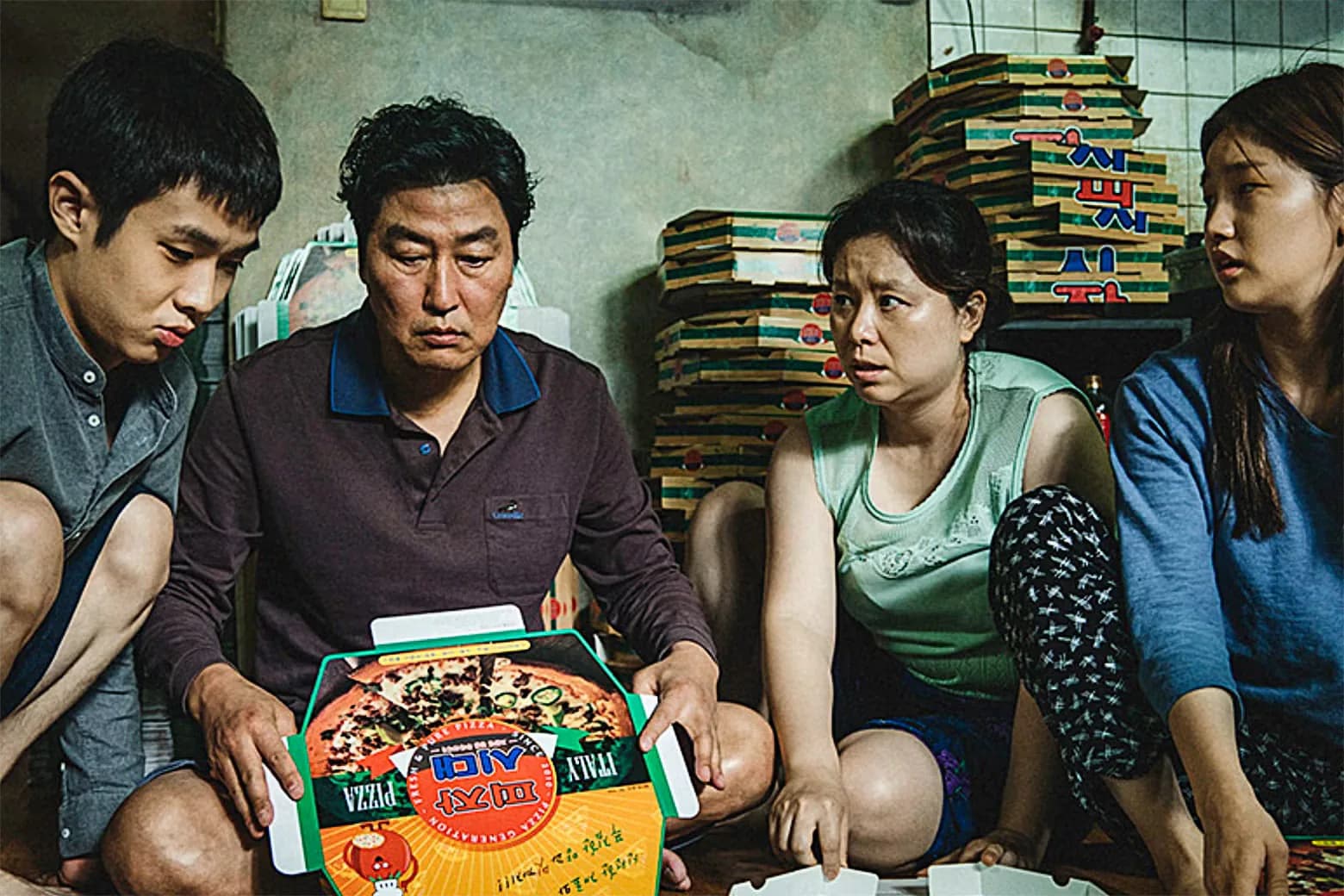
The Best Picture at the 2020 Oscars was one of the most surprising awards in recent memory. 1917, the film many had predicted to be the victor, was overtaken by a foreign movie called Parasite. Parasite, directed by Korean filmmaker Bong Joon Ho, was the first time a non-English film won the Academy's Best Picture Award. Parasite continues to be recognized as one of the best films produced in our decade. The movie, a bold, blunt satirical story tackling capitalism’s conceptual flaws and the complex human psyche, stepped outside the norms of Western cinema. This film is notorious for making you squirm in your seat and greeting you with unexpected laughter, dread, and plot twists. The development of characters and plot amplifies the central theme of social hierarchy. Yet Parasite brings to consideration not just current world strife but also something more grounded in human nature: our complexity.
Parasite follows an impoverished family in Seoul, Korea, struggling with their living conditions. One fortunate day, an acquaintance gave the poor family’s son an opportunity to teach a wealthy family’s daughter English. Through this, the son was able to continuously employ each of his family members to work for the wealthy family, whether it was as a personal driver or housemaid. Each character in this story is morally gray. None of them could be sorted into either “good” or “bad” or any predetermined tropes. This idea is something we, in our daily lives, often fail to take into heart: humans are naturally “morally gray.” Each Parasite character is curated realistically with numerous flaws, all counterbalanced with virtues. For example, the poor son thinks he can achieve great things for his family and earn a spot in the wealthy subset, but he doesn’t put sincere effort into his dreams. When we see these characters, we naturally gravitate to their flaws, their vices, and pour judgment onto them. But, we shouldn’t privilege critique over understanding. Flaws don’t make up even half of someone. Humans are unimaginably complex, and through this complexity, we develop vices, but we also develop the ability to embrace virtue. Parasite brings us to a state where we are not justifying the characters’ actions and philosophies, but understanding, seeing from their point of view. Parasite brings awareness to kindness and gratitude. Some of these ideas are fundamental and are ingrained inside us, yet sometimes we don’t acknowledge simple things like what we say and how we think of others.
In Parasite, the family is destitute when they finally get an advantage to evade the hell of the environment they live in. They were able to escape from making cardboard pizza boxes to barely feed a family of four, able to escape living in a place where drunkards pee at their window, and able to escape their jealousy of the rich. At times Parasite can elicit the trope of wealthy people as snobby or over-privileged. For example, at one point in the film, when a storm hits, the rich family treats it as a minor inconvenience and even turns it into something of a spectacle, while the poor family’s whole living quarters have been wrecked. The next day, when the poor family resumes their jobs, evidently tired and dejected, the rich family continues to nitpick about them with judgments about their smell and fatigue. The rich family isn’t presented as intentionally rude; rather, their behavior seems to stem from being so insulated in privilege that they fail to recognize how insensitive their words are and interpret the poor family’s behaviors as odd traits instead of as a class marker. In Parasite, the poor are blinded by their implicit jealousy and ambition, while the rich are tainted and tarnished by their blindness towards anything beyond their own comforts, and at the end, both families lose horribly. As much as socioeconomic status is real in the film, it is not an impenetrable barrier to human commonality.
Ultimately, Parasite is a film that highlights many values. For example, it spreads awareness about socioeconomic status, arguing that it is only a social construct. Parasite is one of those films that you can not only watch while lying back on your couch, but also really study it and take in its messages, however you interpret them.