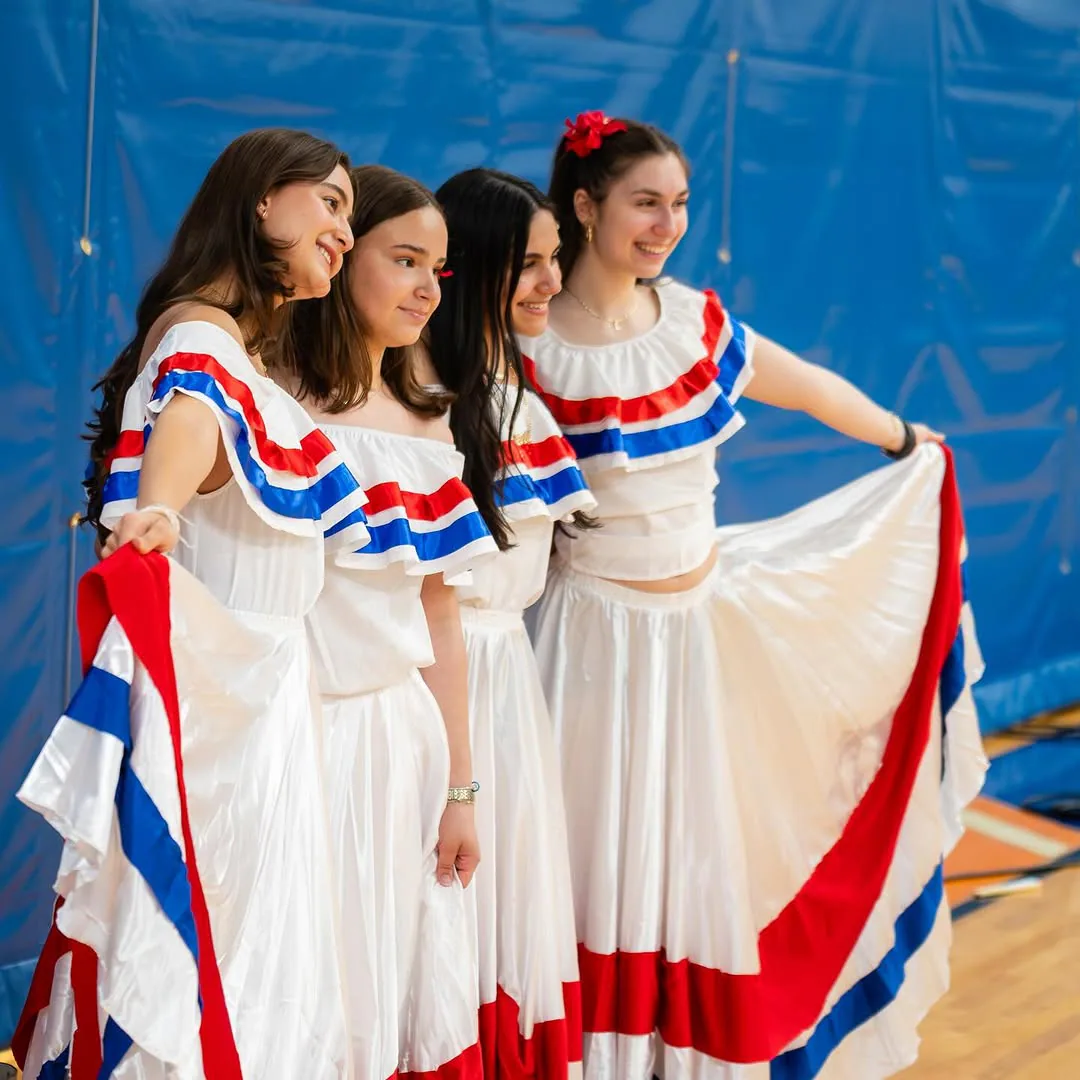
On Tuesday, April 14, Milton held its biennial Culturefest, a half-day event that unfolded in several parts. Students attended morning classes before transitioning into two assigned workshops chosen from fourteen different options, each led by students and centered on cultural learning. After the workshops, the entire school gathered for a series of performances, followed by food stalls where students shared traditional dishes.
For the students on stage, the performances represented months or even years of personal commitment. Isaac Wu ’28 performed Chinese Martial Arts, bringing a decade of experience and training to his routine. His performance included both the chain whip and double broadsword forms, which require a lot of practice, precision, control, and confidence to be executed. He described the experience as “very exhilarating,” especially since he could hear the audience’s reactions in real time. He saw the performance as more than just a display of his skills. He explained, “Chinese martial arts has a very long history and cultural importance. In many of the movements, you encodify cultural practices and history.” For him, performing at Culturefest was a fun and exciting way to represent that history and share it with others in a form that is engaging and memorable.
For Elin Han ’29, the experience of performing felt very different. She sang an old Korean song connected to K-drama culture and described feeling overwhelmed by nerves throughout the performance. “I was absolutely terrified,” she said. “My whole body was shaking. My voice was shaking.” Despite this fear, she chose to go on stage in front of the entire school, her performance reflecting her vulnerability and challenging her to step outside her comfort zone to express something that means a lot to her identity. Looking back, she suggested that students consider their readiness for performing in front of more than 700 people, but still encouraged participation. “If you wanted to make the best out of your Milton experience I would recommend performing,” she said.
These contrasting experiences highlight what makes the performances such a central part of Culturefest. These moments are where students actively present their identities and culture to the wider community, presenting so much more than just entertainment. Wu noted that “performances by their nature are designed to captivate students, and that [exposure] can be very helpful in making people appreciate the culture presented.” Unlike a presentation, where it is easy to lose focus and get distracted by phones, a live performance demands attention and creates a shared experience for the audience. This ability to fully engage viewers makes performances one of the most effective ways to promote cultural appreciation or display student talent within the school.
What many students may not see, however, is the amount of coordination required to make these performances and the rest of the day possible. According to Director of Equity and Inclusion Melissa Lawlor, planning for Culturefest began at the start of the school year. A committee formed in September and met weekly to organize all parts of the event, including scheduling, student proposals for workshops or tables, menus, and more. The board accepted every student proposal for workshops and tables, allowing for a wide range of cultures to be represented in workshops and food stalls. This approach placed a significant amount of trust in students and gave them the freedom to represent themselves in their own ways. The strategy resulted in a diverse and authentic lineup that was shaped largely by student initiative.
Despite the success of this year’s event, students have raised questions about the future of Culturefest. The next festival will not take place until 2029, a longer gap between festivals than usual. Lawlor explained that this change is due to the scale of the event and the challenges of aligning the day with the academic schedule, as well as the time and resources required for planning. She explained that “it takes a ton of time in preparation.” Therefore, rather than holding a smaller or less organized festival, Lawlor designed the three-year gap to allow for more time in between events. However, the DEIJ board is also planning to resume Culturefest annually after 2029 to allow students to enjoy and appreciate the events in the day every year.
Student reactions to the change have been mixed but generally aligned across grade levels. Wu, a Class III student, will not experience another Culturefest before graduating in 2028. While he acknowledged there may be logistical constraints, he said that “the more Culturefests, the better.” Han, a freshman, will still experience Culturefest once more during her time at Milton, even with the change. However, she noted that the timing changes that experience. Han explained that she “kind of wish[ed]” Culturefest came earlier, even though the longer wait might build anticipation.
Even with the gap, Culturefest’s impact has not faded. The performances, experiences, and conversations it sparked will continue to shape the community in the years ahead.