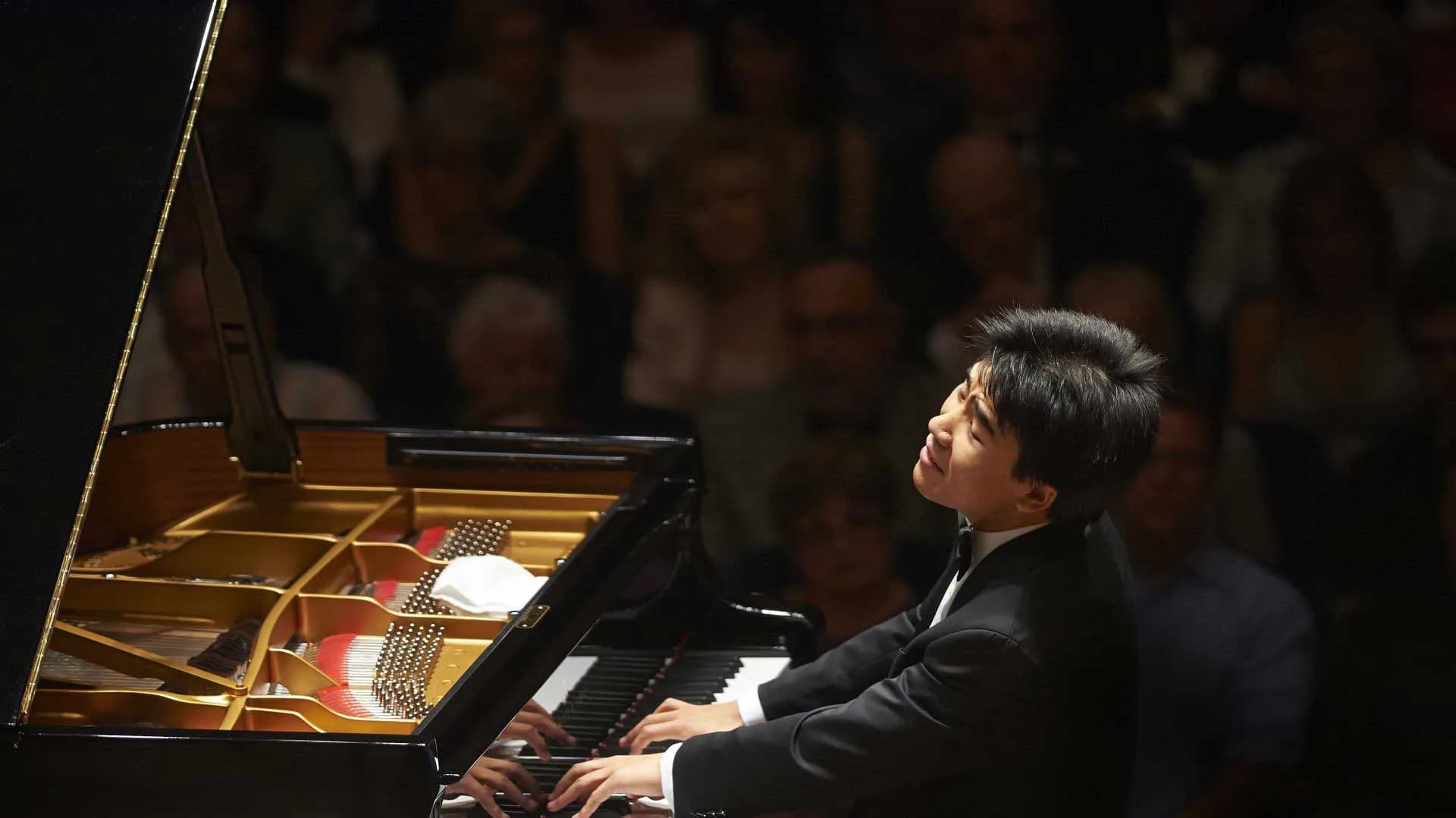
On November 13, 2025, Milton Academy hosted its 95th Gratwick Concert, an annual event dedicated to the memory of Katharine Perkins Gratwick, a member of the class of 1924. This year’s concert, which took place in Straus Library, featured pianist Jiayan Sun, a musician who was praised by the New York Times for his “revelatory” performances. Sun received his Bachelor’s, Master’s, and Doctor of Musical Arts degrees from The Juilliard School, one of the most prestigious music conservatories in the world. He has played in many distinguished orchestras worldwide, including the Cleveland Orchestra, the Hallé Orchestra, the Chinese National Symphony, the Raidió Teilifís Éireann (RTÉ) of Ireland, and others. The Toronto Star has called him “technically flawless” in his performances.
The Gratwick Concert was established in 1924 to honor Gratwick’s passion for the arts, especially music. Over the years, it has grown into a cultural tradition at Milton Academy, uniting students, faculty, and families. Music Department Chair Adrian Anantawan reflected on the concert’s significance, stating, “the concert brought the community together through a shared language of music. The impact reaches far beyond the concert itself.”
Sun selected works by renowned composers Johann Sebastian Bach, Ferruccio Busoni, and Franz Liszt. Specifically, he performed Bach’s Chromatic Fantasia and Fugue, Busoni’s Toccato: Preludio–Fantasia–Ciaconna and Elegy No. 7, and Liszt’s Reminiscences de Don Juan.
Sun explained the thought behind his choice of order: the performance beginning with Bach and concluding with Liszt captured the evolution of music from the Baroque period to the Romantic era. Bach, of the Baroque period, represents the foundation of Western classical music. Many years later, other composers, including Busoni and Liszt, studied and were deeply influenced by Bach’s work. By beginning with Bach and ending with Liszt, Sun showcased this wide range of artistic history.
Sun’s first piece was Johann Sebastian Bach’s Chromatic Fantasia and Fugue, BWV 903. From its first few notes, Bach’s music requires a different kind of focus, emphasizing precision, articulation, polyphony and counterpoint, a technique where an artist combines two or more independent melodic lines that are harmonically related to create a polyphonic texture. The piece reflected Bach’s internal struggles facing the loss of his first wife, Maria Barbara, in 1720. Sun skillfully displayed the intricate feeling and maturity of Bach by adding his own unique understanding and touches to the piece, like manipulating the melodies of the counterpoints.
Sun then chose two pieces of Busoni. After he played Busoni’s Toccato: Preludio–Fantasia–Ciaconna, a piece conveying a sense of excitement and urgency, he stepped aside and explained Busoni’s background before playing Busoni’s Elegy No. 7. “Ferruccio Busoni was a cosmopolitan composer who grew up in Italy and later became notable for his work worldwide,” Sun explained. “After World War I, he spent time in Paris and added layers to his style.” In the time Busoni stayed in Paris, he blended the styles of different musicians and incorporated “very little Baroque music into his composition,” Sun said. “This piece,” he said, smiling, “will be severe rather than pleasant.” The contrast between style and emotions was what Sun wanted the audience to understand. By inviting the audience to join in the journey of discovering the composer’s background, Sun encouraged the audience to connect more intimately with the music.
Sun concluded the concert with Liszt’s Reminiscences de Don Juan, an uplifting, celebratory piece whose rhythm and speed highlighted both Liszt’s excitement and Sun’s energy. This final piece gave the concert a thrilling full stop.
Sun’s performances were met with great acclaim from students. Kaya Howeler ’29 stated that “[she] was astonished by the pianist. He was very consistent throughout the entire concert, it was incredible and it brought everyone together.” Similarly, Sissi Ma ’26 expressed: “I loved the pianist. He was so emotional and I really could envision all the pieces in the style of Busoni,” detailing that “[her] favorite piece was definitely Carmen, and the ambience of Straus library just made the night really magical.”
Anantawan reiterated the concert’s deeper purpose, stating that “music [was] not only a discipline; [it was] a connection, spirit, and passion.” He explained that the experience of having Jiayan Sun mentor young musicians provided invaluable knowledge on the mentees. “This is a turning point for young musicians to see how their music can reach a larger community,” he explained. Jiayan Sun’s performance allowed students and faculty alike to enjoy a memorable, music-filled night.