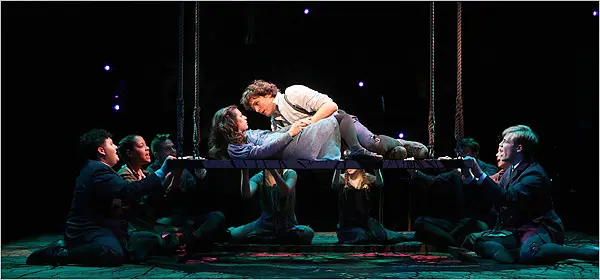
At the time of its creation in 1891, many considered the play Spring Awakening by Frank Wedekind as too controversial for audiences due to its dark and, at the time, taboo themes surrounding sexuality and adolescence. Over 100 years later, the musical adaptation of the play, written by Duncan Sheik and Steven Sater, explores the same themes with a different approach. Although over a century apart, the message remains the same and is especially highlighted through the score and soundtrack of its 2006 musical. Incorporating rock music of the 1990’s and early 2000’s with the original album’s classic musical theatre creates a unique listening experience contrasting the two very different time periods’ styles. While one track might feature a fast-paced, angst-filled rock song, the next might still provoke tears with a slow-moving beat.
One moment that stands out in particular is the album’s transition from the songs “Don’t Do Sadness/Blue Wind” to “Left Behind.” Both songs follow the character arc of one of the leads, Moritz Stiefel, but “Don’t Do Sadness” chooses to feature this through more metaphorical lyrics surrounding nature and rock focused composition, highlighting the teenage angst within his character. The arc is then brought to a heartbreaking conclusion through “Left Behind,” which immediately succeeds “Don’t Do Sadness” and serves as one of the show’s most vulnerable moments. Moments like these truly capture the story’s themes and the teen- age experience despite the omission of much of the dialogue found onstage.
At its core, the story of Spring Awakening is a tragedy. In a society afraid to open up conversations about sexuality, especially with adolescents, the story serves as a warning against a lack of sex education. Whether it be the 1890’s, the early 2000’s, or 2026, the struggle to open up dialogue around these same ideas remains. The themes of sexuality within many of the songs in the Spring Awakening cast album tend to play into the overall awkwardness of the topic particularly through much needed comedy and relatability, making the darker moments within the score even more poignant. “The Word of Your Body (reprise)” being one of the most hilarious of these transitions as it is sandwiched between two of the show’s most important moments. Despite its placement within the lyrics, songs like “The Word of Your Body (Reprise)” as well as a prior track “The B**ch of Living” still serves as important songs for this purpose, utilising raunchy and arguably lewd lines, such as “come cream away the bliss” to capture the perils of the young love (or in some cases lust) found within all of the teenage characters. The music in the Spring Awakening cast album—despite the time in which the story takes place—bridges that gap between then and now, highlighting both how far we’ve come and how far we must still go in terms of opening up conversations about sexuality with teenagers. A testament, and perhaps a solution, to opening up crucial conversation, Spring Awakening’s original Broadway cast recording serves as an engaging listen.