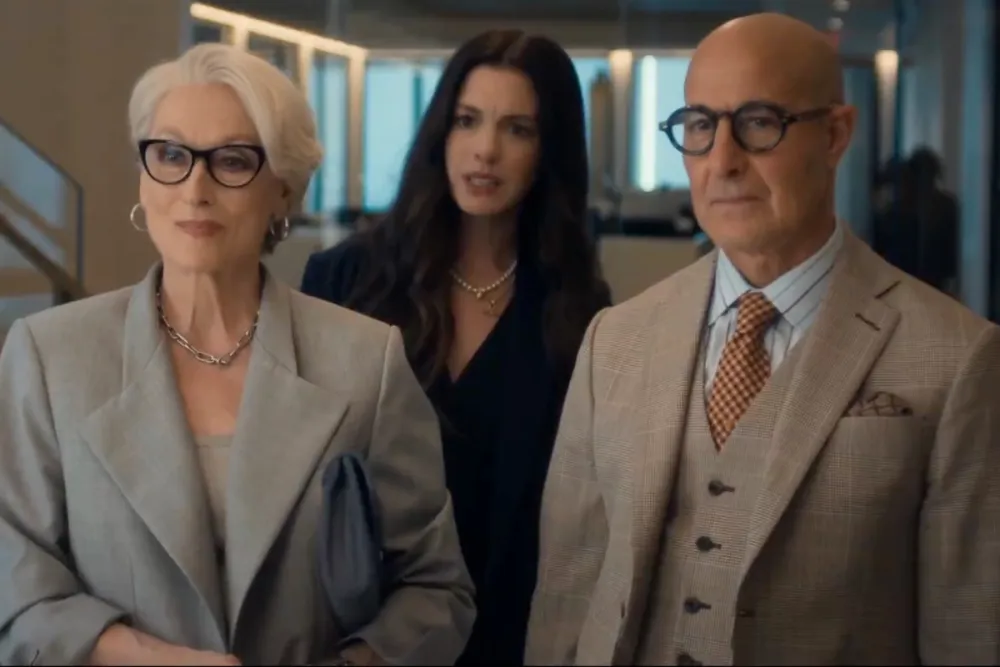
Launching on May 1, 2026, The Devil Wears Prada 2 debuted in theaters with enormous anticipation and equally fierce criticism. With a current audience rating of 6.8/10 on Internet Movie Database (IMDb), this sequel to The Devil Wears Prada has been a massive box office hit, opening at $76 million domestically and grossing $430 million in its first twelve days in release. Twenty years ago, the original movie became a worldwide blockbuster, shaping fashion trends and redefining the fashion industry for an entire generation. Yet two decades later, despite the seemingly successful financials and audience expectations hoping to relive that magic, many left feeling conflicted, anxious, and disappointed.
One major criticism surrounding the sequel is its lack of character development. Rather than creating new emotional journeys for its returning cast, the movie relies heavily on the audience’s attachment to the original film. Played by Meryl Streep, Miranda Priestly, the editor-in-chief of fictional fashion magazine Runway, remains cold and commanding. Protagonist Andy Sachs, played by Anne Hathaway, continues to prove her ability while working with Miranda. Deborah Ross, Chief Film Critic for the British cultural and political magazine The Spectator, acknowledges that the world surrounding the characters has evolved but criticizes how the “characters have remained the same,” describing the sequel as “more sentimental and less satirical.” With little character development, the relationship between them feels almost frozen in time. The sequel focuses heavily on recreating familiar personalities without fully understanding the motivations that once made those characters compelling and relatable. Jaydon Sun ’29 thought the director took the characters' personalities “without understanding the motivation from the first movie.”
The plot itself also received mixed reactions. Audiences praised the movie for its emotional themes about media decline, internet culture, and the influence of artificial intelligence. Online film critic Allison Rose, a senior correspondent at FlickDirect, reflected on the “serious social commentary on the state of print media and the transition to an online presence” despite the “fun moments... biting comments, and… sarcastic lines.” Still, many found the storytelling disorganized. Annie Berke of The New Republic criticized the forceful merging of journalism and artificial intelligence “with various B-plots,” and the movie's attempt to “do too much.” Not only would recounting the plot points of the film be dull and “pointless,” but Berke also classified the film, with its messy, overwhelming content, as “the cinematic equivalent of a cargo pant.”
Despite its flaws, the sequel explores ideas that may strongly resonate with modern audiences. The original movie focused on sacrifice: what someone is willing to give up in exchange for success, luxury, and status. The Devil Wears Prada 2 asks what remains after those choices have already been made. What happens to Miranda after dedicating her life entirely to fashion? What will Andy become after leaving the glamorous yet emotionally exhausting world of Runway Magazine?
Through these questions, the film examines how technology and social media have transformed both journalism and fashion. People often say that fashion trends speak to a certain era. However, when fashion itself no longer feels as exclusive or artistic as it once did, how will people react to those changes? When trends are more commercialized, fast-moving, and increasingly controlled by the mainstream, what is the purpose of the fashion industry?
This theme appears most clearly in the movie’s styling choices. The original film became iconic for its bold contrasts and memorable outfits, using fashion as a form of storytelling and individuality. In the sequel, however, many costumes focus heavily on recognizable mainstream brands rather than unique personal style. As Sun points out, the stylings intentionally mimic the original movie but “fail actually to do anything for the characters.”
Strong anti-AI themes were another target of criticism, as viewers argued that the message sometimes feels too direct and repetitive. Throughout the movie, characters repeatedly discuss digital media, algorithms, and the replacement of traditional creativity by artificial intelligence. Siddhant Adlakha from the American Asian media platform JoySauce concludes that the film’s attempt “to capitalize on contemporary trends – such as the arrival of AI,... warrants at best an awkward mention.” For example, Nigel Kipling, who is the Art Director at Runway, expresses disappointment about the influence of social media on fashion and journalism, but this comment contributes little to the plot. Through moments like this, the movie questions whether fashion and media are truly evolving or simply becoming more shallow and commercialized. Adlakha argues that “characters constantly hint at the shifting digital landscape in ways that threaten to further complicate the story” in a film that no question would expect to be (or even want to be) “a tome on modern venture capitalism.”
Despite all the criticism, audiences still admit they enjoyed the film. Much of that appreciation comes from nostalgia itself. Cortlyn Kelly from the Chicago Reader described the script as “quite funny and rooted in intergenerational jokes,” and admitted that though “almost every element feels and looks like a dupe [of the original],” she was “entertained by its writing and performances.” Watching beloved characters return after twenty years creates an emotional experience, even when the story feels imperfect. “It’s emotional and nice,” Sun admitted. “I still like it because it’s nostalgic.”
Ultimately, The Devil Wears Prada 2 succeeds less as a flawless continuation. It reflects on changes, memory, and cultural decline. Its mixed reception may actually prove why the movie remains worth watching: audiences are not simply debating whether it is good or bad, but whether the world it portrays is one we already live in.