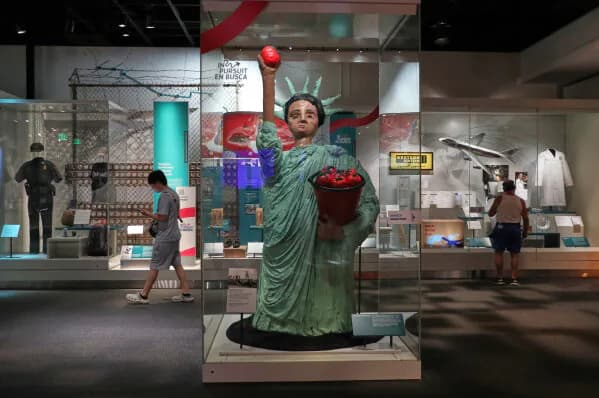
The Smithsonian Institution is undergoing major leadership shifts and structural renovations under political influence as the Trump Administration pressures the institution to change its historical narrative.
Based in Washington, D.C., the Smithsonian, the world’s largest museum complex, was founded in 1846 as an “establishment for the increase and diffusion of knowledge.” During his current presidential term, President Donald Trump signed two escalatory executive orders: the first one, on March 27, 2025, ordered institution-wide reviews of the Smithsonian, which encompasses museums, education centers, research complexes, and the Zoo, to restrict programs deemed “anti-American.” The second executive order, signed July 24, 2026, outlined plans to install “warning signs” leading up to the National Museum of American History. CNN reported that these signs warned of “ideological bias” and “inaccuracies” in the Smithsonian’s portrayal of American history; the order also criticized Smithsonian Chief Executive Officer and Secretary Lonnie Bunch III. For example, the Trump Administration accused the Smithsonian of being anti-American by not adequately celebrating America’s founders on its 250th anniversary. The crackdown aimed to “sav[e] America’s story from corrosive ideology,” the White House said.
On September 16, 2026, the administration declared that it was moving ahead with the warning-signs plan, but the administration says the signs are temporary and shall be placed on National Park Service Land, as reported by NPR.
Although the Smithsonian is an independent trust, it receives around 60% of its annual budget from the government. Its managing Board of Regents is composed of major political figures, including the Chief Justice of the Supreme Court, the Vice President, and six members of Congress. These funds play a huge role in the Smithsonian’s operations, seeing as, in the past, government shutdowns have also led to the museum’s shutdowns. In a letter from the U.S. Secretary of the Interior, Doug Burgum, the signs were calculated to cost approximately $84,000 total.
In his letter, Burgum, citing discriminatory practices, stated, “the administration has recently uncovered evidence that the Smithsonian leadership’s institutional culture may have resulted in significant violations of Federal antidiscrimination law, violations that include creating a hostile work environment and engaging in practices that classify individuals and allocate opportunities, funding and other benefits on the basis of race, ethnicity and other protected characteristics.”
On September 8, 2026, Bunch announced that he was to retire at the end of the year after four decades with the institution. Bunch was the first African American to serve as the Secretary of the Smithsonian and also the first historian to serve as Secretary. Now, one may wonder what the fate of Smithsonian leadership is to be. Bunch was founding director of the Smithsonian’s National Museum of African American History and Culture and is dedicated to telling the nation’s story.
In an interview with CBS in 2019, Bunch highlighted his goal of “find[ing] common ground” through culture. He claims that the attacks on the Smithsonian have no bearing on his decision. A document to Congress asserted that “visitors should be aware of Smithsonian Secretary Lonnie Bunch’s history of invidious discrimination and anti-white animus.”
Senator Jeff Merkley, top Democrat on the Senate Appropriations subcommittee, which oversees funding for the Smithsonian, defended Lonnie Bunch and strongly criticized the plan for the warning signs. Merkley argued, “The administration has already demonstrated its campaign to rewrite history at our national parks, and we should do all we can to ensure the Smithsonian can present our history, arts, and sciences without ideologically driven misrepresentation,” as quoted by The New York Times.
Lonnie Bunch has faced much criticism from the administration this term, as well as Director of the National Museum of American History Anthea Hartig. The New York Times says that many historians supported and defended her after she was accused of spreading “radical activist ideology.”
The timeline of the administration’s strife with the Smithsonian Institution has spanned Trump’s second term and revolved around censorship. For example, in August 2025, details and any references to Trump’s impeachments were removed from the galleries that focused on American presidents. In May 2025, Trump posted on Truth Social that he was firing Director of the Smithsonian’s National Portrait Gallery museum Kim Sajet, a museum that tells the story of America through visual art and media. Citing DEI reasons, he called Sajet “highly partisan…and a strong supporter of DEI, which is totally inappropriate for her position.”
Historians, museum-goers, and politicians alike are holding their breath to see what comes next with the Smithsonian overhaul in a landmark clash between history and politics. In a statement, Senator Merkley said, “I'll fight like hell to protect the Smithsonian’s independence so that the Institution can continue to tell all of America's story for generations to come.”