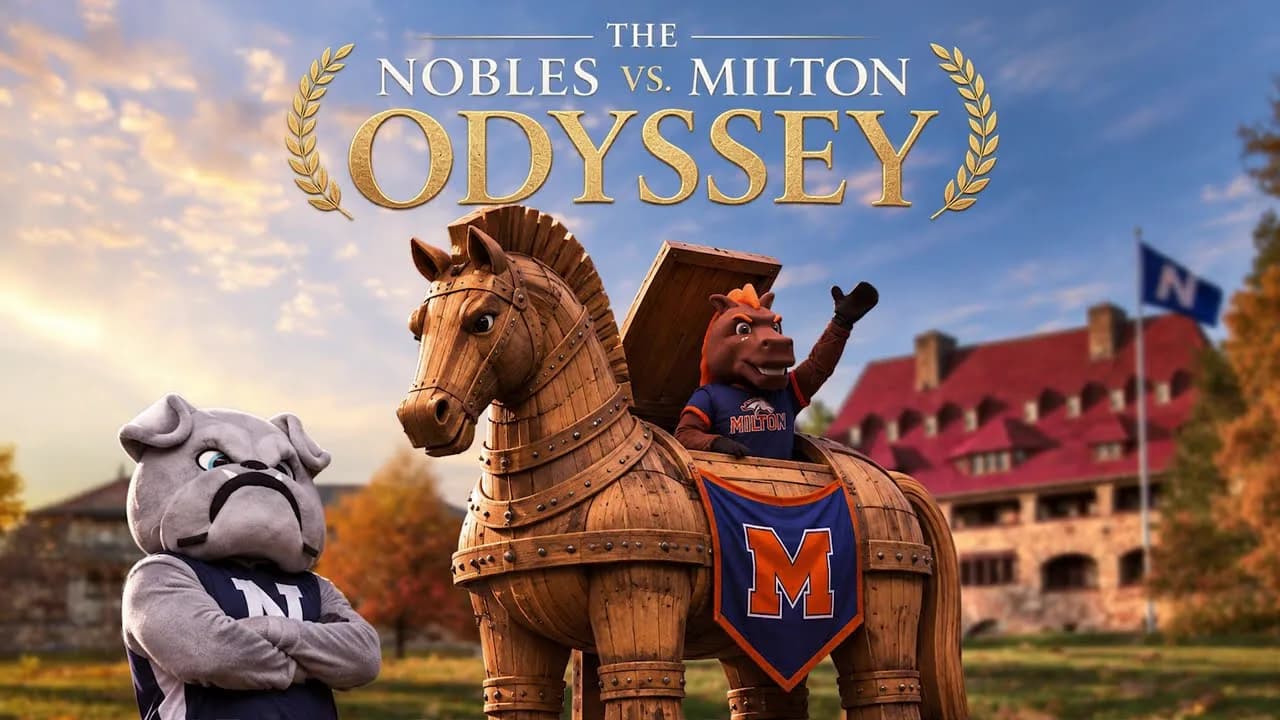
Imagine a Pep Rally in which the emcees, Hype Squad, Stan the Stang, and Ritmo, are replaced by robots—it may look cool, but is this a hypothetical world we want to live in? In this scenario, artificial intelligence would erase members of the Milton Academy community, taking away the opportunity for students to show off their talents and engage with the school spirit. This year’s Pep Rally video, created by Nobles, showing Stan the Stang's AI-generated ride in a Trojan Horse, seems to have already taken a step in this direction.
The Pep Rally video is an annual tradition where Nobles and Milton alternate creating a video to preview the rivalry games. The oldest version the CXXXII Editorial Board traced was one made in 2012, featuring the Nobles bulldog and a much lankier Stan the Stang competing in Twister, hula hooping, and poker (during which Lady Gaga’s 2008 “Poker Face” plays in the background). While the video may not have been as “visually impressive,” it came from human creativity.
Art must begin in the human mind. By handing the task of creating a video—one typically enjoyed for its originality and humor—to AI, we strip the video of its visual artistic expression.
We must also acknowledge that the very models used to create the video were likely trained on art scraped from the internet without their creators’ permission or compensation. A student or any member of the Milton-Nobles community could have brought this Trojan Horse to life, just as the Milton Communications Office invites students to create artwork for the winter holiday cards.
This is not the first time the administration has drawn scrutiny for the use of AI. Compared with this fall’s allegations concerning AI aid in a Talbot Baker Award speech, the Pep Rally video is a smaller offense; after all, Nobles’ YouTube caption, as well as Milton and Nobles’ shared Instagram caption, disclose “AI-generated images.” Nonetheless, the video sidelines artists.
When The Measure used AI to build its website, the AI served as a means to an end: to efficiently bring journalism to the student body. One could argue that the Pep Rally video served a similar purpose: hyping up students and reminding them what rivalry means. But the Editorial Board believes this video was never meant to be a means to an end. The purpose of the video is the video itself. Just as students show their creativity in arts classes like Creative Writing and Filmmaking—without the aid of AI—and breathe their own experiences into their work, the Nobles administration should have also allowed students to breathe their own experiences—and, by extension, the experiences of the Milton-Nobles community—into the Pep Rally video.
Those of us on the Editorial Board who have attended Milton since elementary school remember the thrill of the Pep Rally each fall, and the video was typically a main source of this excitement. Knowing real people—Milton faculty, students, and the Heads of School—are behind the creation of this video seemed to say: This is our community, made of real, breathing people. An AI-generated video achieves the opposite. It distances us from our community—a feeling that is all the sadder during an event at which the word “community” should carry especially significant weight.