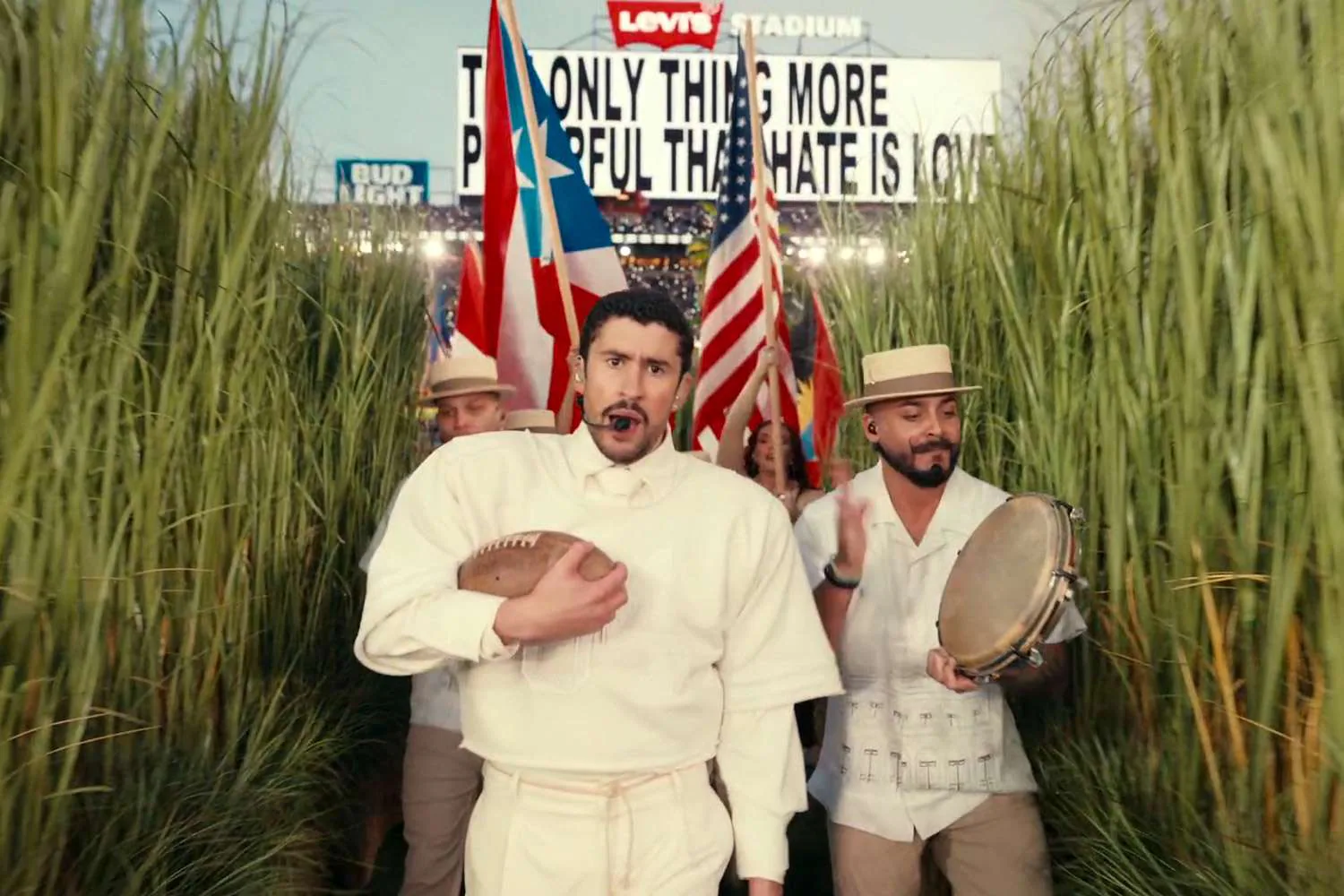
During Sunday’s Super Bowl halftime performance, Bad Bunny yelled “God Bless America” like a battle cry. But he wasn’t just talking about the United States of America; he was talking about all of America. Argentina, Brazil, Cuba, and Puerto Rico were some of the many lands mentioned in his blessing of most countries in America. Through music, the Puerto Rican artist stressed a central message: love born from unity. “The only thing more powerful than hate is love,” Bad Bunny displayed on the stadium jumbotron. Implicitly, however, he demonstrated the potential of musical performances to combat social tensions and spread love.
In a bold, unprecedented choice in Superbowl halftime history, Bad Bunny sang the entire performance in a non-English language, celebrating the diversity of the “American” identity. A congested stage featuring dynamic dancers, bright symbols of Puerto Rico, and even a wedding visually supported the theme of community and love. As the most-watched Super Bowl halftime show in history with over 135 million viewers, the performance, brimming with felicity despite challenges, propagated a message of social resistance.
This January, in Minnesota’s response to the relentless Immigration and Customs Enforcement (ICE) raids and arrests, about 600 Minnesota residents gathered to protest and sing in resistance: “We belong to them, and they belong to us,” the chorus chimes in a Facebook video. Over the past month, the movement has burgeoned; on February 2nd, thousands crowded the streets of Minneapolis to protest, waving signs while singing from a public songbook that they encouraged others to follow. “Under federal occupation, Minneapolis has been going through immense pain, rage, and grief. But when they come at us with violence, we fight back with love,” organizers shared on social media. In conjunction with Bad Bunny’s political performance, this story epitomizes the expression-based community mobilization that quells hatred. In these moments, music not only proclaims straightforward messages aloud but also appeals to a fundamentally human empathy.
Similarly, on February 6, over 2,900 athletes and 21.4 million more viewers tuned into the Opening Ceremony of the Milan Winter Olympic Games. Despite ongoing global conflicts in Europe and the Middle East, the international audience’s stark differences seemed to shrink in the ceremony, paling in comparison to song and dance when dozens of Italian performers took to the stage. For about three hours, viewers around the world put their differences aside and, most importantly, listened.
In a seemingly pessimistic world filled with the growing social injustices, turning to music fuels progress. More than a temporary escape from systematized segregation, unabashed expression, movement, dance, and art unite us. At concerts, for example, differences between audience members seem to disappear when large crowds sing along to an artist’s relatable lyrics. Music reminds us what we have in common—an instinct to tap our feet to the beat, to cheer at talent and awe at beauty, and to feel understood. Thus, at least to an informal extent, music becomes resistance to hate borne from differences.
At Milton, we, as students, need to tap into this music, and listen closely. Beatnik, chamber concerts, Acapella groups and even Miltones’ Serenades offer spaces for unity and connection as long as we lean in and show up for them. Just like Bad Bunny’s performance, such mediums stir conversations of hope and short yet long-lived moments of free-spirited, non-partisan togetherness. Beyond music, we find this same humanity by perusing the details of all artistic expressions: immersing ourselves in Project Story’s “Give Grace” performance or the Gospel Choir Explosion, taking a more careful look at Kellner’s art display, and embracing the unity they represent.
Through the means of social, artistic expression, Bad Bunny, The Winter Olympics, and activities at Milton bring people together, connected through the same human emotions we all share. To live the words presented at the biggest sporting event in American history: “The only thing stronger than hate is love.”