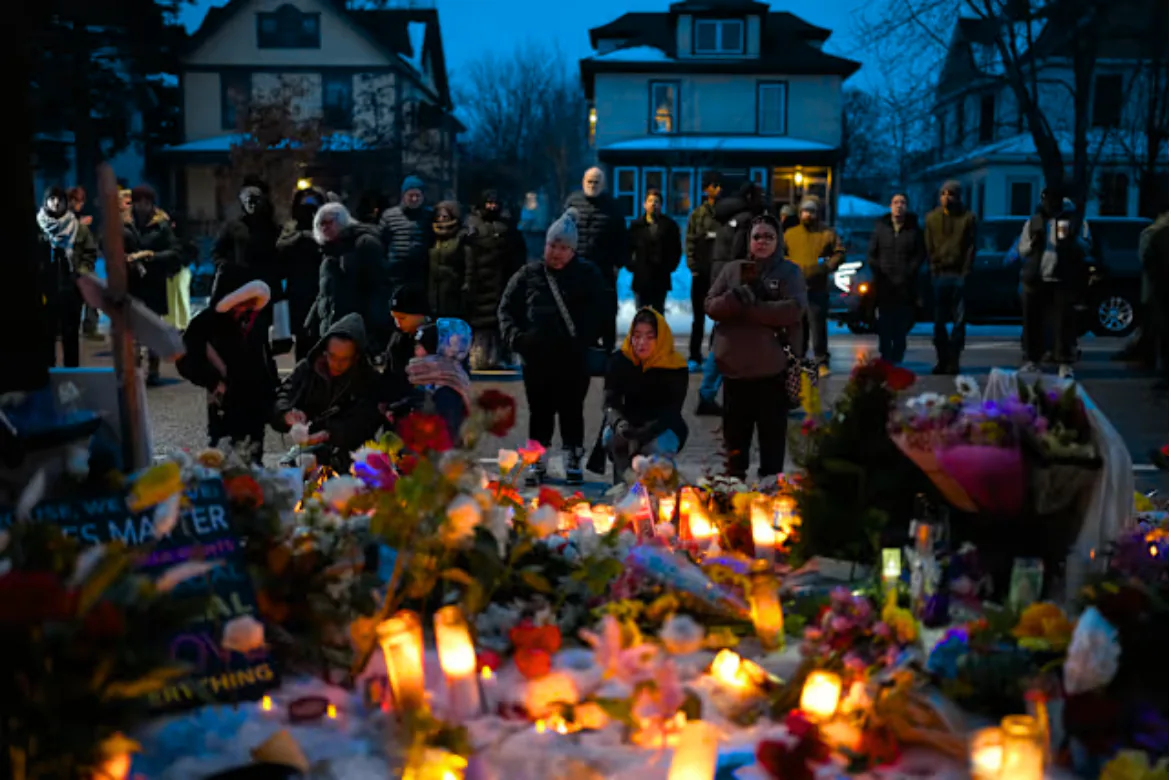
On December 15, Milton’s last Upper School Meeting of 2025, community members mourned the killing of two students at Brown University just two days before, as well as the 15 killed in the attack on a Hanukkah celebration at Bondi Beach in Sydney, Australia. All announcements were subsequently cancelled, and the crowd left mostly in silence.
On January 7 this year, an ICE agent fatally shot American citizen Renee Nicole Good in Minneapolis. Yet during the Upper School Meeting this Monday—five days after the shooting—no members of the community publicly acknowledged or responded to the event. On October 11, the deadliest mass shooting of 2025 occurred in Leland, Mississippi, during high school homecoming celebrations. Three teenagers and four adults died in the attack, yet the Milton administration—as well as much of the student body—remained silent. Of all the country’s mass shootings in the last year, including 233 school shootings, the community has initiated public conversation for only the Brown shooting. Some deaths felt close enough to demand our tears; others passed quietly, reduced to headlines on the screen. We cannot ignore this contrast in our response.
We, the editorial board, understand the difference in geographical and cultural proximity of these events to Milton. Between 2023 and 2025, 18 Milton students matriculated to Brown. Head of School Dr. Alixe Callen ‘88, among other faculty, is a Brown alumna. Meanwhile, Minneapolis is thousands of miles away. No students are from Minnesota, per Veracross. Australia might be even farther away, but the anti-Semitic nature of the attack still resonated personally with Milton’s Jewish population. It makes sense that tragedy closer to us, physically or emotionally, will matter to us more. However, what stance are we, as a community, highlighting when we dwell on some crises and ignore others?
This selective mourning reflects a deeper symptom of the United States’s political fragmentation. Following the September assassination of right-wing political activist Charlie Kirk, U.S. Vice President JD Vance declared that “violence is not OK in our system.” By federal mandate, Milton Academy also lowered its flag in response to the assassination. Four months later, after the death of Renee Good, who was shot by an ICE agent in Minneapolis, Vance described Good as “brainwashed,” asserting that Jonathan Ross, the officer who shot her, “deserves a debt of gratitude” for his “very, very important job for the United States of America.” Biased responses to disturbing events have become pervasive, almost normalized in politics and the media. In response to violence, political leaders increasingly start by asking who the victim was and, in essence, whether their life fits neatly into a narrative worth defending. Politicians use evocative language when violence afflicts their bases—”unthinkable,” “senseless,” “a grave loss for the nation.” But when victims fall outside that circle, silence replaces language, or worse, moral scrutiny replaces mourning. Empathy is modeled as conditional and partisan, not ubiquitous.
At Milton, institutionally-sponsored public shows of empathy are supposedly forbidden. In an email in June 24, the Milton Academy Board of Trustees announced that the school “has decided not to issue institutional responses to external events in the future.” Since the decision to adopt institutional neutrality, the Board has ceased to acknowledge (or suggest its stance) on recent events through institution-wide emails or other written communication. The school’s silence on this front implies a connection between “response” and stance. Consequently, our standardized silence presents a “neutral” front, an idea that Milton is equally connected—or disconnected—from any and all current events. However, in light of the recent spate of national and international tragedies, some of which have indeed received public mention from Milton administrators, it becomes critical to consider what constitutes “response.”
Part of the promise of institutional neutrality was that Milton would be able to facilitate more productive, well-rounded discussions, without issuing an administratively “correct” opinion. Where have those discussions been? Where’s the community discussion on the situation in Iran or Venezuela or Minneapolis?
Regardless of whether the administration officially comments on current events, our student population needs to. For example, a statement of the facts of a shooting in Providence should be a catalyst for conversations about gun control and our country’s mental health crisis. Even more, we, as students, need to recognize and consider how we selectively mourn. When the school encourages discussions on tragedies like Brown and Bondi Beach, we should actively empathize. Even if we don’t respond to distant tragedies as intensely, perhaps we should assign the same amount of attention and understanding to them, despite their distance. This can start small. The next time you see a repost on an event of injustice on Instagram, click on it, finish reading about it (from a more reliable source) and engage based on it. Students and clubs should spread awareness of tragedies across a breadth of contexts and call for—or even create avenues for—the community to take action: the editorial board commends the efforts of PIH’s tuberculosis fundraiser and CEPP’s Hunger Awareness Banquet.
We do not berate emotional responses. Instead, the editorial board calls for students to recognize that our biases cloud our reactions to different types of tragedy. As a privileged community, we need to recognize our words and actions hold weight. When we focus only on tragedies from environments culturally and institutionally similar to us, we hinder productive discussion. We recognize that it’s hard to empathize with a distant tragedy, and even harder to discuss it, but pursuing those difficulties will enrich our community.