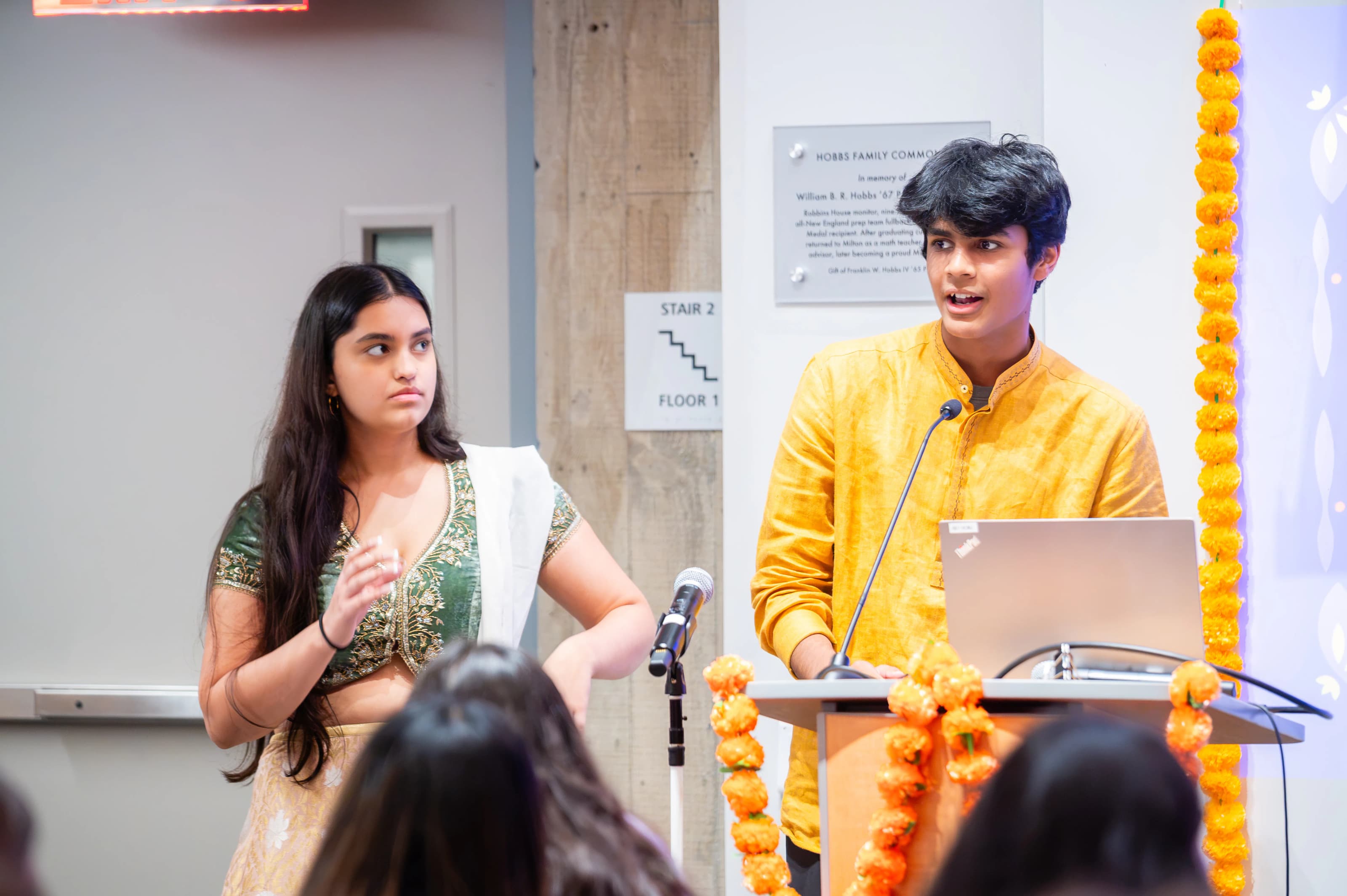
South Asian Middle Eastern North African Club (SAMENA) hosted its annual K-12 Diwali Celebration in the Farokhzad Mathematics Center on November 5. Over the past three years, SAMENA has intentionally developed what was once a small, affinity-only gathering in Thatcher into an event that embraces a broader audience and a more ambitious vision.
Today, the Diwali event spans the Lower, Middle, and Upper Schools and includes attendees across the Milton community. For this year’s celebration, SAMENA Co-Head Meghanaa Balasubramani ’27 identified multiple priorities centered around the goal to “strike a balance between educating people about Diwali and giving them an opportunity to experience the celebration themselves.”
Diwali, the festival of lights, celebrates the victory of good over evil. While celebrations around the world share certain elements, such as puja (prayer) and gathering with family, other aspects differ. At the event, members of the SAMENA board shared their own personal experiences to illustrate the common thread of Diwali’s cultural importance across different practices and traditions.
Balasubramani described her family celebrations in Saudi Arabia as taking place “in the backyards of local Indian families’ homes, where mothers would prepare incredible spreads of homemade Indian food.” She emphasized “a strong sense of community” built through Indian karaoke, sparklers, and “little bang snaps that you would throw on the ground to create an exciting popping sound.”
Amelia Joseph ’28, who also lives in Saudi Arabia, described “gathering with every South Indian family” in her neighborhood for large celebrations with vegetarian food, sparklers, and music that can last five to six hours. When she goes to India, however, Joseph described a “much bigger celebration.”
Several interactive activities highlighted various cultural practices associated with Diwali. Attendees circulated among stations to paint diyas, or traditional oil lamps, get henna tattoos from a professional henna artist, and visit a photo booth with Diwali-themed props. The event also incorporated a dance performed by Lower School students. Aimee Li ’28, a first-time attendee, said the performance was “the highlight of [her] night,” describing it as “really sweet and wholesome.” For Armaan Ahluwalia ’28, “watching the Lower Schoolers dance, perform, and have lots of fun” reminded him of family celebrations and of his niece.
The event prioritized supporting boarders far from home as much as it prioritized increasing cultural exposure among those new to the festival. Sathvika Chadalawada ’29 said the event was “a way for [her] to feel a little piece of home” by replicating important aspects of the festival, such as having mehndi (the Hindi and Urdu term for henna) applied.
The evening featured rice, chicken, and samosas, as well as the savory yogurt dish perugu pachadi and mango lassi. Chadalawada described “all the yummy food [she] got to eat” as her favorite part of the festival and said the food Milton served was “very accurate” and similar to what she would have eaten at home. Li described the food as “amazing.” Balasubramani called this year’s event the “best Diwali they’ve had yet.”