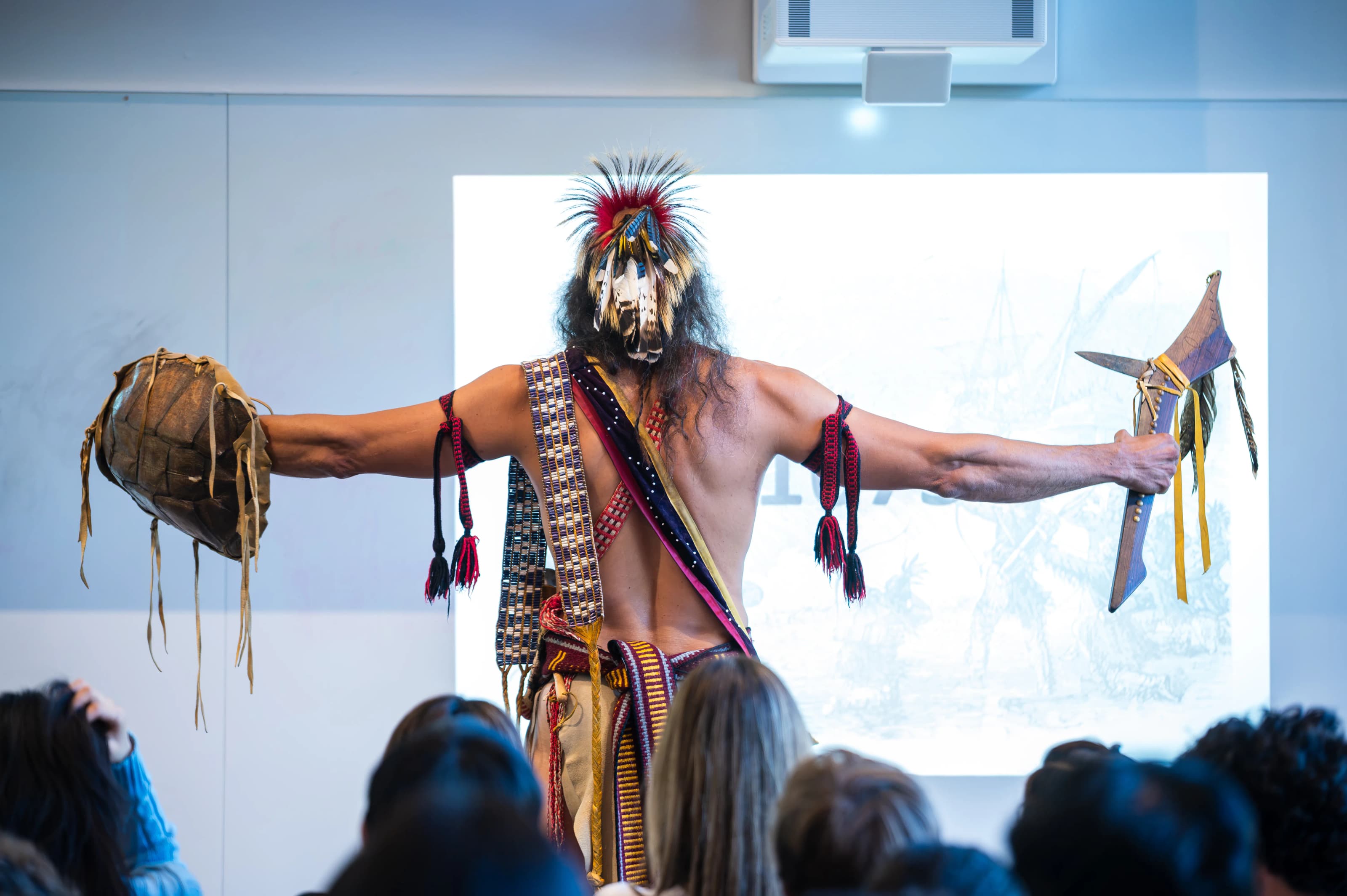
On Thursday, October 15, Milton hosted its annual Indigenous Peoples’ Day Assembly, celebrating Native history and culture. Students gathered in the Farokhzad Math Center (FMC) and the Athletic Convocation Center (ACC) to participate in one of two programs.
In the FMC, Anawan Weeden of the Mashpee Wampanoag tribe put on a dance performance. In the ACC, attendees learned about Native culture and had opportunities to play instruments and participate in a traditional dance. For Lin Takahashi ’30, “the Native American dance broadened [her] cultural perspective.” Mia Silobrcic ’30 “thought the fact that they got the students to interact with the instruments was unique.” Inés Velazquez Correa ’27, a Spanish boarder, said she “didn’t learn about indigenous [American] people at all in Spain,” so she thought learning about Native American history from a Native American was “very cool.”
Director of Equity and Inclusion Melissa Lawlor played a key role in organizing the assemblies. She collaborated with Lower School Director of Equity and Inclusion Matthew Cobb-Ferrara since the start of the summer to plan the events from an intentionally place-based approach. Lawlor explained, “what we tried to do is support and bring to campus members of tribes that are local to this area so that we at Milton can get a better sense of the presence of First Nations today here in Massachusetts.”
Lawlor identified student feedback as central to the event’s planning process: “we usually lean on student input and support… we look back at the last five years, who we invited and what kinds of folks we asked to come to campus.” To engage students with a range of learning interests, Lawlor and Cobb-Ferrara prioritized offering students a choice of programming. Lawlor explained, “We wanted to make the assembly separate so that we could give a more tailored experience.”
Students reported developing a deeper understanding of the varied traditions of the Native American people in Milton’s geographic area. Silobrcic explained, “We learned about and respected the difficulty of the instruments and how [the Mashpee Wampanoag] teach and play them.” However, some students believe the event did not encompass everything that Indigenous Peoples’ Day should commemorate. Adair Johnson ’27, whose grandfather was a member of the Seminole Tribe of Florida, critiqued the event’s framing, saying, “personally, it really bothers me when the rebrand to Indigenous Peoples’ Day causes this really light and airy sentiment where suddenly everyone is joyful about Native culture.” Johnson continued, “There are merits to that, and there is a lot of joy in Native culture, but it really washes over the pain and the suffering.”
Ultimately, Lawlor’s goal for the assembly was to widen the horizons of students and faculty and to prompt them to discover more about Native American history. She stated, “what I really hope is that people get a window to something they haven’t seen or learned or heard about before, and that if they haven’t, if it’s a true window, that they explore that more.”