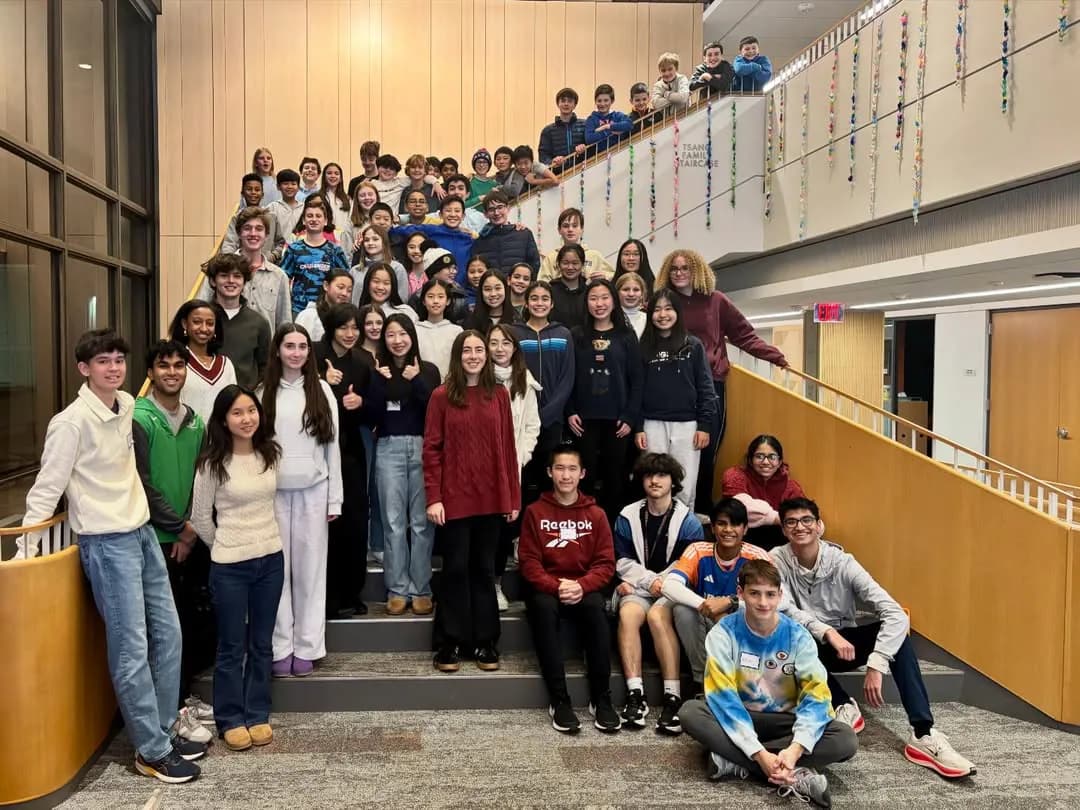
On Monday, December 8, the Upper School Math Club hosted its fourth Milton Middle School Math Competition, also known as M-Cubed, which brought 44 interested middle school students together to participate.
During the club’s recent meetings, members worked on writing and testing problems for the middle schoolers, balancing accessibility with challenge. Math Club Co-Head Eli Berk ‘26 shared that “the concepts are not necessarily hard, but the problems are.” Problems incorporated a range of middle school math topics, including algebra, geometry, and combinatorics. Math Club Advisor and Math Teacher Phil Robson explained that examples included questions such as “How many ways can you get dressed from five items of clothing?” or “How many different playlists can Spotify create from your 10 favorite songs?”
The competition focused on team-based activities. Though competitors could choose one other person with whom to enter, the event mostly assigned teams. “We work with the Middle School to make teams that are balanced across grades and across skill level,” stated Berk. Robson elaborated that team assignment aims to “give each team a good chance of doing well because it is a competition. It’s a friendly competition, but it’s a competition.” The team environment also provides an important leadership opportunity for older middle school students. “It’s an opportunity for students to grow in ways beyond just doing some math problems,” stated Robson.
This time, M-Cubed involved three main rounds: an estimation round, a team round, and a guts round. “In the Estimathon,” stated Math Club Co-Head Celina Wang ‘27, “teams [tried] to estimate answers to quantitative questions as accurately as possible.” Though it may not be possible to formulate exact answers, Wang noted that the round aimed to practice “reasoning through orders of magnitude and narrowing down ranges.” The team round functioned in a more traditional competition style, with each team receiving a problem set to collaborate on. Finally, Wang explained, during the guts round, “problems [were] released in sets of three, and teams [submitted] their answers before receiving the next set.” In the Guts round, problem difficulty increased over time, alongside point value. The competition also featured a live leaderboard, so that teams could monitor their status, particularly in the guts round.
“I’m a big proponent of math outside the classroom,” said Berk. Referencing his own courses, he explained that even though he may not actually use calculus in his career, “learning calculus allows me to practice a type of thinking [and] problem solving that will be applicable to whatever it is I end up doing.” Additionally, Robson shared, “there’s always this kind of stigma around how we’re either good at [math] or we’re not,” and providing competitions such as M-Cubed aims to fight this.”
Modeled after contests that the Upper School team attends, M-Cubed aims “to create a collaborative and exciting environment for math in the middle school,” explained former Math Club Co-Head and founder of M-Cubed Brady Payne ‘25. The idea for the competition formed when members of the Math Club attended the biannual Harvard-MIT Mathematics Tournament (HMMT) in November of 2023. Robson recalled that, “at lunchtime, a then-senior said [that] we should run one of these for our middle school.” The club hosted the first ever M-Cubed competition in April of 2024. This December’s competition was the fourth. “The pipe dream is to not just have Milton kids,” Robson said, “but [to] actually invite other kids from other teams from other schools.”
Each year, participation has increased, and many former contestants have returned to the competition. This year, 61.3% of the 31 middle school competitors polled revealed that they had participated in M-Cubed or a similar competition in the past. Repeat participant Jaysri So ‘31 reminisced: “M-Cubed is extremely fun. First, I get to go to Forbes with all of my friends—my whole friend group generally does it—and eat amazing food, and then solve math problems with friends. The camaraderie and fun at M-Cubed make me do it every time.” So was not alone in her excitement. Ashley Yao ‘30 explained that “math [at M-Cubed] develops my problem solving skills and challenges me. It’s satisfying, logical, and also frustrating, which is part of what makes it so fun.”
Berk emphasized the value of cross-divisional engagement, reminding Upper Schoolers that “we live on a K-12 campus.” He explained that he “would encourage other club leaders to see how they can reach out to the middle school and the lower school because they really enjoy it.”