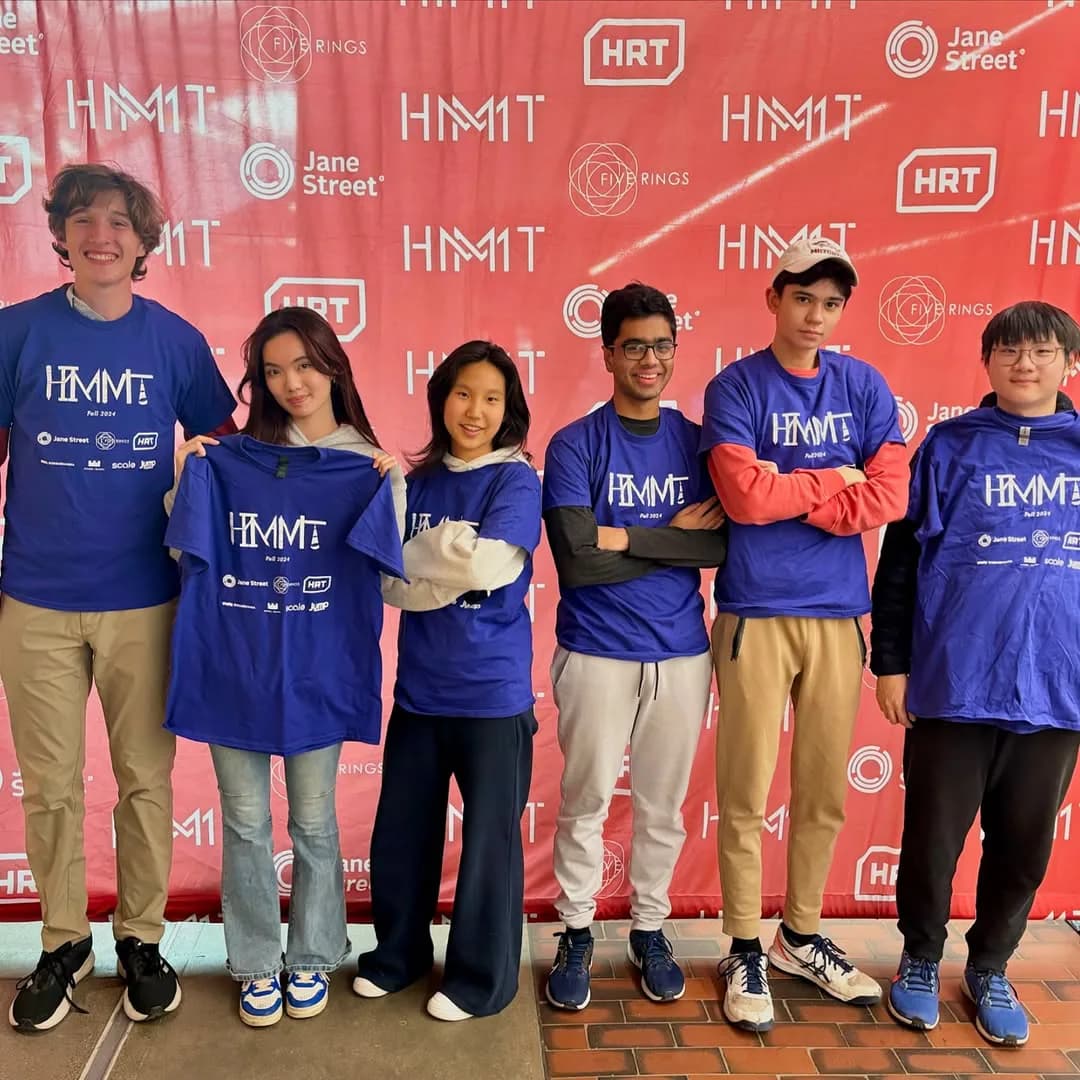
On November 8, six Math Club students spent their day on Harvard University’s campus to compete in the international Harvard-MIT Math Tournament (HMMT), which draws approximately 1000 attendees every year.
The whole event spans three days from Friday-Sunday, but Milton students went on only Saturday, which is the main day of competition. They began the day with 8:00 a.m. registration, then participated in two individual events: a general round and an outer space-themed round. After tackling those problems, the teams completed a team round and a “guts round,” which is a special format in which each set of three problems needs to be submitted before the team receives the next.
As a highly prestigious global tournament, HMMT drew talented teams around the world, contributing to what some competitors described as a positive and energetic atmosphere. Math Club Co-Head Eli Berk ’26, for example, stated that the energy was great. “A lot of people were excited to do math,” he said.
Likewise, fellow Co-Head Celina Wang ’27 recalled, “[it was] very bright, very energetic.” She explained, “many people wouldn’t go unless [they] had previous experience or are really into math.” But even though the attendees were united by their passion for the subject, the students came from diverse backgrounds. For example, according to Wang, the group sitting next to them had flown in from Taipei, Taiwan, which is more than a 17-hour flight away. The competition is “a big deal,” she explained.
Wang noted that the HMMT is also unique in that it includes more collaborative aspects than most math tournaments, but Math Club tries to maintain a strong team atmosphere year-round. “I think we’re a pretty tight-knit club,” she said. “Everyone contributes in their own way. You learn from everybody in the club, essentially.” Wang admitted that while math is definitely very individual, competitions like HMMT “really help bring the team together.” Even after individual competitions like the AMC (American Math Competition), the group gets together to discuss problems.
In addition, Math Teacher and the club’s faculty sponsor Philip Robson, who accompanied the students, stated that he deliberately structured the weekend so that the group could “have moments right after the events where people are talking and being a team.” Robson recalls one of his favorite moments with the group was when they ate pizza together, talked about favorite problems, and played Wavelength.
But pizza and Wavelength were far from all they did: the team also worked diligently to improve their problem-solving skills, which are crucial for competitive math. As the nature of tournaments is very different from tests, competing students have to spend a considerable amount of time practicing outside of their standard math coursework. Wang explained, “[On a] test you’re expected to know all the material,” but “on the math competition, getting three or four questions [out of ten] is already pretty good… You’re not expected to solve all of them.” However, she noted that the challenge does not come from the level of math, but rather the critical thinking skills needed to apply concepts to a problem.
“There’s a misconception that it’s super difficult math,” Wang noted. “It’s not. It’s literally only algebra, geometry, counting and probability, and number theory.” Consequently, Wang highly recommended that students try out because most students will already know the concepts from their first or second year math classes. “You don't have to necessarily be doing super well in your math course to... take a contest,” she said. Wang also acknowledged that some students hesitate because the term “competition” can be intimidating, but she suggested that students might actually find that the contest’s style suits them more than conventional coursework.
Robson also encourages students to “come to Math Club, and figure out, ‘is this me?’ ‘do I like it?’” Berk agreed, stating there is “zero downside” to exploring the competition.