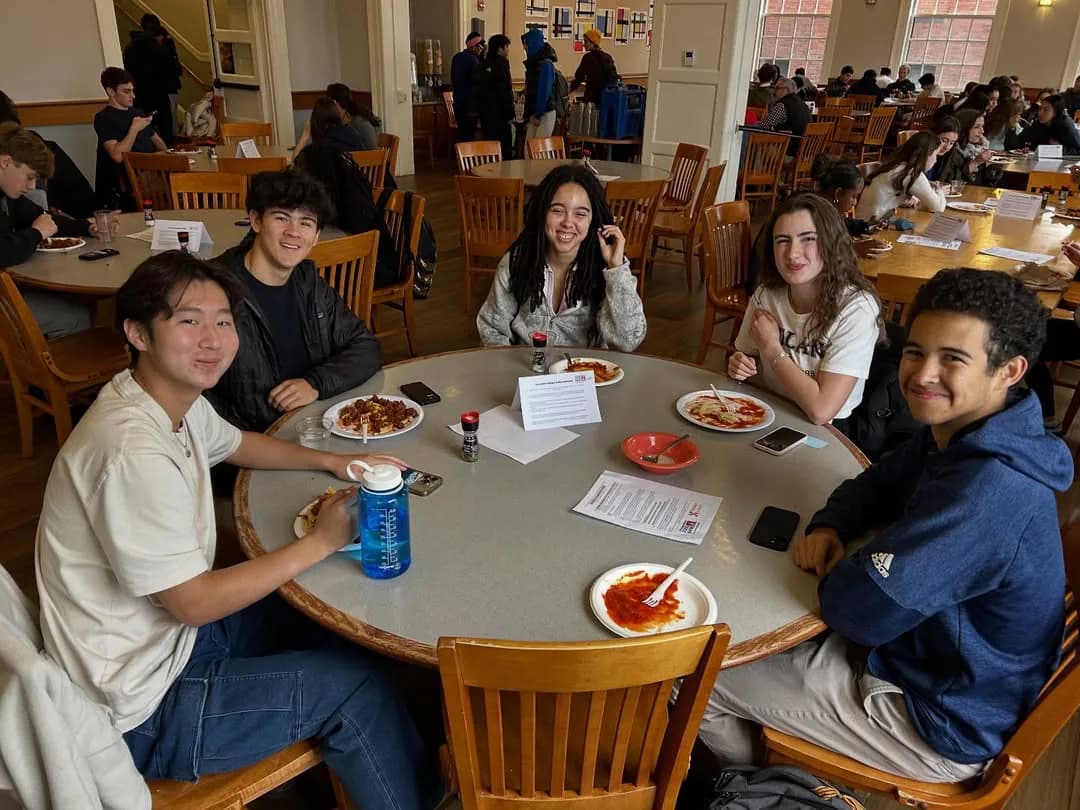
On November 13, Community Engagement Program and Partnerships (CEPP) hosted the annual Hunger Awareness Event, a nearly 40-year-old tradition meant to spread awareness of food insecurity by simulating lunch meals for people of different income levels.
Students entering Forbes Dining Hall drew tickets that assigned them to a low, middle, or high-income meal. “Low-income” tickets corresponded to a meal of plain pasta, meant to represent living on less than ten dollars per day and reflecting the state of 60% of the world population. Students with “middle-income” tickets ate pasta with sauce, representing the people living off $10 to $30 per day who constitute 30% of the population. “High-income” ticket-bearing students received a standard Forbes meal, reflecting the remaining 10% of the global population with a daily income of more than $30. CEPP specifically made an effort to ensure that everyone could participate by communicating with faculty and advisors about medical issues and dietary restrictions.
After picking up their meals, students with low- or middle-income tickets deposited their slips into a collection box, and each ticket contributed to a planned $2,000 donation.
CEPP Director Andrea Geyling-Moore explained that the event aims to encourage awareness about local, national, and global food insecurity. In addition, money from the meals saved will be donated to the Boston Food Bank to combat local food insecurity, as well as to Partners in Health to support child nutrition in Haiti, where many Milton community members and family members are from.
Hunger and poverty may seem like distant issues to many Milton students, but they are present right in Massachusetts, where one in three households have children with food insecurity. This issue has only been exacerbated as the Milton Food Pantry and the Supplement Nutrition Assistance Program (SNAP)—which usually help alleviate this issue—have slowed down due to the recently ended government shutdown. Hunger has also worsened in Haiti, where food price increases have led to 5.7 million Haitians to experience food insecurity and one in four Haitian children to suffer from malnutrition.
The event aimed to provide an opportunity for the members of Milton Academy to acknowledge the privileges that they have and the power they hold to help the community. Geyling-Moore hopes the event will prompt students to “think about choices they make and how they use their money or volunteer their time.”
CEPP Board member Mira Lu ’27 explained the significance of the event: “hunger is a really prevalent issue, not only in the greater world but also for people near us. That wasn't just one meal.”
Lu expressed appreciation for the participants this year. “It was nice when a lot of people went to Forbes, picked the ticket, and actually ate the food instead of going back to their dorm and cooking ramen or DoorDashing.” This year’s Hunger Awareness Event seemed to have increased participation, with around 600 total participants. Lu even mentioned an individual who picked a high-income meal but voluntarily switched to a low-income ticket, believing it would raise more money.
Among the students who participated, Ben Wang ’27, who received a low-income ticket, said he felt empathy for people who experience food insecurity every day. “At Milton, we’re very complacent and sometimes complain about Forbes food, although it still gives you nutrients,” Wang observed.
This year, CEPP made a deliberate change to the low- and middle-income meal, replacing the usual rice-based option with a pasta meal. In a November 10 Upper School Meeting announcement, CEPP Board members Alex Sherman ’27, Emlyn Joseph ’27, and Lu expressed that rice-based meals hold cultural significance for many students—especially those whose families look to rice as an everyday staple. By choosing a more neutral option like pasta, CEPP hoped to ensure all students felt comfortable participating in the simulation.
Directly following the event, the fall musical, Hadestown, held a matinee for Upperclassmen. Iris Chen ’28, who is part of the Greek Chorus in Hadestown, received a low-income ticket. She commented that while it “did not really affect [her] energy for the show,” she thinks that performers could benefit from a heavier lunch, since she felt a bit drained after the musical. Many students participating in athletic tryouts or practices for winter sports, such as swimming and skiing, also had to deal with a less than ideal lunch that day, as did many faculty members.
While the event only lasts one lunch period every year, organizers emphasized that food insecurity persists everywhere. “There’s probably people who we interact with on a daily basis that experience hunger,” Lu said. For some students and faculty, the simulation reflects true experiences they have faced in the past or continue to face—Lu explained that the issue “is really close to us.”