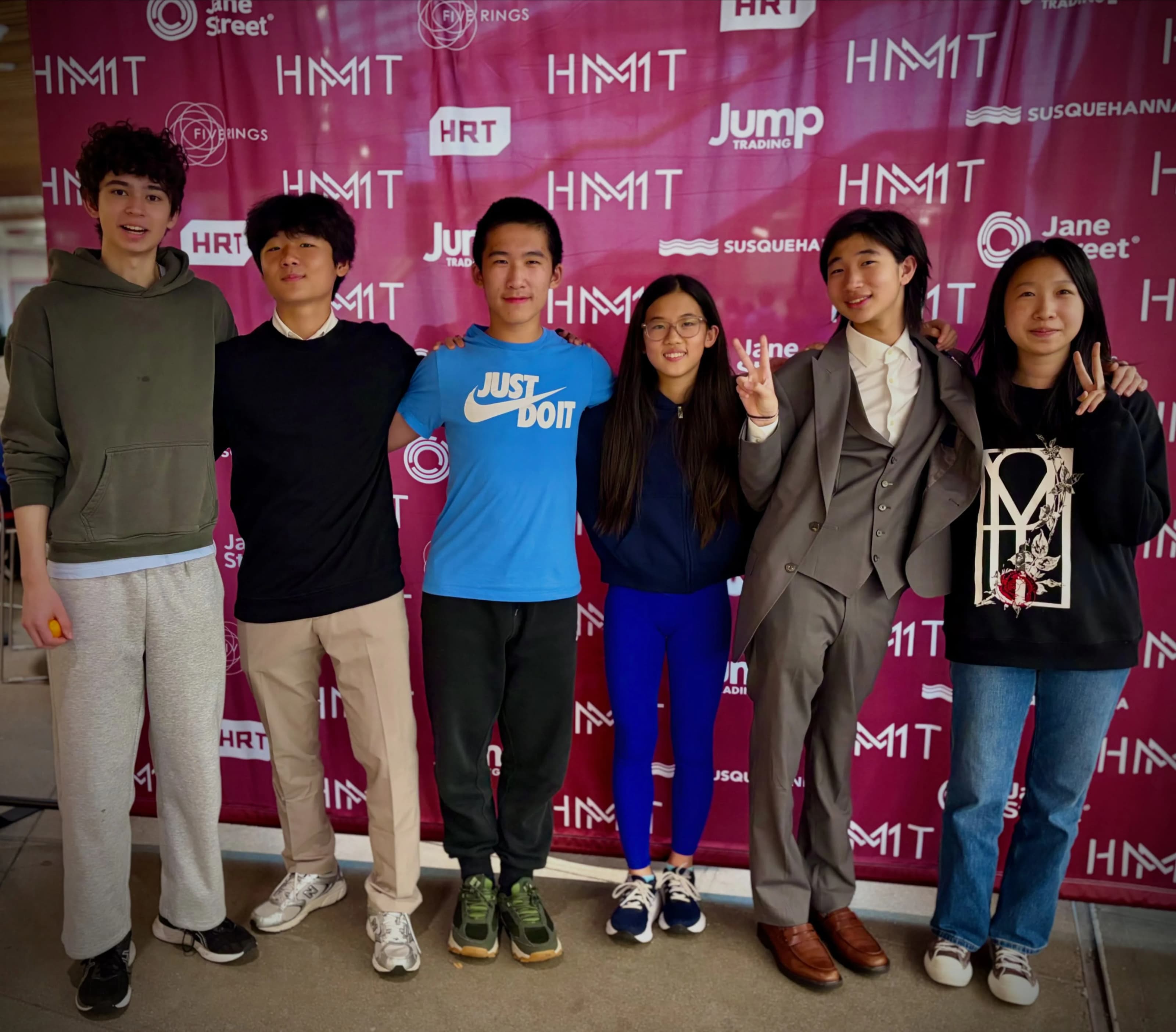
37 Upper School students participated in the American Mathematics Competition (AMC) 12 and 10 at Milton on November 5. Two days later, six students competed at Harvard University in the Harvard-MIT Mathematics Tournament (HMMT). HMMT results have not yet been released, but according to Math Club Faculty Sponsor Phil Robson, “Milton had a record 17 students qualify for the [AMC’s] invitational exam in February,” far more than last school year's eight qualifiers and the year before last's five qualifiers.
The AMC, a 75-minute individual competition consisting of 25 multiple-choice questions, challenges students to apply mathematical concepts in unfamiliar ways. According to Robson, the skill of applying knowledge to new contexts is critically important. He explained, “It’s not just ‘let’s remember the technique we’re supposed to use for this thing.’ [With] the best problems…there’s more than one way of solving it.” Math Club Co-Head Hugh Kramer ’27, who competed in both events, agreed, noting that although AMC competition topics require no background knowledge in calculus, the approach to problems “requires techniques that are not found on the typical math test.”
Participating students had a range of motivations for taking the AMC, including to qualify for the American Invitational Mathematics Examination (AIME), to challenge themselves, or to spend time with friends. Sage Kramer ’29, who returned to the AMC with the goal of qualifying for the AIME, said “When you’re under a time constraint, you really have to work hard, and problem-solving under a time limit makes you more involved.”
Jaydon Sun ’29 said one of the most rewarding aspects of returning to the AMC is “when you solve a question that you know that you couldn’t solve a few years ago.” Isaac Wu ’28, who took the AMC 12, described the atmosphere as “quite fun, especially afterwards,” particularly the conversations in which the students discussed various approaches to problem solving. Robson said students’ motivations for participation are central to Math Club’s and Math Team’s identities. While individual scores and competition results hold importance, Robson emphasized that the team’s success depends on participation and collective effort. “Everyone’s just as much part of the team, regardless of if you’re in the top ten scorers or not,” Robson said.
The HMMT differs from the AMC in both scale and structure. Hosted by Harvard University, the HMMT draws over 100 teams from around the world in competition across institutional affiliations. Unlike the AMC, the HMMT builds collaboration into the competition. The design of the HMMT combines individual rounds with team-based rounds that require participants to solve problems independently and work together under time constraints. Wu described the HMMT’s intentional focus on collaboration as contributing to a difference in atmosphere between the two competitions. During one team-based round at the HMMT, he recalled his group working together on a particularly challenging problem. Even though the team did not ultimately solve the problem, he described the experience as “enjoyable” because of the opportunity to discuss and work closely as a group.
Sun described the exchange of mathematical ideas within and across teams throughout the event as a particularly memorable element of the tournament. He added that although mathematical competitions have strengthened his problem-solving abilities, their broader impact has been in changing how he approaches unfamiliar challenges. Sun explained, “I don’t look at questions as a way of ‘I need to get this right.’ I look at it [as] ‘how might I do this question?’”
Math Club Co-Head Dillan Agrawal ’28 encourages students, even those who typically do not enjoy traditional math classes, to give one or both of the competitions a try: “Everyone starts somewhere, and everyone has their own unique way of approaching problems that can help even more experienced people learn and improve.”
For Sun, the key component of any math competition is the way it brings people together through a shared interest in mathematics. “I don’t see [the AMC and the HMMT] as separate competitions,” he said. “Instead, I see them as one main amalgamation of what mathematical thinking should do to someone. It should encourage them to see the world in different perspectives, taking in other people’s thinking, and to have perseverance and fortitude in times of hardship.”