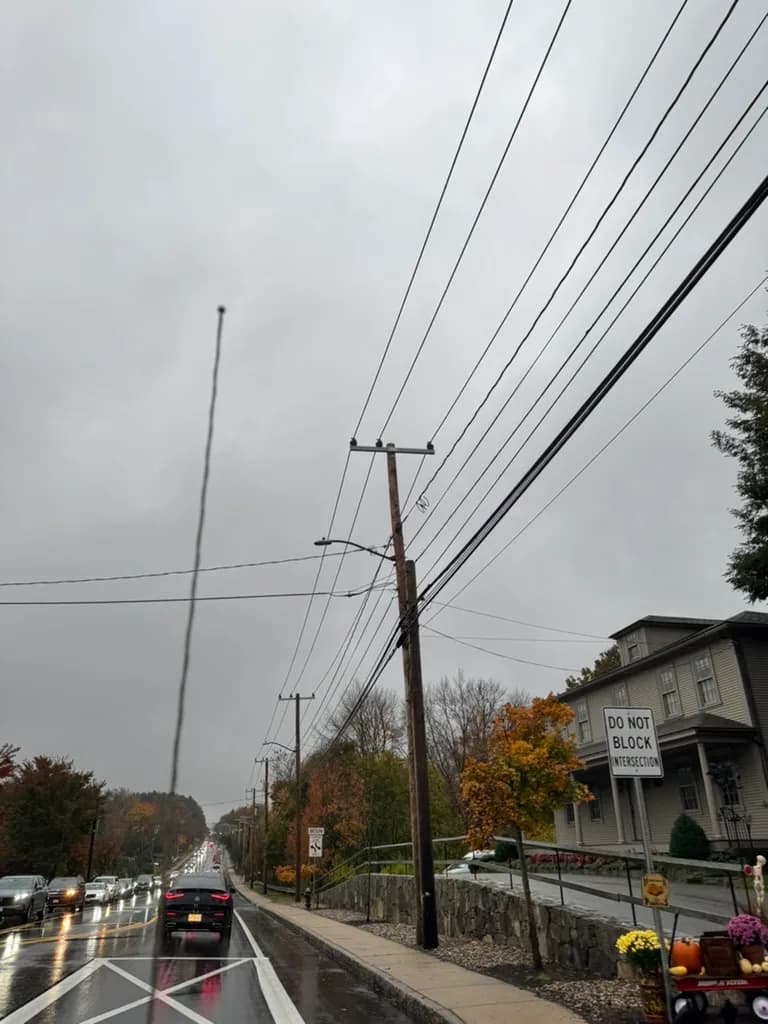
For years, Milton residents have urged the state to address safety hazards along Randolph Avenue, which former Milton Select Board Member Diane DiTullio Agostino once called in a board meeting “an unsafe, deadly, suicidal alley that travels through Milton.” But when the Massachusetts Department of Transportation (MassDOT) finally acted via the Route 28 Road Diet Pilot, the outrage did not dissipate. It simply changed form to blaring horns and endless gridlock.
For decades, Route 28—known locally as Randolph Avenue—has been a menace. Four lanes slice through Milton between Reedsdale Road and Chickatawbut Road, where driveways pour straight into highway-speed traffic. Between 2019 and 2021 alone, more than eighty crashes occurred there—over forty resulting in injury or death—earning Chickatawbut-Randolph the grim distinction of “#1 crash location” in Massachusetts.
Agostino deemed the site “a racetrack.” Day student Sara Callahan ‘27 recalled that, for years before the crash, she had considered the road “a disaster just waiting to happen.” On July 5, 2025, Callahan’s concerns were realized. A Mercedes GLA 250 and a Toyota Corolla collided. Debris tore through yards. An engine block landed on a lawn. Three people died within hours.
At a Select Board meeting later that month, Agostino requested a moment of silence for the three victims. “How many deaths have we had? How many disabled individuals? We’ll never know,” she said.
MassDOT Communications Representative John Goggin said officials had been hearing those pleas for years. When asked about the history of the road, he explained “residents, state elected officials, and Milton town officials have repeatedly raised concerns about safety along this segment of Route 28.” In 2018, MassDOT began the Route 28/Chickatawbut Intersection Improvement Project, aiming to replace the aging traffic light with a modern roundabout.
Still, frustration boiled among some Milton residents. One of them, Rosanne Spring, launched a 2020 petition opposing the roundabout design; it drew nearly 1,900 signatures. The department then commissioned an eight-month corridor study to evaluate the effectiveness of a “road diet,” a redesign that trims travel lanes to slow traffic and improve safety.
Then came the July 5 crash, and all patience vanished. According to Goggin, “MassDOT took steps to accelerate [the road diet’s] development and implementation.” Within weeks, orange cones and white paint had redrawn the town’s main artery.
The new layout removed one through lane in each direction and added a center left-turn lane. Plastic barriers divide traffic and block high-speed crossovers. The design, Goggin said, aimed “to provide a balance between safety improvements and access.” He acknowledged that while the new design to the road has “resulted in additional congestion,” its goal is to “ensure that everyone can travel safely along the corridor.”
Some drivers, however, are not buying it. Computer Science teacher Chris Hales, who commutes daily, summarized the change in a single word: “ridiculous.”
Riley Donovan ‘29 instead chose another: “nightmare.” “It takes 40 to 50 minutes to go five miles when it used to take 20,” Donovan explained. David Shih ‘29 remembered a similar experience: “It took me 20 minutes to go three-tenths of a mile.”
According to Campus Services Manager Courtney Hawkes Gaidos, the Newton/Wellesley bus—the only one that typically uses Randolph Avenue—“tested out getting on the highway via Canton Avenue to Blue Hill Avenue and it took even longer.” Frequent passenger Jane Shoemaker ‘28 said that the bus, scheduled to arrive on campus at 7:45 a.m. each morning, now “arrive[s] late at least three times a week.”
The effects have rippled inside Milton’s campus as well. Head of Campus Safety Jay Hackett reported “an increase in students’ being dropped off in places other than official drop-off points, including on Centre Street and Randolph Avenue.” He added, “We’ve seen students come close to being hit by other cars.” The school, he explained, “has placed warnings in the weekly newsletters…that this [behavior] places students’ safety at risk.” However, Hackett assured that student safety remains Campus Safety’s top priority and observed that to compensate for additional congestion, “families and employees are building extra commute time into their schedules.”
And the numbers back him up. In a poll of 80 Milton Academy students and faculty, 81.3% reported worsened traffic on Randolph Avenue. 61.3% said their commute grew by at least six minutes; more than a quarter reported a difference over 16 minutes.
Those figures play out each morning, with horns honking at the Randolph Avenue light and drivers idling between Centre Street and Reedsdale. Hackett nonetheless reinforced that “timeliness should not occur at the expense of safety.”
MassDOT has yet to budge. Goggin said the agency “will evaluate before-versus-after traffic volumes, vehicle speeds, crash data, and public and stakeholder feedback to determine whether the pilot should remain.” Analysts will also track whether rerouted drivers are overwhelming smaller side streets. Yet with only 12.5% of surveyed Milton Academy community members perceiving any improvement in safety, confidence within the school community is thin.
Though Goggin reinforced that “public feedback is and will continue to be an important component of the road diet evaluation… MassDOT intends to let traffic patterns settle before making more substantial changes to the pilot.” For now, orange cones and white paint will continue to divide what used to be four lanes into two. Milton will have to slowly—very slowly—learn how to live with it.
Still, not everyone sees the delay as disaster. Stella Tjan ‘27 argued that complaints miss the point. “Our small inconvenience is nothing compared to the deaths caused by the old and dangerous design of Randolph Avenue that really encouraged reckless driving.” She added, “A few extra minutes are worth preventing those deaths.”
On the other hand, former Facilities Services administrator Lynn O’Sullivan said “[the road diet is] too drastic.” She explained, “We needed a change, but maybe one or two more lights would’ve worked better.”
Maybe so. But for those who remember that July afternoon, the alternative form of “drastic” still lingers. So instead, drivers inch forward. The price of safety, it turns out, is patience.