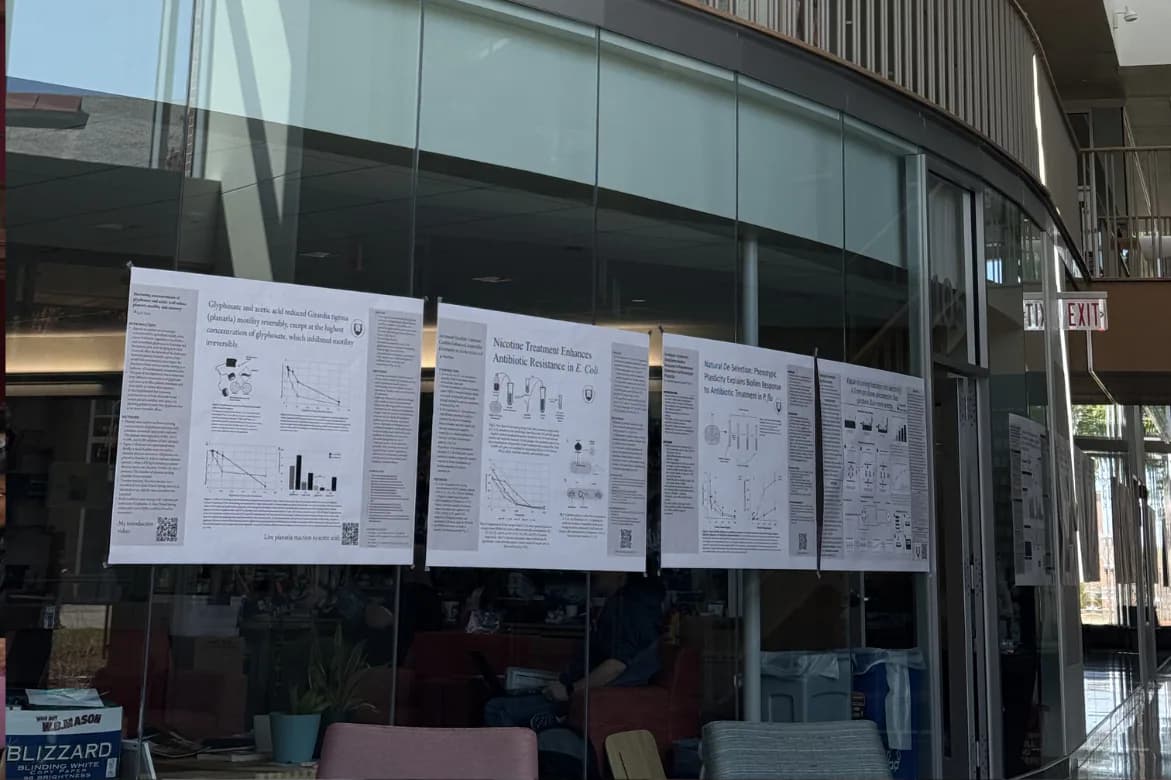
On Tuesday, April 28 from 7:00 p.m. to 8:30 p.m. in the Pritzker Science Center, Advanced Science students presented their Design Your Own (DYO) experiments at the Science Symposium to 111 faculty, student, and parent attendees. DYO brainstorming began before spring break, and for their final product, the students needed to “prepare data, [set up a] website for Science Symposium, make the poster, and write a report,” according to Disease Biophysics student Leah Li ’26. At the Symposium, advanced science students Vickie Mao ’26 and HT Xue ’26 shared opening speeches about how they have explored their passion for science at Milton. Afterward, all students orally presented their posters, pasted around Pritzker's walls, to eager attendees.
To approach the project, students chose a broad topic and investigated a more niche idea based on that topic. Advanced Chemistry student Jayden Lee ’27 worked with his partner Liana Bolosova ’27 to investigate the synthesis of a quinine-doped gelatin film and how its fluorescence is quenched by sodium chloride and potassium iodine solutions. This experiment, building off a previous Advanced Chemistry lab, investigated how mixing gelatin-based film with a titanium dioxide base forms a paper-like, water-soluble substance. Lee explained that, because quinine is insoluble in water, he and Bolosova had to test multiple ways to successfully integrate the material. His experiment reflects the curiosity and the persistence necessary to achieve a deeper understanding.
Kailyn Love ’26 took a dual approach, designing an experiment that meets the requirements of both Advanced Chemistry and Advanced Physics. Love’s experiment investigated the effects of choice of metal on diffusion using microfluidic chips (chemistry), as well as how flow rate impacted diffusion (physics). Love’s interest in microfluidic chips arose when she “participated in prior microfluidic chip research last summer.” For Love, designing an experiment that was connected both to physics and to chemistry required countless hours of lab work both in class and during open lab. Love described that she then “spent frequent free time researching and drafting [her] lab reports to ensure that [her] research [was] clear and supported.”
Clarity and support were not the only values that science students stayed true to as they researched and wrote. Li highlighted the importance of exploring the unknown: “Whenever I [first] went into the lab…I wanted to do things that I was [only] pretty sure would work.” She advised future students working on DYOs, above all, “to try new things.”
Teachers, the backbone of the Science Symposium, ensure that the event runs smoothly. Science teacher Jim Kernohan explained that teachers “have to make sure that all the posters are printed, up on the wall, that there's food, and invitations sent out.” Nonetheless, science teacher Julie Seplaki explained why the effort is worth the Science Department faculty’s time: “The buzz that evening is electric…I love the enthusiasm, confidence and pride each scientist demonstrates…and [the] support our scientists receive from peers and adults alike.” Both Mao and Xue expressed deep gratitude to their science teachers in their speeches.
Jennifer Li ’26, who attended the event, shared her “awe at the sheer volume of work reflected in each poster, especially since [she] had witnessed the amount of time [her] friends spent testing in open lab or writing lab reports.” Anh Tran-Nguyen ’26 echoed that “there was a diverse array of interests expressed.” Seplaki expanded that the Science Symposium inspires younger students by demonstrating the “opportunities that abound for students choosing to engage in scientific discovery throughout their time at Milton.”