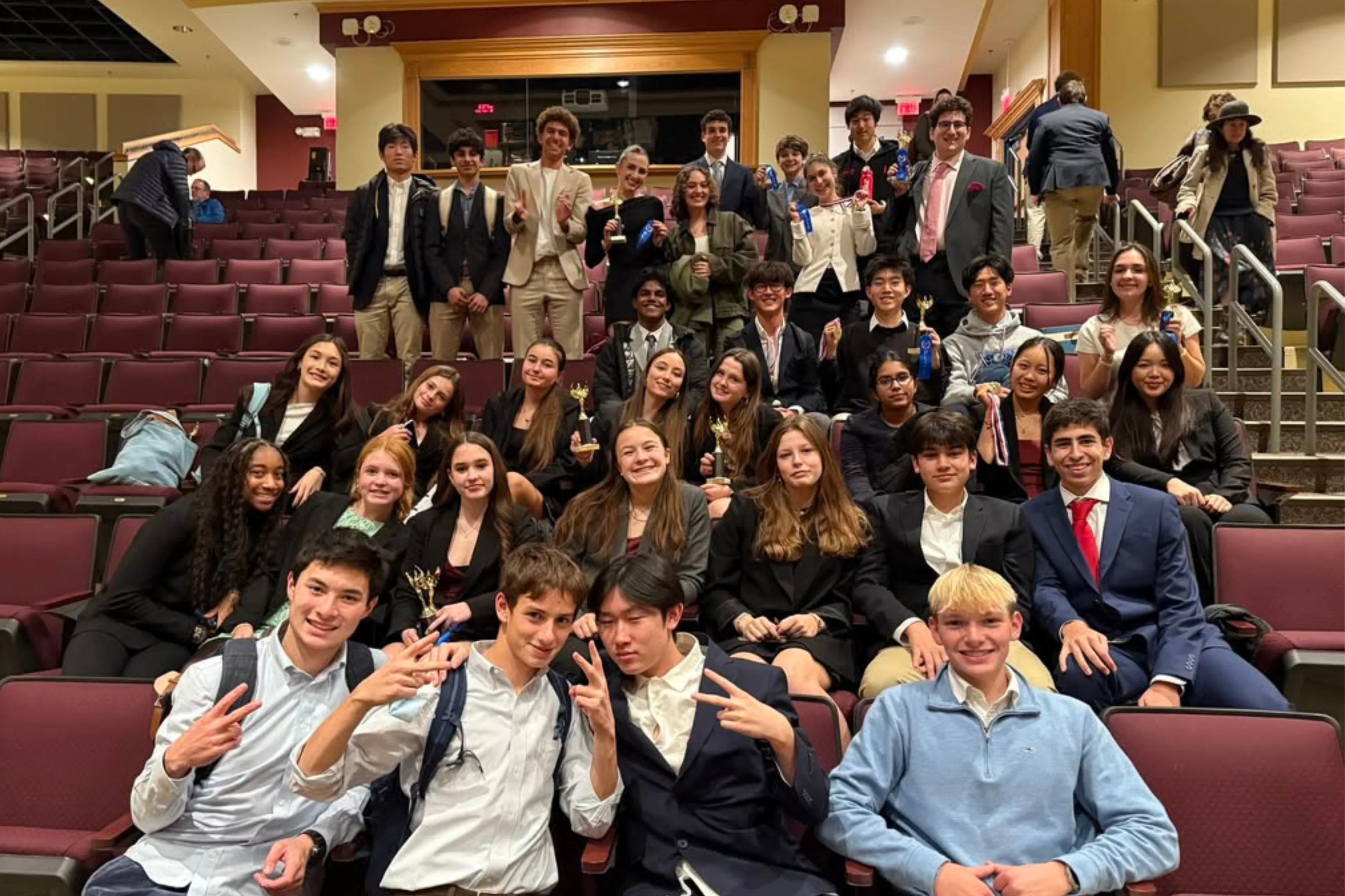
“The Only Way Out Is Through.” I see the quote in a frame sitting atop a bookshelf on the far side of Kellner 229, Speech & Debate Coach Scott Caron’s classroom. Together, the rounded words of the quote create a white spiral against the dark green backdrop of the frame. Accompanying the quote frame is a nutcracker, another quote frame, and, of course, tournament trophies.
Trophies of all shapes and sizes adorn the room, serving as a testament to how much team members past and present have worked “through” to consistently win state and national championships. In both 2024 and 2025, the team won the overall Sweepstakes awards at the National Speech & Debate Association (NSDA) qualifiers, cumulatively earning the most points among all divisions (Congress, Speech, and Debate) in the state.
At the beginning of the 2025–2026 year, there were 29 juniors on the Speech & Debate Team. By mid-October 2025, however, only 17 remained. Despite what the framed quote preaches—that “The Only Way Out Is Through”—many team members of the Class of ‘27 departed early. I had thought that the sunk-cost fallacy, the phenomenon by which people are unwilling to let go of an endeavor due to having invested heavily in it, would have discouraged the juniors from departing. Of the juniors who quit between the start of the school year and the middle of October, all except for one had entered the team as a freshman. In other words, the vast majority of these juniors had two whole years of Speech and Debate involvement under their belt. In addition, junior year is typically the time to seek leadership positions and maintain longtime commitments in the name of preparing for college applications. Then why, not two months into the 2025–2026 school year, did nearly half of the junior members depart the team?
I found that, as of mid-October, a total of eighteen juniors had quit the team since they joined. To obtain this information, I compared the current Speech & Debate Team roster with the email list of the 2023–2024 Novice Boot Camp (an introductory program to newcomers which takes place at the start of the year). Only one departed junior had attended the 2024-2025 Boot Camp the following year. A mid-October survey ascertained the month and year of each departure, showing that twelve had left as juniors and the remaining six as sophomores. For the rest of the survey results, I focused only on the group I was interested in: the twelve juniors who’d left the team between September and mid-October.
The survey asked the juniors to select multiple reasons for their decision to leave. 83.3 percent of respondents chose “Time Commitment” as a reason; 75.0 percent chose “Team Environment;” 58.3 percent chose “Tournament Stress;” and 16.7 percent—two students—chose “Other,” both writing “Lack of Enjoyment.” As well as the most selected on the survey, team environment and time commitment came up most prominently in interviews.
Among the reasons students could choose on the survey, “Time Commitment” was the most common reason for their departure. Indeed, for another question that asked the respondents to rate how big of a time commitment the team was on a scale of “1” (“you spend little to no time throughout the semester on Speech & Debate”) to “5” (“you dedicated a significant amount of time to Speech & Debate, more than was asked”), 7 out of 12 juniors selected “4.” Joanna Zhang ‘27, a junior who quit this school year, stated, “Speech & Debate takes up a lot of time—especially Thursday nights and the weekends,” referring to weekly two-hour Speech & Debate practices and weekend tournaments.
Adair Johnson ‘27, another junior who quit this school year, said that it was difficult for her to balance her Speech & Debate responsibilities with other commitments. “My course load this [school] year is truly awful,” she expressed. Alongside courses such as Honors Biology, Multivariable Calculus, and Linear Algebra, Johnson also plays after-school sports, competes on the robotics team, and edits for The Measure.
Beyond individual time management challenges, however, many of the students who quit felt the commitment Speech and Debate required was unrealistic. For example, Cindy Zeng ‘27, another junior who quit this school year, criticized how only local tournaments counted toward the tournament requirement, and how state championships, national qualifiers, and national tournaments did not. Coach Caron explained that this rule was in place to prevent inequity: if non-local tournaments were to count toward the minimum, only some members would be able to use that opportunity to fulfill their requirements. The two main national speech and debate organizations, the NSDA and the National Catholic Forensics League (NCFL), put limits on how many students could attend national qualifiers, so the coaches needed to select who could attend based on aspects such as seniority, commitment, and attendance.
While acknowledging the equity challenge, Zeng nevertheless felt, “it's such a waste of time to prepare for these qualifiers… and after a week of work [to] not [have] any progress in terms of your team commitment… [The coaches] always say you get as much out of this as you put into it. So if team commitment is an indicator of your skill or your progress, if you can prove your skill and prove your progress by, say, qualifying for a national tournament, why can't that national tournament then go back and fulfill your team commitment? You're not taking anything away from the people who [the coaches decide] don’t go to qualifiers. They can still fulfill their tournament requirement by going to local tournaments.”
The beginning of the 2025–2026 school year saw the Speech & Debate coaches and student leadership team altering the number of tournaments that students are required to attend per semester, as part of an effort to help students better balance their commitments. Every year, the number can change depending on the school schedule and the overall number of tournaments offered by the Massachusetts Speech & Debate League (MSDL), Massachusetts’ primary high school Speech & Debate organization. But the requirements are always the “majority of” the tournaments offered each semester.
While the minimum was previously three out of four tournaments per semester—last year, due to scheduling conflicts, the number was unusually two out of three tournaments per semester—the coaches changed the minimum this school year to four out of five tournaments in the first semester and none in the second. What hasn’t changed is that, in the place of attending one tournament, students can judge a middle school tournament on a Sunday. However, since students often have other weekend commitments—Johnson had robotics tournaments which also took place during the weekend—she was unable to adjust to the new tournament requirements.
The survey showed that 7 out of 12 juniors gave a “5” when asked to rate how overwhelming the tournament requirements were between “1” (“not overwhelming at all”) and “5” (“very overwhelming.”)
Current Speech & Debate Team member Emlyn Joseph ‘27 stated that “it’s definitely better” to spread the required tournaments out across both semesters, as sports and extracurriculars can make people’s fall and winter schedules “really packed.” Despite the change in the tournament minimum, Joseph says he has learned how to manage his time well, a skill that has factored into his reason to stay. One anonymous member of the team said that “taking a step back” in their level of team commitment has allowed them to struggle less with balancing different commitments. “Because I put in so much time [last year], I got a little burnt out,” they said. Similarly, Anna Schmults ‘25, who competed on the team all four years of high school, thought that fulfilling the tournament requirements wasn’t difficult, since she was investing a lot of time in the team anyway. “[The requirements] were less than what was necessary to be successful,” she said.
“The tournament requirements and practice requirements were actually less than you would need to do to be competitive at a national level,” she explained.
Speech & Debate Team Co-Captain Grant Morishita ‘26 believes that Speech & Debate is a high-commitment extracurricular by nature. “Unless you don’t go to tournaments… or don’t practice a piece… or don’t do any prep work, I don’t think there’s really any way around having to do quite a lot of work,” he expressed.
Caron said that he and Co-Coach Lindsay Donovan have continued to shape their requirements to benefit the students. Caron, who has entered his sixth year of working at Milton, thought that low upperclassmen retention was “a very recent Milton issue within the last decade.” On this school year’s tournament requirements, he said, “I think our minimum requirement is actually very minimal.”
Additionally, Caron said that he and Donovan have “worked very hard” to make sure that the Speech & Debate schedule is comparable to an athletic schedule, making practice happen on Thursday evenings. “It’s one evening versus… every day or every evening,” said Donovan, referring to sports practices that often take place daily. Aside from weekly practice, Speech & Debate Team members are also required to attend a single one-on-one meeting with the coaches per semester.
“Students have a difficult time… navigating their priorities,” said Caron. “We are not… a team that is able to entertain low-level or minimal involvement. So I think, sometimes, there’s a bit of an impasse when students think that we’re asking for too much.” He concluded, “I just can’t overstate how little I think we ask of them.”
“The least amount of fun possible”
After “Time Commitment” on the survey, the next most common reason for the juniors’ departure was “Team Environment.” The survey asked the nine juniors who selected “Team Environment” to choose the specific aspects of the environment that were disappointing. Eight of those nine selected “Coaches;” Four selected “Lack of Individual Support;” and none selected the remaining two options, “Teammates” and “Leadership.”
“The culture of the team got to a point where Speech [& Debate] was expected to be your number one priority, and it wasn’t always mine,” said an anonymous junior who quit this school year. In addition, the junior stated that the team had a tradition whereby, “if you got on the bus [to the tournaments] late—like, a minute late—[the coaches] would make the whole bus shame you. It was just a weird culture.”
The survey showed that 6 out of 12 juniors who left this school year rated the consequences for violating the Speech & Debate Handbook—a rulebook all members sign when they join—at a “2” on a scale from 1 (“not reasonable at all”) to 5 (“very reasonable”).
One anonymous current member stated that reliance on the disciplinary actions of the Debate Handbook made the practices less enjoyable, explaining, “we always open with meetings in which the… Handbook is cited a lot. It’s like, ‘if you don’t do this, you get kicked. Here’s our system of strikes.’”
Schmults recalled that she had felt as if any good behavior, time, and energy that one invested in the team wouldn’t necessarily be valued if one made a mistake. “I've been on this team for years. I poured my blood, sweat, and tears… and then [when encountering] stuff like missing a deadline, arriving late, having a family emergency or a conflict, I felt like I would still be punished as if I were someone who hadn't been invested in the team… We're sort of treated as if at any point, we're going to revolt and quit and stop caring about the team.”
An anonymous current member criticized the “shared prep” requirement, which asked members participating in current affairs-related events, such as debate and extemporaneous speaking, to input a certain amount of prep into a designated folder for other members to read and benefit from. The problem, the member said, was that there were no specifications on what the prep should be about. “What ends up happening is, everybody puts a bunch of stuff in the folder that no one else reads. And then, if you don’t do that, the coaches will send you this very passive-aggressively worded email.”
Many students believed that these demands, which they saw as unreasonable, reflected deficits on the coaches’ part. A current team member reflected: “I’d like to just say that the coaches on many fronts are very unprofessional. They play favorites and have, on many occasions, gossiped about students to other students. They frequently lash out at members for very minute offenses. Overall, the general environment is not conducive to team spirit, instead being unpleasant and at times actively hostile.” An anonymous junior who quit attributed their decision specifically to their perception of the coaches’ conduct: “a lot of the conversation… in private meetings I would have with [one of the coaches], was about other students on the team… [they were] critiquing other students, some of whom I was friends with, some of whom I wasn't friends with. And I think that felt pretty weird… these conversations were typically started by the coach whom I was meeting with and not myself. I would be like, ‘I was talking to [redacted] the other day,’ and the coach would roll their eyes.” Calling the team culture “bureaucratic,” one anonymous current member noted, “it seems like everything about the way the team is designed, everything about the way the coaches interact with members of the team, seems intentionally to make the team do the least amount of fun as possible.”
To the accusation that the coaches favor some students over others, Donovan responded, “The [Speech & Debate] Handbook, our accountability measures, and other rules and regulations function in a couple of ways. An important consideration… is that clear rules ensure that coaches do not play favorites in a systematic way. We have always been transparent in how we organize the team, practices, and how we make decisions. We outline them in multiple places—the Handbook, our weekly newsletters, and team meetings.”
“Setting clear expectations”
The leadership team has worked to strengthen the team environment through various means. Team Co-Captain Rhys Adams ‘26 stated that he is focused on creating a team culture that fuses competitiveness and interpersonal support, believing that specific advice on competing, writing speeches, and managing members’ team-related workload make for effective leadership.
Many juniors recalled positive aspects of the team environment. Madeleine Wu ‘27 said, “Regardless of who they are, the captains are always amazing… We would do late night library sessions where they would teach me how to do everything.” Indeed, 6 out of 12 juniors gave a “4” or “5” when asked to rate how effective student-run support and leadership were between “1” (“not effective at all”) and “5” (“very effective”).
According to Team Secretary Davey Glazer ‘28, the leadership team is discussing ways to improve the Handbook and considering how time-commitment policies could work in tandem with students’ non-Speech & Debate commitments, such as sports. Glazer also believed that the leadership team should encourage team members to have more one-on-one meetings with the coaches, calling the meetings “really helpful” for improving one’s skills. “I have weekly meetings with [Caron], and he’s really helped me work on my pieces… and Ms. Donovan is very kind… Overall, they’re really great teachers.”
An anonymous current member noted, “The coaches are handling a pretty big team, so it’s impressive that they manage to keep at least most people in order. Basically every weekend, they’re taking 50 students on a field trip to different schools and keeping them there for 7 to 8 hours.”
In a general response to the poll results and student criticisms, the latter of which were sent anonymously, Donovan said: “We cannot litigate individual student opinions or situations, anonymously, in the school paper, as an appropriate forum for dialogue. No students who have departed the team have given us this feedback directly, even when we have reached out for individual feedback or conversation… [We have] not gotten substantive feedback to make any large-scale changes. The larger changes we have made, such as shifting our tournament schedule and requirements this [school] year, has come from student feedback in the past few years.”
“Furthermore, the Speech and Debate team is not a casual club,” said Donovan, “and runs similar to a varsity level sports team, setting clear expectations of students. Students opt-in to the team and expectations by signing the [Speech & Debate] Handbook at the beginning of every year. We have structures in place to hold over 85 students accountable and on track with their goals and team participation, as well to manage logistically this large number of students. The [Speech & Debate] Handbook, as well as our tournament schedule, has been created not just by myself and Mr. Caron, but with years of oversight and direction from our department chair, Milton Academy’s legal counsel, and other administrators… We regularly seek feedback from students who remain on the team as we start to plan for the following year… We are constantly trying to make changes to the team every year, and some things are not always perfect when first implemented.”
However, an anonymous current member shared the reason they are reluctant to share negative feedback to the coaches directly: “There’s a power structure in place that makes approaching the coaches with criticism difficult. They are super vindictive. They hold grudges, which is something that an adult should not inflict upon a child, much less a teacher upon a student… It’s intimidating.” Additionally, another member noted, “It… feels totalitarian in the sense that… you can always bring up minor concerns because those are not a big deal, but you're not really allowed to bring up major concerns about the team without… becoming an enemy.”
Standing in the empty Speech Room, I look once again at the quote frame that caught my eye before, “The Only Way Out Is Through,” and think: maybe I thought wrong. Maybe the juniors who quit did abide by the quote, just in a different way from the students who chose to stay. The juniors’ departures, as well as the reasons behind them, may be part of a larger story that involves going “through” the process of determining how the team can reform its structures and practices to improve the team experience and retain upperclassmen members. “The ultimate thing that you want as a team is obviously membership,” said Schmults. “If you don’t have membership, you don’t have a team.”
Editors’ note: The Milton Measure generally does not permit anonymous quotations unless the editors have reasonable grounds to believe an interviewee could face consequences for sharing their testimony. In the rare cases of anonymous quotations, the writer informs the Editors-in-Chief of their sources’ identity and takes pains to fact-check their contributions.