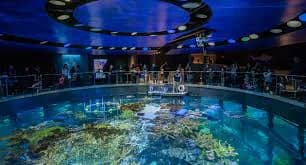
On November 9, Science Department faculty Tom Gagnon brought ten Marine Science semester course upperclassmen on an optional but highly encouraged field trip to the New England Aquarium. Gagnon arranged the trip with his son, a 2017 graduate and aquarium volunteer working primarily with the Giant Ocean Tank. The visit offered students a chance to observe a range of marine life intersecting directly with their class content.
Gagnon encouraged students to wander the aquarium’s 70 exhibits, but the focus of the trip was the Gagnons’ dive into the Giant Ocean Tank, a 200,000-gallon tank of circulating Boston Harbor seawater featuring a micro-reef for a Caribbean habitat. The tank houses over 700 individual animals across over 60 species—many of which Gagnon discusses in his course. From around the tank, students watched the father-son duo descend into the water and interact with a range of marine creatures including Myrtle, the 550-pound, roughly 90-year-old green sea turtle; Carolina and Retread, the two loggerhead sea turtles; and Cirri, the tank’s lone nurse shark.
In addition to showing the aquarium’s most famous creatures, Gagnon pointed out some animals that they had studied in class, namely glass-eyed sweepers and sea anemones. For Gagnon, his dive was a teaching tool. “Seeing someone you know actually in the Giant Ocean Tank gives you a reference point,” he explained. It “always gives students a place to go back to” when working outside the lab. Gagnon, who also teaches Class IV physics, has structured his courses around hands-on learning. His former physics students Will Frazier ‘26 and Eugenie Smith ‘26 both noted that he often used labs as a first step in learning new topics. A large portion of laboratory learning in marine science is what Gagnon has termed “virtual dives,” where students spend class time learning about a new species. The aquarium trip, Gagnon asserted, was intended as a real-world extension of this lab-based approach.
Before the trip, the classes had begun broadly discussing their final project for the semester and had conducted some background research on the New England Aquarium’s online database. Gagnon framed the trip as a “leaping-off point” from which students could use to explore areas of interest for these final projects. Projects may focus on species-specific research, biological themes like camouflage, or aquarium husbandry. The hands-on field-trip experience aimed to help students refine their interests.
Molly Gooch ‘26, for example, learned she was “interested in captive penguins and the aquarium's sea turtle rescue program.” She commented that “the trip definitely focused [her] interest because [she] was able to see what is actually out there.” Theo Edgar ‘27, who will be taking marine science next semester, echoed the excitement. Having previously taken Gagnon’s Class IV physics course, he explained that hearing about the aquarium trip made him even more eager for the semester ahead. “I saw the Instagram post by Milton and heard about the trip from people on the hockey team,” Edgar explained. “It will be really cool to have a teacher who is knowledgeable and stays current in his field. I’m even more excited to take marine science this spring.”
By the end of the Aquarium visit, students had explored the exhibits, listened to aquarium experts, watched Gagnon frolic among the fish, and begun forming ideas for their semester projects. Gooch pointed out this activity as one of the ways Gagnon combines scientific depth, real-world application, and personal connection. “It was really cool to have a teacher so involved in his field,” Gooch said, “it almost felt like a college experience.”
As students begin to think about the focus of their final projects, Gagnon hopes the Aquarium trip may serve as a spark, allowing them to step out of the flat pages of their textbooks into a three-dimensional reality of their studies.