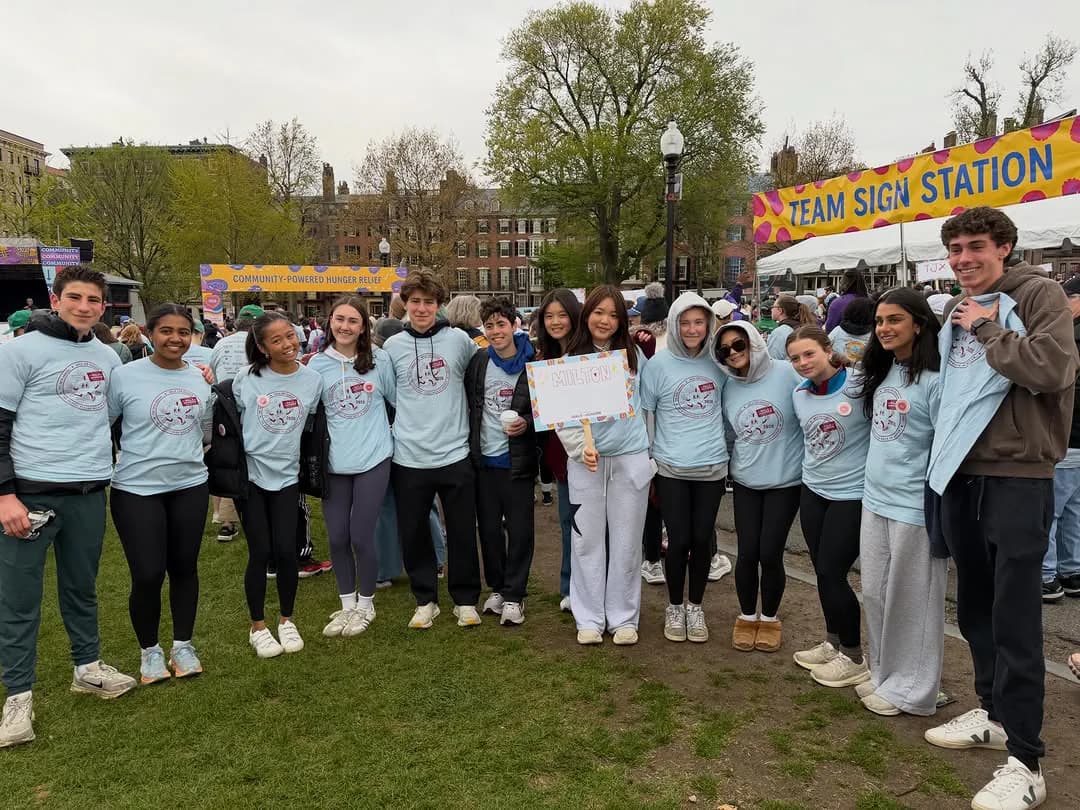
On Sunday, May 3, eighteen Milton students, faculty, and family members participated in Project Bread’s 58th Walk for Hunger to raise awareness of food insecurity in Massachusetts. At the annual event, 3,500 people walked three miles around Boston Common, raising one million dollars for Project Bread, an organization that aims to provide Massachusetts communities with reliable food sources.
The Community Engagement (CEPP) board planned the logistics of Milton’s participation weeks in advance. Co-Head of the Community Engagement Board Emlyn Joseph ’27 said, “most of the planning [centered] around publicizing through Schoology, emails, TV screens in the Stu, flyers, and Instagram posts, and setting up a page on the Walk website for volunteers to register and donate.” Joseph continued that Milton community members raised $540, surpassing expectations and causing the team to “[raise] the donation goal several times.”
The day’s cloudy weather with brief showers added an obstacle for walkers. Angela Breyer Essiam ’28 stated that she “thought the weather did have a big impact,” saying it “really made your mood more negative, because it was going on and off raining, and it was also really cold.” Harper Simoneau ’29, however, did not “think the weather [really] had an impact,” since “the cause was big enough so nobody really minded the rain.” Simoneau also added that the well-planned structure of the event—an 8:30 a.m. sign-in time and the prompt distribution of t-shirts—added to the rain’s insignificance. The early arrival time not only allowed the group to prepare for the meaningful walk around a Boston landmark but also helped them avoid the worst of the rain.
In addition to its fundraising goals, CEPP Board also hoped that students would gain insight and perspective into the experience of food-insecure people. CEPP Board Member Harris Felix ’27 reflected on his own experience in the walk and his hopes for student participants. For Felix, food insecurity is “not something that [he] considers every day.” Because, for Milton students, food is constantly available in Forbes and at home, Felix underlined the importance of having “a larger event like [the walk],” and of thinking about others who "have to think about food and hunger every day.” By participating in the walk, Felix hopes that he and other students will broaden their perspectives and “consider [food insecurity] more often.”
Student sentiment surrounding the walk reflected CEPP’s goals. During the Walk, Gabi Ramos ’28 said she came closer to “[understanding] the resilience and the perseverance that goes along with poverty.” She complimented the high attendance, noting that “many people were willing to gather in the Boston Common.” In addition, she felt that the sense of “unity [at the walk] was really important to [her].” Similarly, Breyer Essiam found the walk “really impactful because it showed the way a lot of people showed up for the Greater Boston community.” Felix spoke further about how “the scale of [the event] really struck [him],” as well as the number of different fundraising teams present. Moreover, Felix highlighted the “stage setup” of the walk and how it allowed people to share “really inspiring messages.” He credits the positive atmosphere of the walk to the fact that “everyone gets excited when we can all come together and support such an amazing cause.”
In addition to the Walk for Hunger, the CEPP offers other initiatives during the year, including the Hunger Awareness Banquet. Reflecting on these efforts, Joseph “[hopes] that volunteers recognize the importance of supporting critical issues that surround our communities.” For future years, Alex Sherman ’27 hopes to increase “outreach to parents and lower schoolers because [the walk is] a really family-friendly activity.” This year’s edition saw “a couple of lower school members show up,” a moment highlighting “the depth of the Milton community.” CEPP board members hope that the event encourages students to participate more in other Community Engagement events and brings them closer to their classmates. Sherman, who has attended the Walk for its last three years, explained that “[The walk] was one of the first ways [he] experienced Community Engagement.” Since the walk spans three miles, Sherman believes it allows volunteers to “get to really engage with the people around [them].”