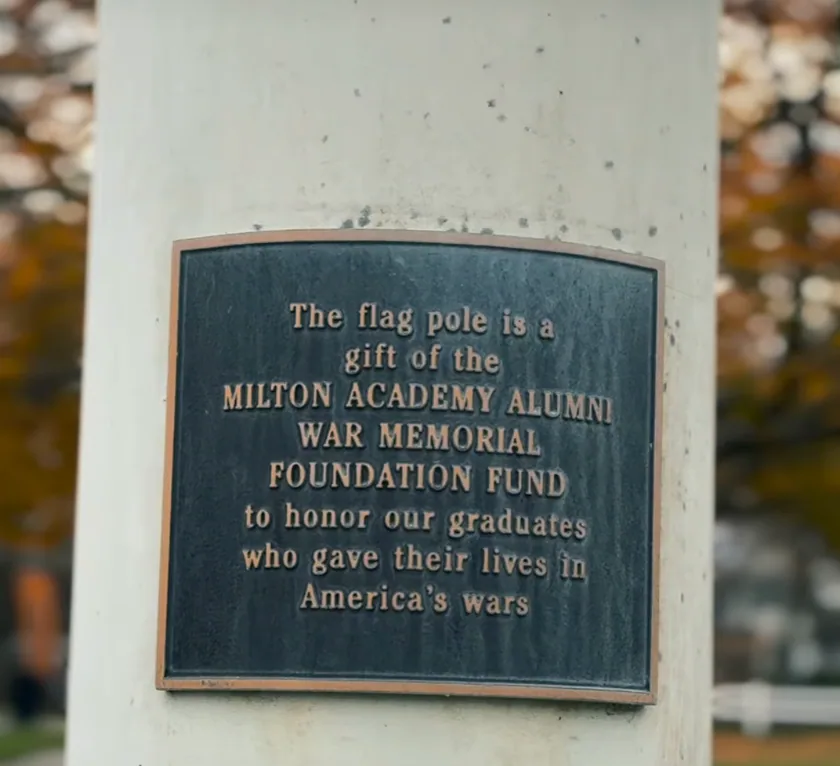
On November 11, K-12 students and faculty gathered near Apthorp Chapel to observe the annual flagpole ceremony honoring military service members on Veterans Day. While most K-12 gatherings are marked by loud displays of school spirit, this one stood in complete silence. “It’s just compelling,” expressed Performing Arts Faculty Peter Parisi, one of the event coordinators.
Due to a special schedule that Tuesday, students had no class until 10:05 am. Academic Dean Heather Sugrue, who coordinated this schedule change, said the late start was necessary so that advisors could meet with families about quarter-one grades. But the change imposed a logistical challenge: transportation. “K-12 buses could only run at normal times,” Sugrue noted, “so unless day students could get a car ride, they had to come to school early.”
After the community surrounded the flagpole and waited for the clock to strike 11:00 am, the chapel bell was tolled exactly 11 times, the number commemorating the end of World War I at 11:00 am on November 11, 1918. Upper School Head Monitors Pati Pogorzelska ’26 and Nemo Sanon ’26, Middle School students Nathan Bah ’30 and Erin Mundt ’30, and Lower School students Anna MacDonald ’33 and Bobo Fomekong ’33 took turns lowering the flag to half-staff. Following the final ring of the bell, buglers Niamh O’Donoghue ’28 and Nora Jin ’28 played “Taps” from the chapel roof. The traditional 24-note bugle call is used at military funerals and memorials. The ceremony ended as the six representatives raised the flag back to full-staff, and students and faculty walked to their next destinations in silence.
O’Donoghue, one of the two buglers, found it “a really special opportunity” to be able to play for the meaningful ceremony. A trumpeter since fourth grade and a member of the Advanced Chamber Orchestra at Milton, she was chosen alongside Jin for their similar skill and tone on the trumpet. O’Donoghue also shared a tradition of Milton Veterans Day buglers “where you use a key to scratch your name onto the metal tower on the roof of the chapel.” She thought “[it was] cool seeing all the trumpeters’ names from the 70’s onward.” The chapel itself also holds historical significance. According to Parisi, “in the Second World War, Milton boys were required to do shifts [on the chapel roof] using binoculars to scan the skies and memorize profiles of enemy planes.”
The day’s programming continued with a guest speech in the Athletic and Convocation Center, where Milton alumnus and veteran Jonas Akins ’97 shared both his experiences and those of Milton alumni who fought in World War I.
“I am really glad the school chose someone who had served and gone through our shared experience as a student at Milton,” said Dylan Chu ’29. “It was refreshing to see someone speaking from the ‘I’ perspective.” Chu added that while he had been part of the ceremony since Middle School at Milton, this was his first time hearing from a speaker.
Reflections on the day vary from both local and international perspectives. Day student Eleanor O’Connor ’29, for example, said that her old public school had a day off on Veterans Day, but due to the lack of “involvement and connection,” they were less aware of the day’s significance. Observing the flagpole ceremony, she felt “special taking part in something Milton’s been doing for a very long time.” O’Connor also suggested that history classes should have a ten minute conversation about the day to help students further understand its importance.
Aruzhan Nugmanova ’28 related the day’s practices to the military traditions she had in her home country, Kazakhstan. “We celebrate May 9, ‘Victory Day,’ the victory of the Soviet Union over Nazi Germany,” she explained. “[It is] a day where we dedicate time to celebrate ancestors—usually grandparents or great grandparents—who passed away on the battlefields. [The day] reflects the idea of appreciation for them as their sacrifices led to our peaceful lives today.” Nugmanova said that her home tradition, too, incorporated moments of silence while also holding public performances of songs about victory.
Sugrue and Parisi, both Milton faculty members for over two decades, hold gratitude toward the tradition. Sugrue appreciated “the fact that it is held in complete silence when there [usually] is not much time to pause in remembrance.” Parisi expressed he is glad that, of the “so many traditions [that] have gone away throughout [his] time at Milton, this has been passed on.” He hopes that students, as they take part in this “uniquely Milton” ceremony, “can hear the bell toll and feel the power of all of us together in silence.”