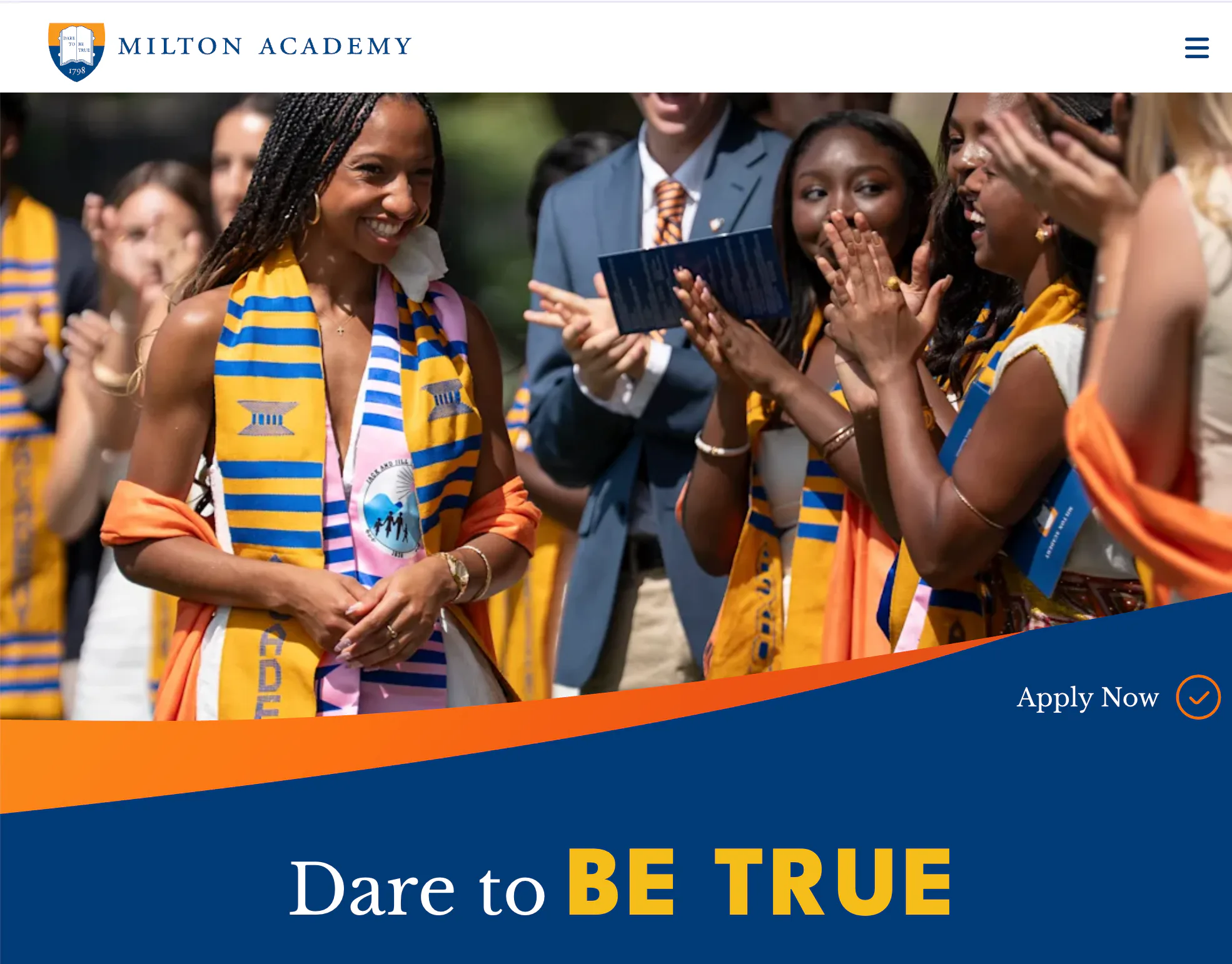
The 2026 Convocation included a speech from Head of School Alixe Callen ’88 with her iconic line: “My favorite word is community.” Accompanied by various synonyms, Callen used this word several times throughout the speech, each example building upon the concept of simultaneous unity and authenticity. Less than four hours after the ceremony began, several photos were posted onto Milton Academy’s official Instagram with an incredibly suspicious caption. The three paragraphs contain generative artificial intelligence patterns, including the unmistakable phrase: “School connectedness isn’t a nice idea. It’s the whole point.”
When asked whether the school used AI to generate Instagram captions, Chief Communications Officer Eileen Newman stated that the Communications Office “[does] not cut and paste AI generated captions into [their] social posts.” She explained, “it is important that we are writing our own captions so that we are capturing the 'Milton voice' in our work.” Then again, she acknowledged that the Office does “occasionally use AI to spark ideas or as a training tool for new or junior members of [the] team to help them learn how to include important institutional messages and not just logistics in our posts.” Newman also mentioned that Milton frequently shares content from the over 100 student Instagram accounts. She wrote that, in her experience, “student accounts quite often use AI's design tools to help create more interesting graphics than what they might be able to make on their own.”
Nevertheless, when I scanned the three most recent Instagram captions that were not reposted from student accounts through GPTZero, all three times, the source predicted the writing to be 100% artificially generated. According to research conducted by Felix Stuart ’27, the Milton Academy official website contains 786 em dashes in the context of writing, excluding news articles; of the 199 pages, 193 contained at least one em dash. A 2026 McGill University Office for Science and Society article, citing independent researcher E. M. Freeburg, reported that GPT-4.1 used em dashes 3.28 times as frequently as human writers in standard essays.
The teachers of Milton Academy have made their perspective on artificial intelligence unequivocally clear: in the first week of school, I received two articles from history teacher Nicolette Gable about AI-use regarding assignments.
“These will not be two conflicting opinions,” Gable said, “because I feel the need to represent only one side of this issue.” I was assigned a handwritten in-class essay for English to prevent AI use. My chemistry syllabus noted that AI removes the dynamic of creativity from the course. Even beyond academics, cross country coaches compared advice from a machine to advice from a human and concluded that models lacked the same raw experience as people. Perhaps unintentional, yet ever-present, artificial intelligence is something the school seems to inherently mistrust students with.
Thus, when I opened my social media page to find an Instagram caption abundant with AI hallmarks, I was disappointed to see the post was made by my school.
We are expected—as a community—to be unified in our approaches to AI. This expectation is equally applicable to each community member, including those who set it.
Admittedly, a student forging work possesses a different impact than an adult generating captions. But frankly, the purpose of prohibiting artificial intelligence extends beyond educational benefit. Bret Stephens’s New York Times article “I’m Begging You: Never Write With AI” advocates against artificial intelligence usage, especially for mundane tasks. Most will agree that AI has no place in writing one’s wedding vows, but few are prepared to end its use for repetitive, redundant writing. In the words of Penn Fellow and English teacher Julian Spiro, “If there is no thought behind the writing, what is the purpose in writing it?”
Furthermore, the primary fault of artificial intelligence is frequently not the quality of its output but the dearth of authenticity it possesses. Each time we use AI, irrespective of whether it is for major assignments or Instagram captions, its replacement corrodes our own voice. AI steals our opportunity to show the world who we are and therefore evolve—through individual words, mistakes, and nuances. AI takes away from us in the moment but also as a person.
Beyond the injustice of the Milton administration’s hypocrisy lies the impossible expectation currently placed on students. Why does artificial intelligence undermine authenticity in education but not other areas?
English Department Head Jessica Bond confirmed that all use of artificial intelligence is banned for Class IV English students, a ban that includes the generation of grammar practice. This standard is difficult to enforce, difficult to follow, and impossible to uphold without unanimous commitment. Had one of my classmates used an AI model to study last year, I likely would have fallen victim to the same trap. After all, justification of our wrongdoings is easier when we have others to share the penance with.
But what happens after we share our transgressions with the very body that ratified their banning? We have lost sight of accountability. We have lost “community.”