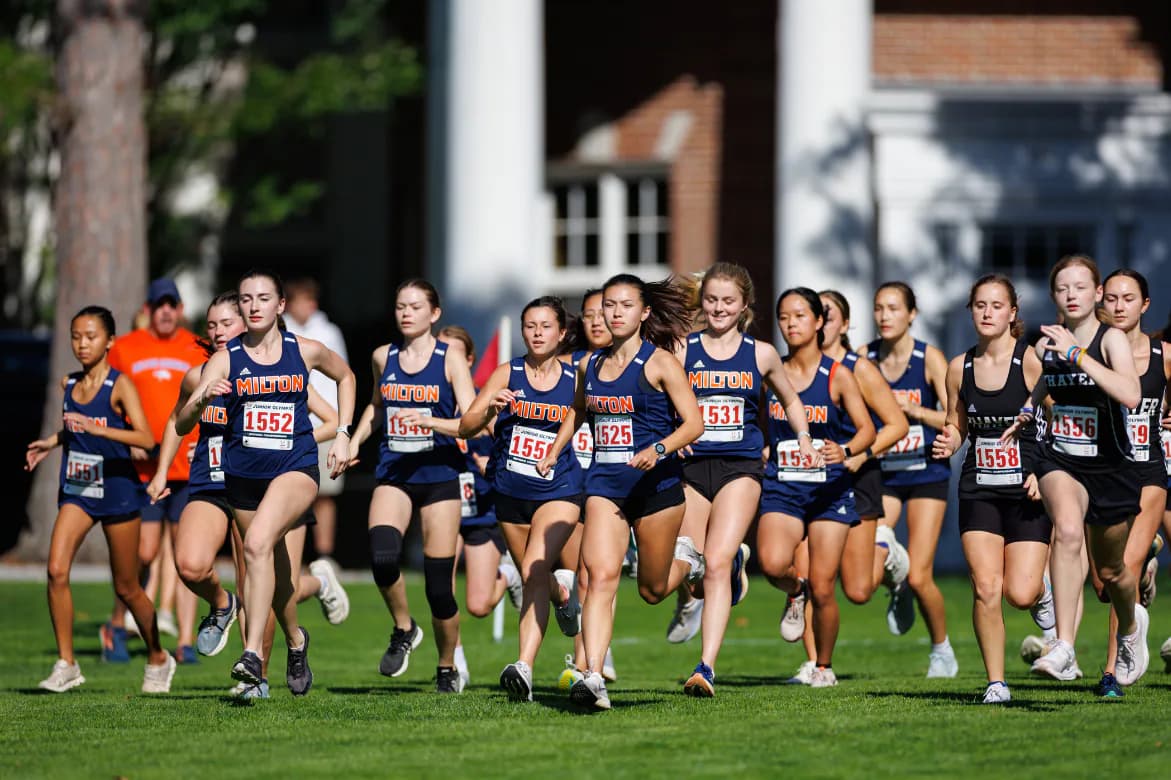
According to the popular college-connection website Niche, over 50% of polled students and parents consider Milton a competitive environment, and reasonably so. Students vie for leadership positions, aim for higher grades than their peers, and generally look to “be the best,” whatever that means. Still, we feel like we don’t do enough—as The Milton Paper’s State of the Acad reported in 2025, 82% of respondents felt academically insecure at least rarely, despite 80.7% having an average grade of an A- or above. This imbalance begs the question: to what standards do we compare ourselves, and how should we set them?
Interpreting the concept as threatening or divisive, we often look down on any spirit of competition. For example, instead of grading systems like the bell curve, many students prefer to receive scores based on a fixed rubric or other systems that allow everyone to receive a high grade. We might refuse to share grades to avoid competitive comparisons or remain silent about major awards to maintain an easygoing atmosphere. Even many faculty members, who frequently ask students not to reveal their grades on specific assignments, reject any notion of academic competition.
Nonetheless, an atmosphere of academic and athletic competition still lingers throughout Milton, as one would expect in any preparatory boarding school.
However, assuming that this competitive environment dampens the community’s bond would be misguided. Milton offers an academically motivated community that favors friendly encouragement rather than flagrant, angry rivalries. This encouragement, of course, stems directly from a culture of well-intentioned competition. Exposure to this kind of friendly, competitive environment pushes us all to be better and work harder; for example, we might choose to try to outcompete our peers on a test instead of resigning ourselves to a mediocre grade, and our education would benefit from that extra effort. Many a time in my math classes, for example, I’ve chosen to partake in friendly competition, after which the grades of both me and my friends significantly improved. One time, I even proposed a mutually agreed-upon, low-stakes bet with a friend on the multivariable calculus midterm. While I missed out on five dollars by getting a higher grade, I’m happy to say I won a sizable portion of dignity. However it turned out, I studied harder than ever before for that midterm.
Our current society has made this competitive urge a natural part of our day-to-day lives. Just as business corporations compete with one another for a better market position, we now battle for top grades, sports accolades, and academic validation. Although these competitions may seem divisive, they ultimately formed an even tighter community. Through competition in the industry, business corporations transform rivalry into notable benefits. For instance, companies facing competition are often forced to innovate their products, improve efficiency, diversify their manufacturing, and enhance overall quality. In today’s academic domain, albeit with lower stakes, we students hone our skill set toward the ideal through competition with others, and by contributing these refined skills to the school around us, we create a richly talented and diverse student body filled with purpose.
We all see signs of this relentlessly competitive philosophy—from club leadership positions to academic classes—but we also see its positive effects in an engaged and collaborative student body. When one person aims high, their friends—and by a domino effect, their community—aim high as well: not because we feel animosity towards one another but because we feel exactly the opposite. Seeing that community members value success in whatever capacity, we impart that same drive in ourselves and thereby form a connection that holds us all together. As Raphy Rufino ’27 added, “I feel more inspired when I see my peers excel academically, and it motivates me to work even harder. It makes me realize that if they can do it, I can do it too.”
I neither suggest that we embrace a toxic culture of social or academic validation nor posit that we constantly chase a mindset of comparison. I simply ask students to consider the vast merits of collaborative competition, which we so often dismiss as a trait of an unhealthy academic environment. Instead, competing fosters a healthy scholastic climate.
In a world where we excel by merit and constantly watch others’ successes, we must compete not to tear others down but to support the collective improvement of our communities.
So, the next time your classmate scores higher than you on an exam or your friend applies for that Co-Head position, follow in their footsteps. Compete. Push them to do better. The world—and your friendship—will improve from that competition.