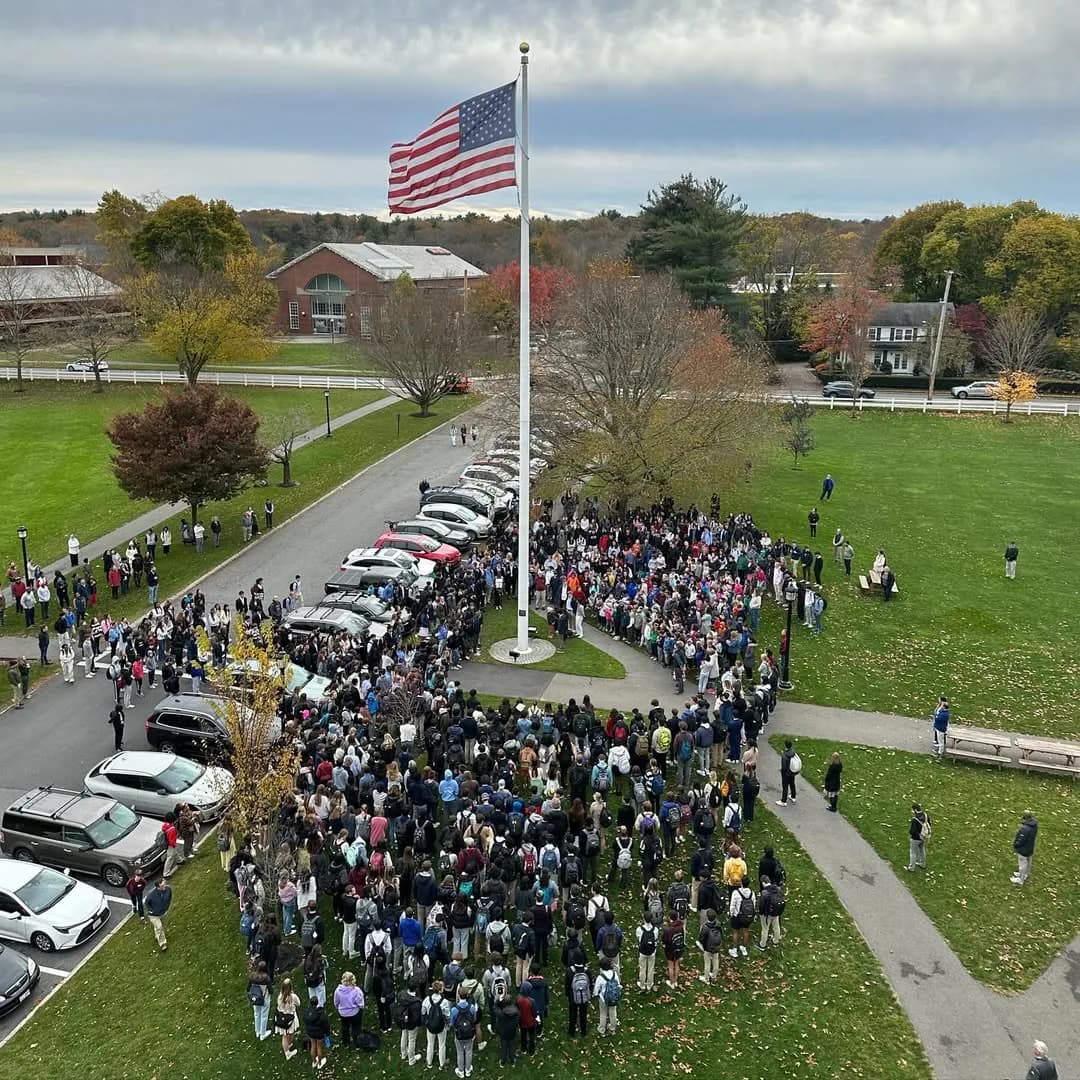
Every year, on November 11 at 11:11 am, the entire Milton community gathers outside the chapel to commemorate Veterans Day. The moment is profound; in shared silence, the community becomes one, united by reflection and tradition. Yet as I stood there this year, participating in one of Milton's most spiritual and grounding rituals, I realized something surprising: I could not recall the last time I had been inside the chapel.
Perhaps, tucked away on Milton’s campus like the chapel itself, religion has been pushed to the margins. That realization raises a larger question worth examining: What role do spirituality and religion play at Milton today, and what role should they play in the Milton experience?
In recent years, there has been a noticeable shift away from religion as a central part of the Milton experience. Before COVID, boarders convened weekly for a non-denominational service to mark the start of each week. Suzanne DeBuhr, previously the school’s last chaplain, transitioned to her role as Director of Restorative Justice in 2020. According to DeBuhr, the school discontinued its ethics course—formerly a requirement for all seniors—sometime in the 1990s, due to changes in the school schedule that arose for a variety of reasons, which DeBuhr could not name because of the frequent nature of schedule changes.
Part of the shift away from religion was merely logistical: large-scale congregating stopped during COVID and the increase in the size of the boarding community made it nearly impossible to fully congregate in the chapel. There was also an intentional shift: “The demands on student time outside of Milton no longer make it possible as time and energy are spread in other places,” DeBuhr explained. Moreover, DeBuhr and Upper School Principal Rachel Stone reflected together on the challenge of a school-sponsored service with an implicitly Protestant identity. For some students, they noted, that expectation felt harmful and divisive. “We want to have spaces for students seeking the time and space for religion, reflection, meditation, and spirituality,” they said “but we want our students to initiate this, not to force it on them.”
While Milton has moved away from these practices, other schools have continued to lean into the spiritual side of life, even as they too have evolved beyond their explicitly Christian groundings. Groton, for example, begins four weekday mornings with a chapel service grounded in the Episcopal Christian tradition but having evolved to promote inclusivity for all faiths. The service intends to “strengthen the sense of community and offer stillness and reflection before a busy day.” Taft similarly asserts that “education is both an intellectual and a spiritual endeavor… and that a sound, broad-based liberal arts education has, at its core, the quest for meaning and purpose.”
That said, Milton should not copy Groton’s nor Taft’s model. The transition away from a required boarding service and a formal ethics class was aimed to meet the needs of a more pluralistic community. But it has also resulted in the loss of shared context and a sense of spiritual community. Without a spiritual base, no matter how much we pride ourselves on strong academics and extracurriculars, we are less grounded as a community and miss a dimension of connection.
In his farewell column in the New York Times, David Brooks writes about the idea of a “secure base.” He argues that every life is a series of “daring explorations” rooted in a foundation that is emotional, material, and spiritual: “Part of that base is emotional — unconditional attachments to family and friends. Part of that secure base is material — living in a safe community, with a measure of financial stability. Part of that secure base is spiritual — living within a shared moral order, possessing faith that hard work will be rewarded, faith in a brighter future.” He suggests that “every healthy society rests on some shared conception of the sacred — sacred heroes, sacred texts, sacred ideals — and when that goes away, anxiety, atomization and a slow descent toward barbarism are the natural results.”
Milton excels in many areas of the emotional and material base: friendships, support systems, and academics. But when it comes to a spiritual base—a shared moral language, a common space for reflection—we feel more scattered. We have individual clubs, affinity groups, and informal conversations, but we have few school-wide structures that invite us to pause and reflect what we value as a large family. Milton should seriously consider the spiritual questions that quietly shape our lives. What do we owe to one another? What kind of people are we trying to become? What do we consider sacred?
We could begin, modestly, by creating more regular, optional spaces for reflection in the chapel—moments of silence, student talks, interfaith observances, or guided discussions on meaning and ethics.
We could revive an ethics or philosophy requirement that focuses on moral reflection in a pluralistic way.
If Milton is willing to invest in this kind of spiritual infrastructure as a commitment to shared reflection, we can become a place not just of high achievement, but one that offers students a secure base of purpose, community, and care.