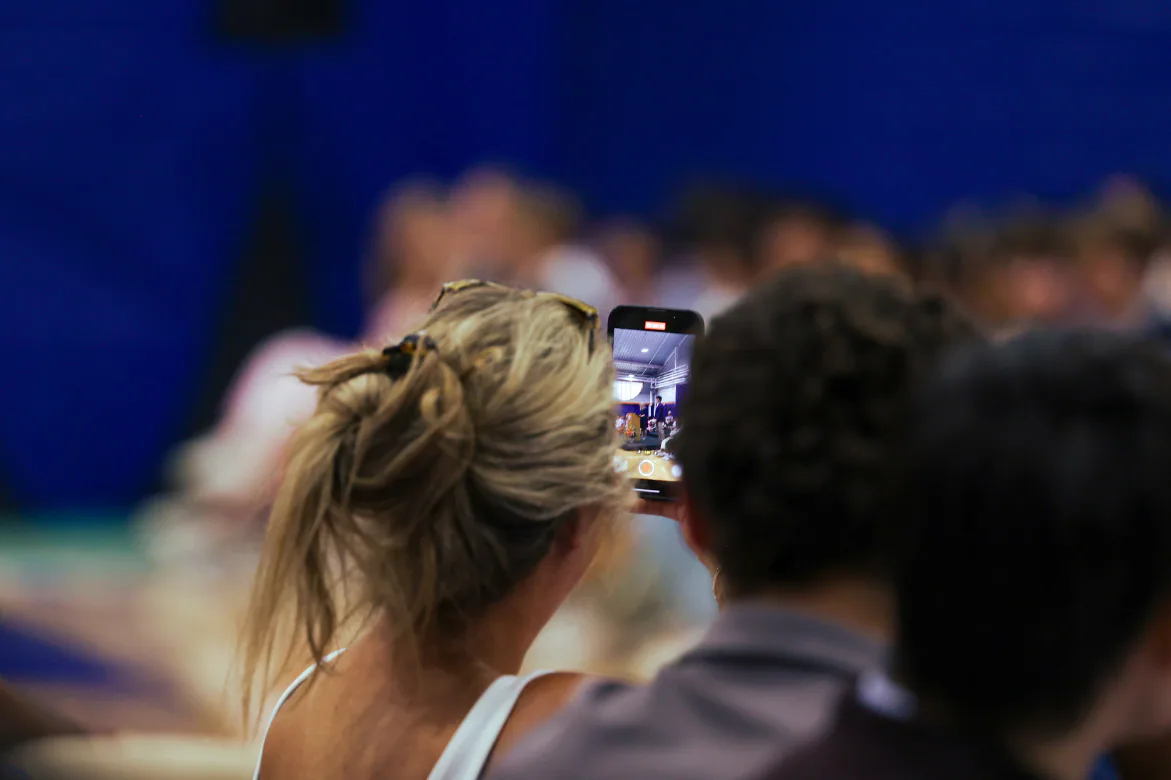
In Stables on Monday, I rushed in a couple minutes late after finishing a last-minute biology reading. As I set my bag down and looked up to the announcement slideshow, a QR code stared back at me. Scanning it—with my phone, of course, along with everyone else—led me to a Google form and a brutal realization that administrative conversations on a possible phone ban were getting serious.
The administration has gotten one crucial thing right so far—student input. But the committee’s considerations still remain distanced from both the student experience and the quintessential role of technology for the younger generation, which most adults seem to find foreign. First, a logistical argument alone could easily dismantle any possibility of a phone ban. Personally, I don’t have the mental capacity to memorize my schedule, so Google Calendar, easily accessible from my phone, guides me throughout the day, especially during all-too-common schedule changes. Using their phones, students have quick access to Gmail and Schoology—both places where quick announcements about schedule changes, reminders about class materials, and brief assurance of homework completion abound. Of course, a counterargument would propose computers as a substitute, but stopping to take out a laptop after every class, lunch period, and assembly will provide more distraction, tardies, and social isolation than brief phone usage for three minutes maximum between periods. It’s frankly laughable to ask students to check a computer inside a mob of students after a USP, and even more laughable to propose paper schedules, which allow no room for frequent room changes and fail to teach students the crucial skill of working with technology.
This last caveat draws me to my next argument: a blatant fear of technology that truly disregards the present in an attempt to cling to the past. Technology like social media, texting, web-surfing, and online games have drawn so much demonization in the past years, with 64% of American adults viewing social media negatively and only 10% relating it to positive outcomes, according to a 2020 survey by the Pew Research Center. Some of these claims have grounding in reality, but a proposed link between technology and social isolation, one of the most prominent arguments against phone use, has no proven causality. As a particularly large 2025 paper spearheaded by Valerio Capraro found by examining over 1,400 other studies, harms like social isolation, perfectionism and attention loss might be unrelated to social media use. A rejection of phones also ignores the social reality of the present day: while students’ interactions online might not be physically social, they encompass widespread communal socialization and propel friendships forward with a non-physical presence. Since the pandemic, virtual experiences have permanently annexed part of the younger generation’s social environment, and this change has expanded possibilities for connection instead of shrinking them. Spaces like texting, social media, YouTube, and video games enable colossal environments for expanded social interaction between friends, family, and even strangers. The hesitance of many adults to embrace these changes speaks volumes about their static understanding of this new world that gifts agency to children and teenagers instead of limiting them to the slow-moving molasses of the past.
Technology opens channels of communication to family and may often be the only way to reach loved ones, especially for international students, who represent 18% of Milton's student population. For Panshul Purusharthy ‘27, whose family’s time zone is eight hours ahead of Boston’s, the only time to reach his parents is before 1:00 p.m., and taking away his phone would effectively remove all contact with his parents. Although there are computer-based alternatives to this problem, phones allow ongoing, accessible, and convenient communication with family during activities like lunch or walking to class. These moments may sound trivial, but in such busy schedules, every second with a loved one counts.
Many students struggle with this issue. Even as a day student, I rarely see my family due to tight work and school schedules, and texting my dad on his lunch break or sending a Snap to my brother during his recess gives us a treasured glimpse into one another’s lives. While many would propose that I do these things on my computer, they ignore that some students like me do not have MacBooks and thus cannot communicate over text without a phone. Also, I try to avoid apps like Instagram and Snapchat on my computer so I don’t get distracted while trying to work.
Another concern Purusharthy brought up was the ban would impact boarders’ ability to immediately contact an “advisor, dorm staff, Campus Safety, or the Health Center” in emergencies. The rarity of these disasters should not dissuade their consideration due to their severe gravity, and they are more common than people think. Twice, I’ve experienced truly frightening allergic reactions on campus that limit my ability to move around, and although I was with friends both times, I shudder to think of what I would do asphyxiating alone in a bathroom without my phone.
Finally, a possible phone ban reeks of social engineering, an unavoidably authoritarian tactic. Social engineering refers to the shaping of a society’s social fabric by an authority, a prospect that unavoidably afflicts the pro-phone ban argument. After realizing that teachers, who should maintain their teaching autonomy anyway, would not allow wayward phone usage in class, proponents often resort to a loathing of the supposedly failed social system at Milton, where many students scroll in the Stu, text during lunch, or play Clash Royale in their free time. They argue that we should not accept this level of disconnection from the community, but who decides what the social environment should look like? Why should one friend group’s preference for screen-free interactions impede another’s for Clash Royale? This sort of social engineering would be a disgusting overreach by the administration seeking to warp a social fabric it does not understand to its liking. The beauty of law is not that it aims for a perfectly conforming society where everyone has the same “good” behaviors, but rather that it prioritizes personal freedoms over supposed scientifically-proven morality. Sugary desserts, for example, may cause harmful addiction if overconsumed, but we do not outlaw eating them, because doing so would damage individual agency just as a phone ban would revoke students’ agency here at Milton.
Phones are a part of our world, and being scared of them will only limit technological literacy and agency. Please, let high schoolers text our parents at lunch, Snap our brothers in the library, check our Google Calendars after class, play Clash Royale with friends, be assured that we would be able to call 911 in case of disaster, and sit in our classrooms ennobled, knowing that our agency is respected.