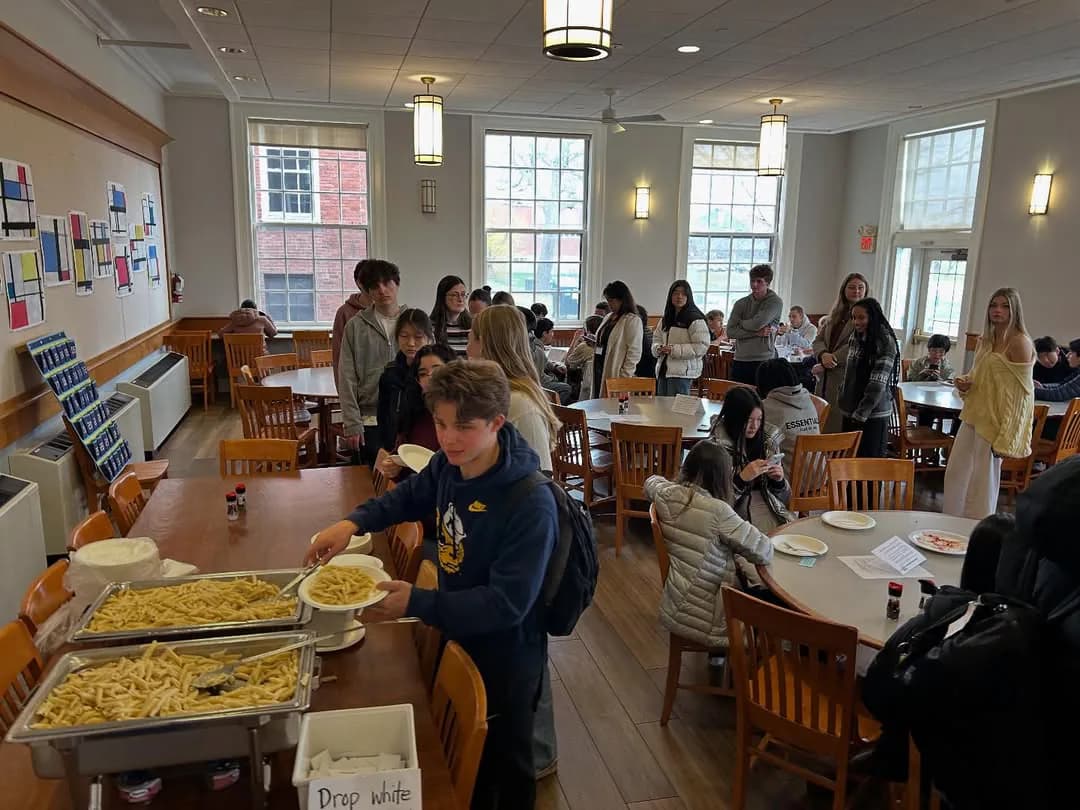
I march into Forbes Dining Hall. After two Community Engagement Board members greet me, Community Engagement Programs and Partnerships (CEPP) Director Andrea Geyling-Moore hands me a ticket. Geyling-Moore diligently guards a Great Wall of culinary accessories separating the simulated income classes.
Half the tables in the high-income section remain empty. While the conversation at my table begins by questioning our privilege, it soon melts into jokes about “L’Hôpital’s rule,” or the “Hospital” theorem, in Calculus. Other sections’ smiles suggest similar tangents in conversation.
In contrast, students clump in the Stu like schools of fish. Accusations of DoorDashing flow across the space, but no one dares confess. However, I soon notice Chipotle on a tall table. Atop high chairs, above all others, four smirking faces indulge in laughing chatter between bites of nutritious burritos. A neon jacket blinds me with its white, glossy black, and radioactive pink over the blue-gray floor. Their privilege contrasts the uglier reality simulated in Forbes. Their eyes shoot at me. They decline to comment. I leave.
According to Head of School Alixe Callen ’88, who helped run the event during her time at Milton, students have run a Hunger Awareness Event for four decades. This year, Financial Aid at Milton (FAM), an affinity space for students on financial aid, collaborated with the CEPP board, which handled logistics, to organize the event. Ration ticket divisions reflected wealth distribution: 60% low-income (pasta), 30% middle-income (pasta and sauce), and 10% high-income (regular Forbes meal).
Callen believes that the event “[promoted] empathy” and “conversation” while grounding our usually “abstract” model of food insecurity in physicalized reality. Echoing this statement, CEPP Board Co-Head Rhia Patel ’26 remarked that the event allowed us to leave “the Milton bubble” and acknowledge our “privilege.”
However, the Hunger Awareness Event missed these goals; in fact, it unintentionally failed to confront food insecurity, indoctrinated us with oversimplified world dynamics, and insulted community members.
Firstly, while Callen believes that the “inconvenience” some students felt forced them to confront food insecurity, DoorDash removes that annoyance—for students able and willing to pay. Of course, as Callen said, DoorDashing further demonstrates inequality. The Chipotle cradled by the hands of those students mentioned above, for example, radiated nothing but privilege. However, in their flaunting of wealth, DoorDashers insulted the food-secure through a blatant disregard of the event and a refusal to confront the issue.
In addition, the event also incited insensitive remarks. I hear students toss around comments like “why can’t you just DoorDash?” which blatantly disrespect the reality of food-insecure individuals, including community members who walk our halls. Furthermore, when many chose not to eat the “poor” food—over 100 students did not participate—we implicitly degraded the meal as below our standard, an affront to those who eat such food regularly.
Even for those who wholeheartedly participated in the event, the Hunger Awareness Event still confined them to the Milton bubble. Instead of allowing us to observe local food insecurity, the event merely created an inaccurate simulation on campus. This simulation oversimplified socioeconomics, risking indoctrinating us into certain beliefs: since the event rendered the distribution of “food wealth” static—the probability of getting low, middle, or high quality food could not change—the event implied that we could not increase average “food wealth.” Furthermore, the nutritional value of low and middle income meals was constant: pasta is pasta, regardless of the middle income’s added sauce. Thus, the Hunger Awareness Event implicitly blinded us to the possibility of wealth creation, which refers to building wealth through long-term financial planning. The idea that average “food wealth” is somehow immutable suggests that to help the poor, society must take from the rich. Hence, the Hunger Awareness Event’s oversimplification suggests a Communistic-style wealth redistribution as a solution—a divisive view whose promotion is questionable.
Both of my parents were born in Communist China during Mao’s Cultural Revolution. Similar to the event’s structure, they received tickets in their youth—tickets that rationed rice, meat, eggs, and milk in a systemic lack of nutrition that my dad blames for his lower height.
To grant their children—me and my little brother—a better life, my parents studied hard for the Gaokao, China’s college entrance exam. On the merit of their score, my mother and father went to Peking and Fudan University, two of China’s premiere universities, respectively.
At Fudan, my dad studied diligently to attain a coveted international student visa, and he graduated first in his class. As my little brother memorizes vocabulary for the Independent School Entrance Exam (ISEE), my dad recounts how he memorized the entire English dictionary to score higher on the Test of English as a Foreign Language (TOEFL).
Both of my parents had to acclimate to America while working to pay for graduate school. Even though luck certainly influenced their success, their hard work is undeniable. My parents worked hard so that my little brother and I could have more opportunities and a better livelihood. They worked to prevent us from experiencing the rations of their youth.
However, the Hunger Awareness Event forced me to regress to those chaotic times. While one day may have only inconvenienced others, it denied the always nutritious plate which my and other students’ parents labored to provide.
Despite its flaws, Geyling-Moore, the CEPP board, FAM, Aramark, Forbes staff, and others all put significant effort into the event. The event donated over $1,500 to address food insecurity—though compared to the approximately $75,000 upper-school tuition, this amount is negligible. Beyond figures, students engaged in impactful conversations—both this year and four decades ago, according to both Patel and Callen. But because some students are circumventing the event via DoorDashing and dealing microaggressive comments about the food-insecure, and because the event oversimplified society into divisive ideals, the Hunger Awareness Event is not succeeding.
We must feel food insecurity. Instead of the Hunger Awareness Event, we should do a hunger-focused Community Engagement (CE) day. For example, Gabriel Galva-Diez ’28 suggested that the Upper School go into Boston to directly help families facing food insecurity, perhaps by helping food pantries or soup kitchens. During the frigid winter months, families especially need warm food, Galva-Diez said.
In addition, the total value that the school could give in a 3-hour service day. Valued at $15 per hour by the Massachusetts minimum wage, the work of our 714 students’ amounts to $32,130 worth of assistance, twenty times the $1,525 from dining-hall savings.
Vivid, real-world experiences make our abstract conversations on hunger concrete and capture intricacies that no simulation can. Furthermore, once we have a personal connection to someone facing hunger, none of us will dare insult the food-insecure. Instead of feigning empathy, let us face real hunger directly through a hunger-focused CE day.