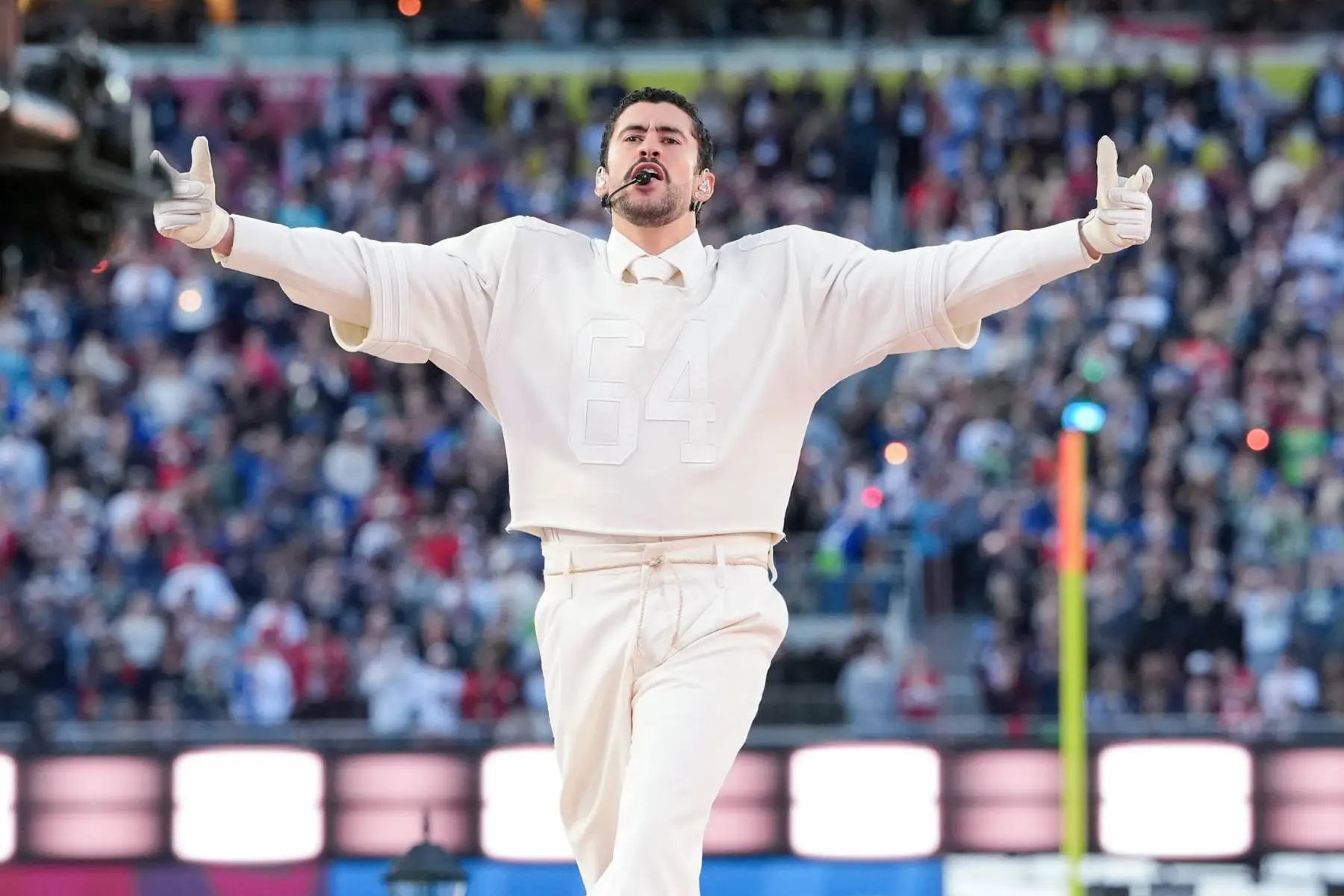
Puerto Rican Music Artist Bad Bunny made history on Sunday, February 8, when he took the Super Bowl halftime stage with the first entirely Spanish-speaking performance in the event’s history. The show flowed seamlessly from early hits like “Yo Perreo Sola” to more recent releases like “DtMF,” blending rhythm and identity into a vibrant celebration of Puerto Rican culture.
The stage design echoed this pride, featuring traditional elements like piragua stands and coco frío served in fresh coconuts—an ironic contrast to the glass bottles of the event’s major sponsor, Pepsi, a hallmark of corporate America. Each vending stand in the beginning of the performance reflected the hardworking Latino community in America, challenging the right-wing media which paints them as illegal criminals. In each detail, the performance radiated cultural authenticity and defiance, promoting love, not hate.
Despite his powerful performance, the initial announcement of the event received harsh criticism. Just a week earlier, Bad Bunny received three Grammys yet attended wearing a bulletproof vest out of concern for potential political violence. Critics argued that many would not understand his lyrics, and some went further, questioning whether a Puerto Rican could represent such a quintessentially American event and exposing a concerning ignorance surrounding Puerto Rico’s status as a territory of the United States. Alissa Rabin ‘29, a Spanish student and devoted fan, acknowledged the divide: “I’m very excited to have him as a Super Bowl performer. However, I can see where some people have an issue with it.” This wave of criticism may at first seem natural given the lofty expectations of the public, but this discomfort is telling. The issue is deeper than football or language—it is about which Americans are considered worthy of celebration on one of the most watched stages.
From a more corporate perspective, the choice by the National Football League (NFL) was bold but strategic. The event guarantees a crowd of avid football fans, but the halftime show poses an opportunity to extend beyond them. Football player Johnny Heller ‘29 stated that “[Bad Bunny] is fairly left wing and I think people are trying to make it a political statement, but for me, it’s the music that matters.” His sentiment captures the NFL’s gain: appeal across a variety of demographics and even past international borders. As Hannah McComb ‘29 observed, “Many of my Argentine friends who would otherwise never watch the Super Bowl are now planning to for the first time, and I’m excited to share this event with them.” In embracing an American artist with Latino roots and global reach, the NFL has expanded its influence and provided representation rarely seen on its stage.
Bad Bunny’s performance also challenged assumptions about language and emotion within music. Guest appearances bridged cultural gaps: Lady Gaga’s salsa-style rendition of “Die With A Smile” demonstrated how Latino style informs United States pop, while Ricky Martin’s “LO QUE LE PASÓ A HAWAii” carried a deeper message of grief, loss, and resilience rooted in colonial history. Strings Teacher Wilson Bernadette reflected, “There’s something inherent about music that allows you to connect with it, and removing words removes the barrier of immediately trying to figure out the meaning of the lyrics [to] instead focus on the music.” The variety of synthesizers and instruments used in his music also provided ample opportunity to interpret the emotion in his music, though others state that it can be misleading. Adair Johnson ‘27, for example, remarked that “‘DtMF,’ or DeBÍ TiRAR MáS FOToS is stylized to sound super happy, but the lyrics are actually a tragic ballad about loss, and ‘LO QUE LE PASÓ A HAWAii’ does a similar thing. They have such dual natures that I sometimes play them as hype songs to energize me and sometimes play them as sad songs.” Still, the style serves as a metaphor for the optimistic creative expression growing out of negativity, just like the show’s final message on a background billboard: “The only thing more powerful than hate is love.”
The debate surrounding Bad Bunny’s Super Bowl halftime performance, or “El espectáculo de medio tiempo del Súper Tazón,” performance exposes a national truth. The resistance to accept Spanish on America’s largest stage—a language that around 20% of Americans speak according to a 2017 article in The New York Times—isn’t a rejection of language but rather a rejection of inclusion. His performance redefined which voices and cultures in America are allowed to be celebrated and reminded viewers that American identity stretches beyond familiar faces and the English language.