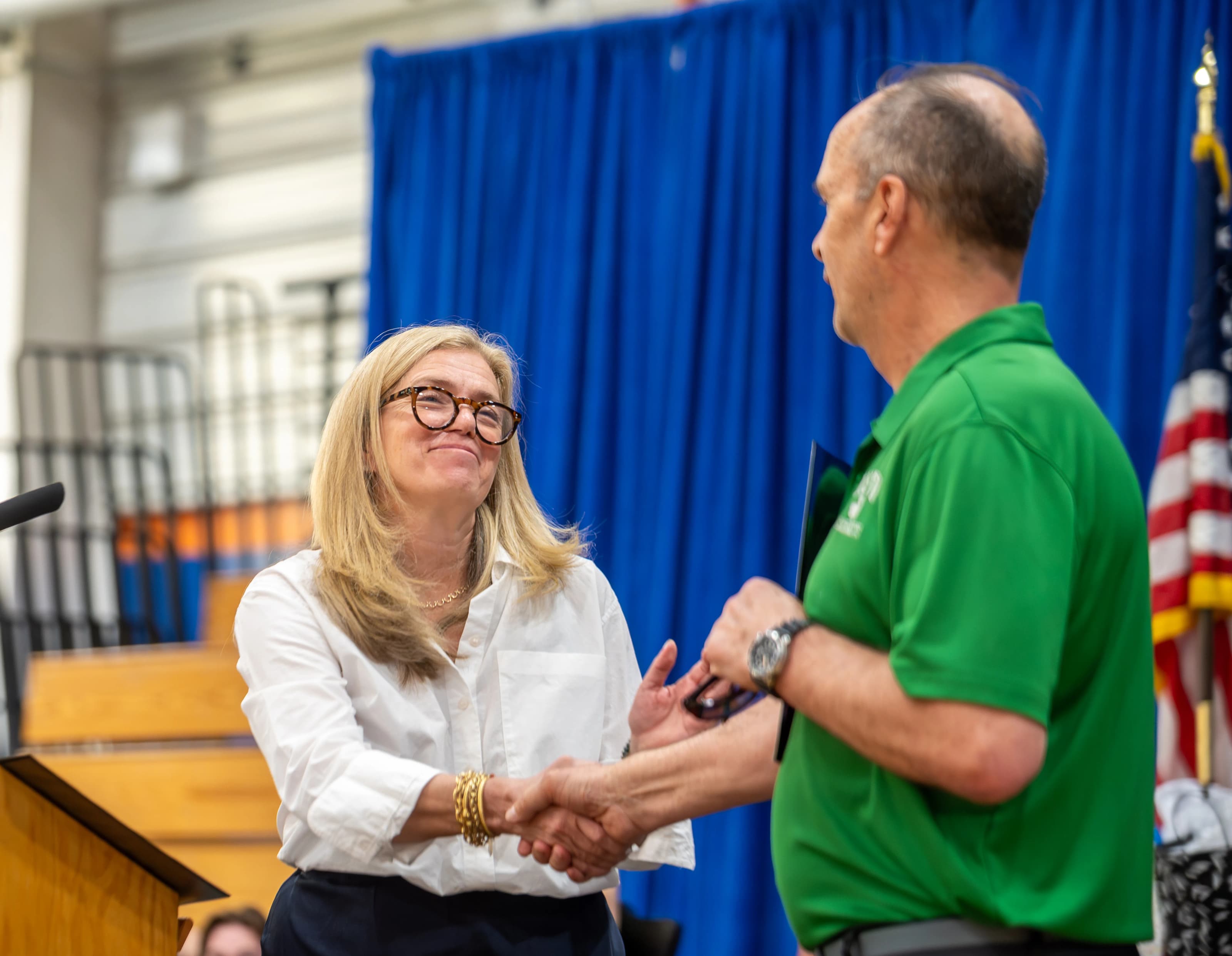
Clap clap clap. Like robots, we clap even as our hands go numb. For the hundredth time, another teacher gets on stage, opens their folded paper, and reads about a student’s accomplishments. The awardee walks up, claims their goodie bag, and sits back down. Clap clap clap…
Soon, Head of School Alixe Callen ’88 walks on stage in front of a tired crowd of kids in suits and dresses. But as she awards a teacher for his human service, the words of a robot come off the page: Science Teacher Tom Gagnon “leads not from the front of the room, but from within the work itself, and students feel the difference”; “Not because he has to, but because that is who he is, someone for whom the entire school is his community.”
Every year, Milton hosts the Prize Assembly to celebrate faculty and student achievement through awards like the Talbot Baker Award, which Gagnon and a few other teachers received for their exceptional teaching, and the Head of School Award, which honors certain Class I students who have shown traits such as self-sacrifice, leadership, and integrity.
However, we suspected that AI may have entered the writing process for Gagnon’s Talbot Baker Award speech: Pangram, which has a one in 10,000 false positive rate, reported 100% of the text as AI. Other AI detectors such as ZeroGPT and Grammarly also flagged significant portions of the text.
Callen, when interviewed, explained that the speech writing process begins months ahead of the speech with nominations from faculty and staff. The “administrative staff ” then collect these nominations, which include the nominators’ reasons for proposing a particular individual and any supporting anecdotes, according to Director of Communication and Media Relations Esten Pérez.
“Last year, AI was used to organize all the source material from multiple nominators [by] grouping similar themes together for the encomia,” Pérez said, referring to the award speeches.
Then, a team of several people—including those close to the recipient—collaborate to write the tribute speeches.
When asked whether AI was used to generate text for the Talbot Baker Award speech, Chief Communications Officer Eileen Newman neither confirmed nor denied; she said that the writing team has “no way of knowing how those materials were drafted or whether or not AI was used in the individual submissions.”
Finally, the Communications Department completes a final review of the encomia, and Callen said that she saw the speech only on the day of the Prize Assembly.
At first, we may see AI use for the Prize Assembly speech as an example of the administration lacking human care in their writing. Rather than a thoughtful, human message for the awarded teacher that expressed Milton’s deep appreciation of his service, AI’s role in the writing created a generic message: the three sentences in the introduction lacked substance. That a human did not put in the effort to reciprocate this teacher’s efforts exhibited a lack of appreciation.
However, even with other human-sounding speeches, the 2026 Prize Assembly failed to provide a memorable experience for many students: the median returning student reported remembering only 2.5 student-award pairs per a survey of 78 Upper Schoolers. The overwhelming quantity of awards in the 90-minute assembly numbed our hands along with the emotional impact and thus memorability of each award. Thus, per the same form, only 60.8% of students said they would attend the Prize Assembly if the school did not force them to.
In addition, repeated procedures in the same assembly, the redundancy of information with emails, and the weekly recurrence of the meeting diminish the meeting's meaning. Likely because Upper School meeting (USM) lacks emotional, human events and contains these two repetitions, only 28.4% of students would attend USM if it were optional.
Dana Chung ’30 wrote that when a meeting could have been an email, they neither add nor change anything she knows or feels. Out of students’ and faculty’s busy schedules, Milton creates times every week to bond as a community, only to treat us as robots to feed information to.
In this school that seeks for students to develop as humans, we find meetings morphing us into emotionally numb robots through endless repetition. To make meetings that emphasize our humanity and let us grow as emotional humans, we must cut the robotic repetition of our assemblies. We should use email announcements with a quiz to convey information. To truly award community members, we can have a private award ceremony.
Truly human ceremony takes emotional effort to create and participate in, so such ceremonies must not occur too frequently.
At Milton Academy’s 2026 graduation, Ania Maria Robinson ’26 shared a vulnerable experience about her biracial identity and slightly teared up from retelling her story. As the Class of 2026 started supporting her with motivational cheers, the whole audience joined in a great moment of community and emotion. Such a speech took human effort from both Robinson and the audience that only a special and sentimental event like graduation could bring out.
Yet a weekly graduation ceremony would deprive it of both meaning and an emotional response nearly as powerful. According to a 2011 peer-reviewed study in the journal Evolution and Human Behavior from Elsevier, for religious rituals, frequency of the ritual has an inverse relationship with emotional arousal.
The significance and deep emotion of graduation could explain why an incredibly high 90.5% of student respondents said that they would attend it even if the ceremony were optional.
Despite the seemingly repetitive procedure of grabbing the diploma, taking a photo, and shaking hands, the emotional weight of the moment along with the uniqueness of each senior kept the ceremony human rather than robotic. Students had Class I friends to look forward to and cheer for.
While we may hope to spend our little time together as a school to build a human community, we instead waste our time on duplicating the information sent in emails. Even if faculty and student leaders cannot trust students to read their emails, class representatives could send out an announcement email followed by a short quiz to verify student understanding.
Cheating on this quiz still involves reading the email or listening to someone tell the answers, which contain the key announcements; the cost of using AI to do such a browser task outweighs the few-minute benefit.
Instead of the Prize Assembly or any school-wide awarding events, students could get awards privately or in groups together, where the teachers could express their appreciation, give personalized feedback, and provide advice over a longer period. Already, the Bisbee Prize for U.S. History research papers and the Persky Awards for student journalism occur in private settings for the awardees. Such exclusive programming and direct advice from teachers could give more meaning to the award and a deeper experience for the awardees.
Thus, the other purposes of Milton’s repetitive mandatory meetings have clear replacements, so to maximize human communal bonding, Milton must cut meeting repetition. Rather than turning us into robots who clap and absorb information, information often written by literal robots, let assemblies emphasize our humanity.