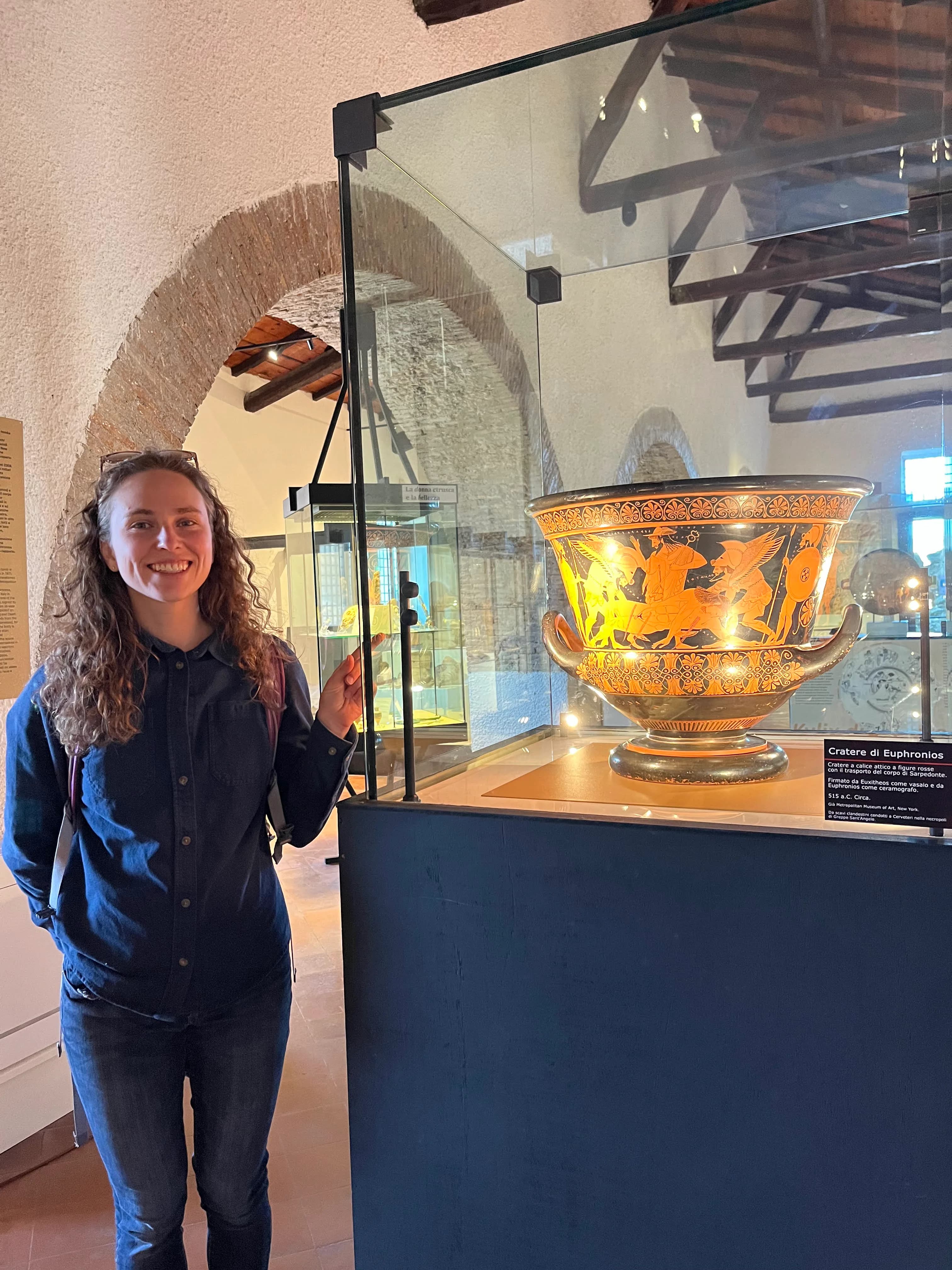
Every morning before Selected Readings, I wait outside the classroom of Sarah Weiskittel, known to students as Ms. Weiskittel. Before I can step through the door, a flood of sixth grade advisees spill into the hallway. They emerge animatedly discussing a video they watched or debating the outcome of a game they have played. Almost always, one of the students will remember a final question and dart back through the doorway. The excitement that emerges for Middle School students in Ware 304 is hard to miss. Moments later, Ms. Weiskittel greets me with an identical energy.
Somehow, the teacher who spends her mornings helping sixth graders navigate indirect objects and email etiquette approaches discussions of Cicero, Seneca, and Ovid with equal enthusiasm. Whether introducing a twelve-year-old to the Latin language or guiding seniors through Milton’s most advanced classics courses, Ms. Weiskittel has a remarkable ability to make every student excited about their learning.
As Milton bids farewell to beloved classics teacher Ms. Weiskittel, it is difficult to summarize her impact because she has never occupied a single corner of campus. Teaching in both the Middle and Upper Schools, she has guided students through nearly every stage of Milton’s classics curriculum; she is well-versed not only in Wheelock’s Latin's "Sententia Antiquae," but also in Suburani’s tales of Sabina and Faustus and Cambridge Latin Course’s sentences about Lucius Caecilius. “There is something uniquely special about helping students take their first steps in a new language,” Ms. Weiskittel reflected.
Ms. Weiskittel earned her bachelor’s degree in Ancient Greek and Latin from Boston University before completing a master’s degree in Latin at the University of Georgia. Prior to her time at Milton, she taught at several independent schools throughout Massachusetts. Still, what distinguishes Ms. Weiskittel as an educator is the immense amount of work she does to make every text feel accessible and alive.
A single passage may send Ms. Weiskittel searching through dozens of commentaries before she finds the explanation she was searching for. Earlier this spring, a question about the ablative of attendant circumstances sent Ms. Weiskittel to Dickinson College Commentaries, then to Wheelock’s Latin, and finally, to a 1929 journal article, “The Social Ablative.” Ms. Weiskittel expressed her love for moving through challenging material that requires “a real depth of understanding and attention to details.” She explained, “there are many details in Latin.” While in Ms. Weiskittel’s class, discussions of Homer will always lead to articles about mythology, quotes from the Odyssey, and even speculation about the cast of the upcoming Christopher Nolan film adaptation. Long after class ends, students can find their inboxes populated with article recommendations and resources Ms. Weiskittel discovered while pursuing a question raised earlier that day.
Next year, Ms. Weiskittel will begin a new chapter teaching at The American School in Switzerland (TASIS), located in Lugano, Switzerland. While Milton is excited for the adventures that await her abroad, her departure leaves an undeniable void in the Classics Department and beyond. The teacher who could spend a morning speaking Latin with sixth graders, an afternoon discussing Stoicism with seniors, and an evening searching for a perfect poem or article for tomorrow’s lesson has become an irreplaceable part of many students’ Milton experience.
I feel extraordinarily lucky that my years at Milton overlapped with hers, and I wish Ms. Weiskittel the very best in her next chapter. TASIS is gaining an exceptional teacher, scholar, and mentor. Milton will miss her dearly.