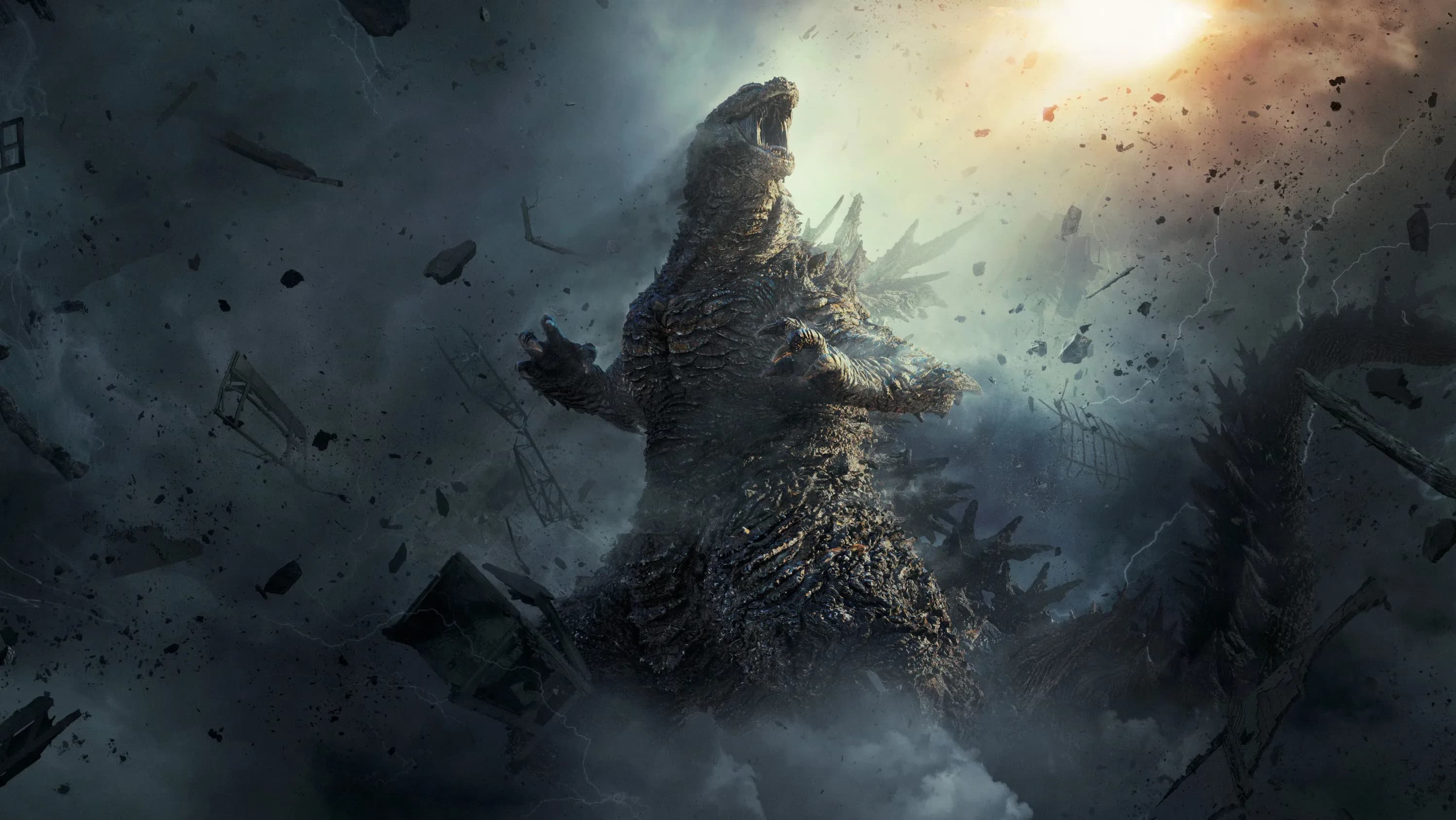
On November 3, on the 72nd anniversary of the original Godzilla, Toho, the parent company, released Takashi Yamazaki’s Godzilla Minus Zero, the sequel to his Oscar-winning Godzilla Minus One, in Japan. Three days later, the film opened in North American theaters with more than $30 million in its opening weekend, setting a record for a foreign-language film. The film stars Ryunosuke Kamiki, as former kamikaze pilot Kōichi Shikishima, and Minami Hamabe, as Shikishima’s wife, Noriko. Set in 1949, two years after the first film, the movie explores the family’s return to battle against a new monster, Ghidorah. I enjoyed the movie overall, and its monster sequences are among the most visually impressive I’ve ever seen. Yet, Minus Zero spreads itself across too many characters and keeps Godzilla offscreen for such an extended period of time that the movie feels a little detached from the greater story.
The film’s greatest strength is its scale, which Yamazaki achieves on a reported budget of under $20 million. The opening attack introduces Ghidorah as a smaller, single-headed creature before it grows into the iconic golden, many-headed dragon. This development, which somewhat reminds me of other Godzilla movies that follow a monster's full evolution, showcases the pace of its growth and the urgency to kill it, adding subtle but exhilarating pressure. The best sequence is an aerial chase over Nagano Prefecture, where Shikishima flies ahead of Ghidorah while disaster-response chief Kenji Noda (played by Hidetaka Yoshioka) and meteorologist Makoto Aoyama (played by Masami Nagasawa) watch from the ground. Even when Ghidorah and Godzilla finally collide, the camera keeps every blow easy to follow. These high-scale scenes are clearly built for the largest screen available, and every fight scene felt increasingly dramatic when paired with Naoki Satō’s booming arrangement of the classic Godzilla theme.
What lifts Minus Zero above a simple brawl between kaiju is its confidence and willingness to confront history, elements I find refreshing in movies that explore Japan’s wartime history. Godzilla has always symbolized the atomic bomb and nuclear warfare, but here, Yamazaki drops the metaphor in favor of directness, following a scientist through the ruins of Hiroshima and staging a long tracking shot of a doctor tending to the dying on the day Godzilla struck Ginza in the first film. Similarly, the film felt very pointed in its portrayal of American occupation forces, who seem more interested in testing Ghidorah’s power than in protecting Japanese lives. Through these harrowing scenes, destruction carries a stronger moral weight than in most blockbusters.
However, the human drama lacks the clarity of Minus One, in which nearly every scene served one pilot’s struggle to believe he deserved to live. Minus Zero divides its attention among Shikishima and Noriko, who are tempted to return to combat; Aoyama, who blames herself for deaths in a storm she predicted but the government ignored; and an American military subplot that offers no conclusive verdict, leaving it without payoff. Each thread raises questions of guilt and responsibility, but too many threads not only make the movie hard to follow, but also leave too little time to develop a proper answer. As Katie Rife of Inverse says, bluntly speaking, the movie “is all over the place.” By contrast, Molly Edwards of GamesRadar+ found the human story “devastating and hard-hitting.” Though I resonate more with the former—I felt the family scenes relied too heavily on attachments formed in the first film rather than on anything new—critics are divided on whether or not the movie carries true emotion.
In my opinion, the film’s strangest flaw is how little it shows Godzilla. Phil de Semlyen of Time Out observes that “like a diva waiting for an encore, Godzilla doesn’t even appear until halfway through,” and, until then, the film lingers on Noda’s team as it plans to defeat Ghidorah with the weather. When Godzilla finally appears, the battle is worth the wait, but my anticipation has long since turned to impatience—the overlong climax blunts its impact.
Still, I would recommend Minus Zero to other viewers. The film definitely doesn't disappoint or mark a fall-off in respect to the entire franchise. As a Japanese student, its success means something personal to me too. I find it meaningful that a Japanese-made film about Japan’s wartime trauma, with subtitles and all, has found a bigger audience in North America than any foreign-language film had before. Following the franchise’s trend of addressing sensitive history, Minus Zero was an impressive movie that paired its most spectacular fights with an unflinching look at the war that created Godzilla.