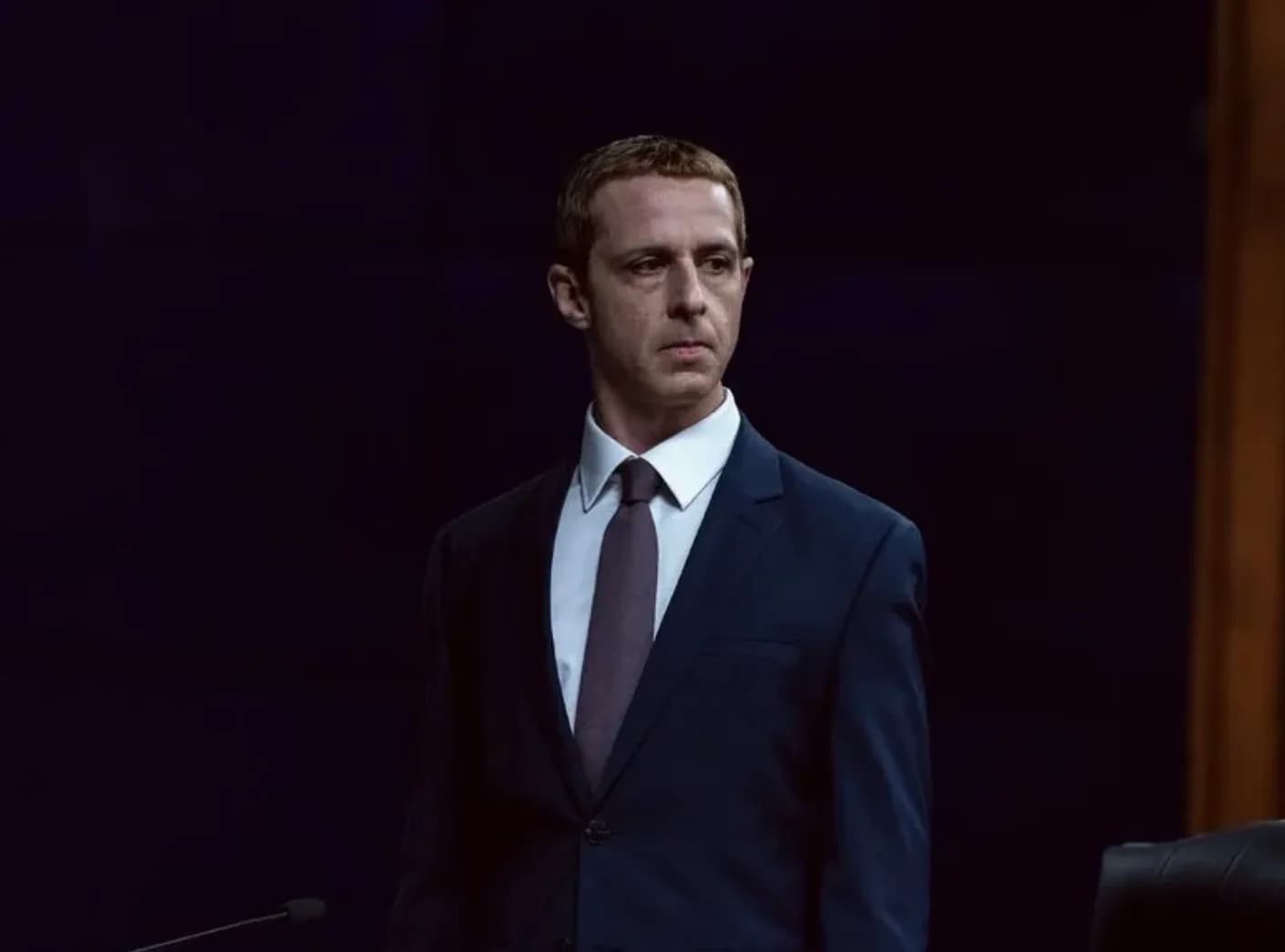
Sixteen years ago, David Fincher’s crew turned parts of our campus into Harvard for The Social Network, a film that made the founding of Facebook feel like a heist. Last month, its Oscar-winning screenwriter, Aaron Sorkin, returned to the same film company as the writer and director of The Social Reckoning, which opened in theaters on October 9, 2026. The film centers on Facebook data engineer Frances Haugen (Mikey Madison) and Wall Street Journal reporter Jeff Horwitz (Jeremy Allen White), who collaborated on the 2021 investigation, “The Facebook Files,” as Mark Zuckerberg (Jeremy Strong) gears up to address Congress about his company.
The film’s greatest achievement was making something as abstract as a ranking algorithm feel concrete, damning, and interesting. The last thing audiences want is a lecture on data science, so the only significant number Sorkin uses is 64%—the percentage of people who were steered to join extremist groups by Facebook’s own algorithm. The film uses a split, pseudo-counter-chronological approach, constantly shifting between the late 2010s and 2021 as it slowly pieces together what led to Zuckerberg’s trial preparations. Cutting ahead to his preparation for his 2021 testimony easily spoiled the outcome, but the film does a great job of making viewers want the details in between the two decades.
As a student journalist, I also left the theater reassured that journalism still carries real power in a world of TikToks, GenAI, and other sources of digital disruption. Much of the film’s drama comes from the unglamorous labor of reporting: secret meetings with a reluctant source or data read and explained line by line. In addition, Horwitz’s bureau chief (a sharp Betty Gilpin) gives him only 90 days to get up to date on the technology beat, despite the fact that Horwitz doesn’t even have a Facebook account. Since the real Facebook Files led to Haugen’s Senate testimony in October 2021, the film’s argument—that power doesn’t just lie in the hands of Big Tech but in the hands of those who document it—feels real and inspiring.
Though the film does a great job of dramatizing events and highlighting the dangers of social media, it falters in how it looks and feels. Like many critics, I found the color grading gloomy and flat, closer to streaming than cinema. William Bibbiani of TheWrap describes its aesthetic as “above average primetime network television.”
Fincher’s absence from the directing chair hurts, but the deeper problem was the story itself. Sorkin wrote this successor, The Social Reckoning, as a story of exposure, while The Social Network was a story of creation. The Social Network invited viewers to marvel at something being built, and it is even credited with inspiring young entrepreneurs by accelerating the rise of startup culture. The Social Reckoning, by contrast, tells a story in which its heroes win by publishing documents about a product we already distrust, and Zuckerberg is no longer an underdog in a Harvard dorm room but an incumbent defending a conglomerate empire. Although the Facebook Files sparked the multistate investigation that ended in Meta’s settlement this August for up to $17 billion, this reckoning came five years later in an offscreen courtroom. Facebook initially survived the 2021 scandal largely intact, and the victory feels more procedural than exhilarating or victorious, which may be honest but far less exciting.
My strongest objection, however, concerns politics. The film’s climax is built around the January 6 attack on the Capitol yet intentionally avoids naming the overarching catalyst, Donald Trump, referring to the president only by “him.” Sorkin told POLITICO that showing anything related to Trump would make the film “just become about something else.” I understand that avoiding partisan distraction matters, but the omission seems to unfairly blame American political division entirely on Facebook’s software, even though many other factors have played and continue to play a role in the polarization of the American people.
After all, the real Facebook Files told a more complicated story: Facebook’s shift to ranking posts by “meaningful social interactions” (MSI) incentivized political parties to reorient their messaging toward outrage. Politicians were led to shift their content to exploit the system, and lawmakers had little incentive to restrain a system that rewarded them with attention and support, no matter how spiteful it was to the other side of the political debate. Odie Henderson of The Boston Globe raises a similar objection about users, arguing that the algorithms merely “push people off ledges they were already standing on.” By sparing those who weaponized the flawed algorithm, the film wrongly blames a single villain when the problem stemmed from a shared set of wrongs.
Especially with the midterm elections on November 3, The Social Reckoning’s warning lands close to home. Recently, The Milton Paper reported that History Teacher Perin Gokce urged students to factcheck their social media feeds against mainstream outlets. After all, even if very few of my friends use Facebook, all of them use Instagram. For those of us voting or pre-registering for the first time, The Social Reckoning is a sharply written reminder that a feed ranked by engagement promotes content that keeps us scrolling rather than content that is true.