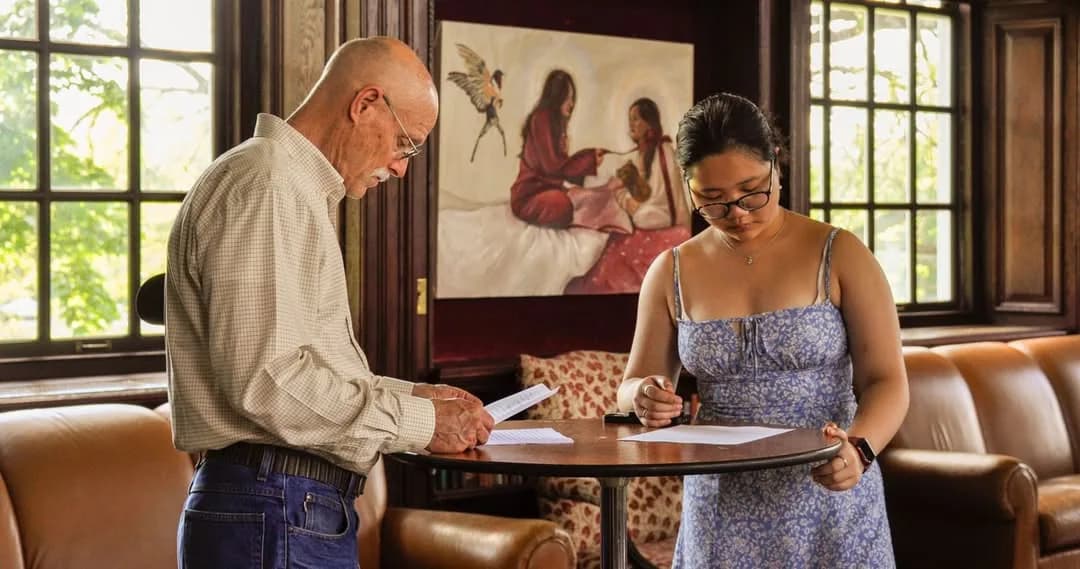
On Tuesday, May 19, around 60 students, faculty, and parents gathered in Straus Library to hear from Bisbee Prize winners who shared their U.S. research paper findings, as well as from students recognized for outstanding work in the social sciences as part of the Social Science Forum.
Established in 1983, the Bisbee Prize aims to both “recognize and…celebrate” research papers that were “truly exceptional,” according to History and Social Sciences Department Chair Joshua Emmott. It was originally proposed by History and Social Sciences Teacher Ethan Bisbee, who, according to Emmott, suggested that “the research paper should be the cornerstone of the history department.”
While there are no set standards that qualify a paper for the Bisbee Prize—making the selection process “some what subjective,” opined recipient Lukas Caggiano ’26—prizewinners typically use more sources in their paper than average. Most history courses required students to have between 2500 and 3000 words and a minimum of ten sources, whilst Bisbee papers generally cited around thirty sources. Apart from the quality of a student’s research, Emmott emphasized that the History Department’s main criterion was “the originality and the sophistication of the question that the student asked.” One senior, three juniors, and eight sophomores received the award: a total of twelve prizewinners out of the fourteen sections of U.S. History and U.S. in the Modern World II.
This year, topics covered by American history papers ranged from Lyra Dvorin ’28’s paper on the impacts of McCarthyism on academic freedom in the 1950s to Caggiano’s exploration of Standard Oil’s growth to a massive monopoly.
To bring such topics to the attention of the broader Milton Academy community, the prizewinners each stood at their own table during the Bisbee Tea, where they described their research findings to attendees who approached their table and fielded questions. The room was a “buzzing” mix of faculty, parents, and students, according to Director of Library Services Molly Wong, who attended the Tea for the first time and appreciated seeing how each student “ended up taking their interpretation of the information that they found and crafting it into a paper that was uniquely their own.” Bisbee recipient Kaia Evans ’27 was “honestly intimidated” by other recipients yet enjoyed sharing her research “because [she’d] put so much work into [her paper].”
Along with the common first question of “What was your research paper about?,” many received questions about the modern implications of their research. Dvorin, whose paper argued that “Harvard’s actions during McCarthyism…showcased the limitations of academic freedom,” held a lot of “modern relevance” in light of current debates surrounding prestigious universities’ stances on political issues. Evans’s paper, too, held modern implications because she incorporated a recent investigation about Cesar Chavez’s sexual assaults on women into her paper centered around the United Farm Workers Union, which Chavez figureheaded. For Evans, her research “made [her] think a lot about the way that our history in the past…can still be evolving and changing today.” Dvorin shared a similar sentiment and urged others to “remember that understanding history is the key to bettering the future.”
Winners gained important takeaways from the writing process, about writing, history, and themselves. “I think this paper…made me realize how much I really do like history, even though in the past I’ve had this idea that I’m not good at it,” Evans reflected. Caggiano learned how “important front-loading the work” is and noted that it was difficult to “push through… writing a huge amount.”
Evans emphasized the importance of picking an exciting topic because “[writing is] such a long process, and you’re gonna be spending so much time on it.” In Dvorin’s opinion, “the most powerful papers are those that you don’t expect to write, challenge your previous misconceptions, or debunk a myth.”
Dvorin, Evans, and Caggiano each reflected that they had not entered the project expecting to win the Bisbee Prize, nor had their teachers placed much emphasis on the prize. “I didn’t really write my paper for the purpose of winning the Bisbee; I just tried to make it as interesting as possible,” Dvorin explained. Capturing the essence of the Tea, Community Engagement Director and Social Sciences teacher Andrea Geyling-Moore, who attended the event, highlighted how Milton Academy has “incredibly smart, dedicated, passionate students,” many of whom chose to pursue “topics that relate to social justice and issues that others should know about.”