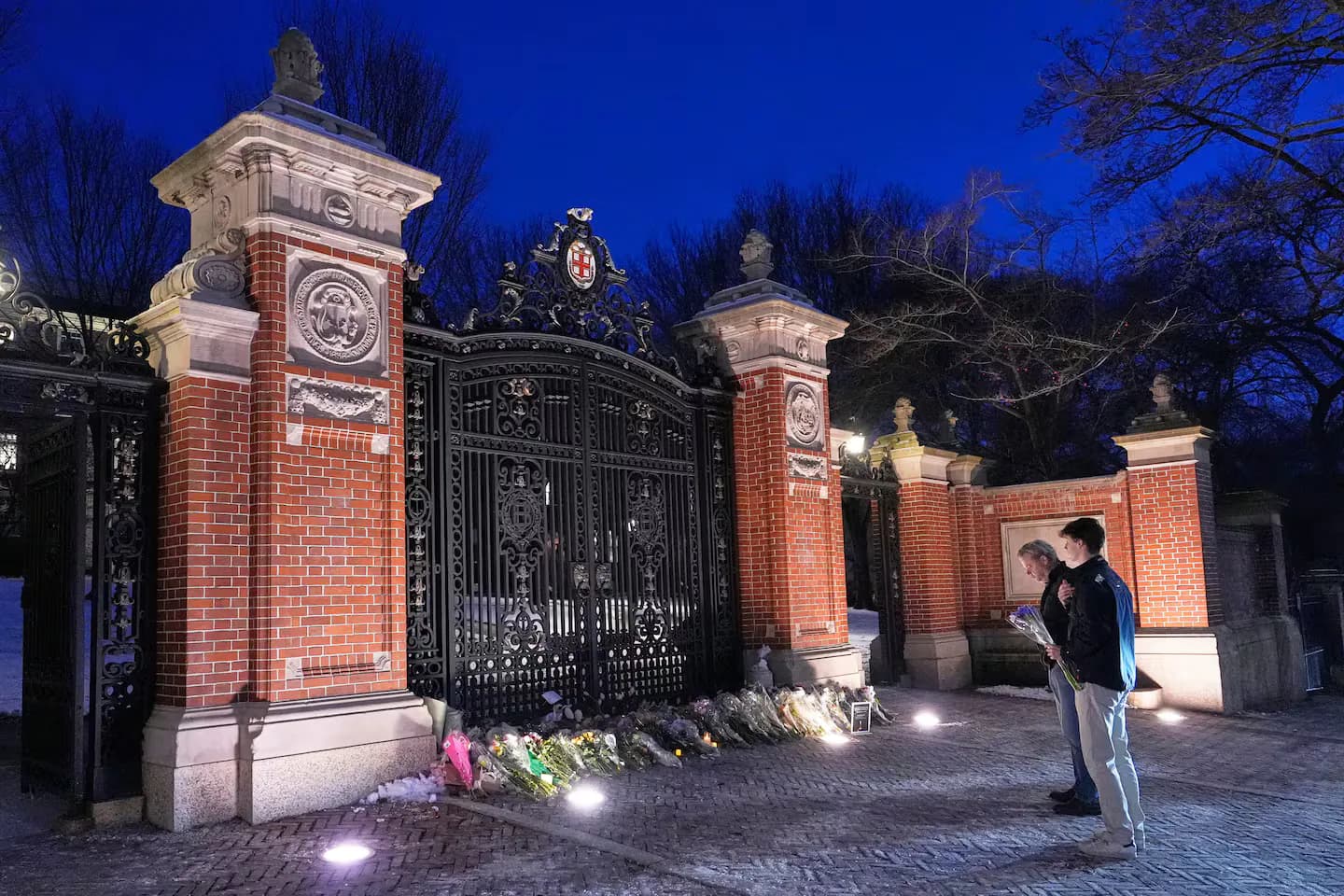
On December 13 at Brown University, Claudio Neves Valente killed two students while injuring nine more. The reverberations of this tragedy extend beyond Providence, including on Milton’s campus.
Those who attend Brown shared their horrors in the aftermath of the shooting. “I was in my dorm with two roommates when one of our other friends texted us saying, ‘there’s a shooter, watch out, be careful, and stay safe,’” Gabriel Friedman, Brown ‘28, recalled. “We were all kind of in shock.” Twenty minutes later, they received a shelter in place alert from the school: “We knew it was real.” They turned off the lights, barricaded the door, and stayed in the room for the next sixteen hours. “We didn’t leave even to go to the bathroom,” he said.
Friedman lost a friend, Ella Cook, Brown ‘28, to the tragedy. “[W]hen we saw that [Cook’s] Find My location had been pinned to the room for hours, we knew something was wrong,” he said. “She was a really kind and bright person who was very passionate about the things she believed in…and this event was traumatic for me.” Friedman added that returning to school will be difficult because his “home, a place where [Brown students] all felt really safe, no longer feels that way.”
Max Donovan ‘25, Brown ‘29, learned about the shooting via texts from friends when he was off-campus. Like Friedman, he had felt skeptical and then scared–worried for his friends who were there. Right after the shooting, Donovan felt a sense of relief: “All my closest friends were okay, so I thought, okay, I’m out of the woods. It’s gonna be okay.” Then, he received devastating news at 11:00 that night. “I found out that [my friend] was shot multiple times in the torso, the neck,” Donovan described, pointing all over his body in illustration. “She’s okay, but…that really hit me hard. I mean, that hit like a train.” Donovan felt particularly shaken because he would likely have been in the review session when Neves Valente attacked if Donovan had not placed out of the course earlier that year.
Alexa Burton ‘24, Brown ‘28, was in a cafe near Brown when her friend texted her around ten minutes after the shooting. “My friend had seen two students on the ground, but from very far away, but she knew that very clearly something was wrong, and so she texted us and said ‘Guys, get inside. I don’t know what’s going on, but something really bad is happening.’” Burton continued, “I thought of shooter drills that we did at Milton…and one of the things I remembered is that you’re supposed to get off campus… [My friend and I] immediately left the cafe, but we were right across the street from our dorm, so we decided to actually go back in the direction of campus because we wanted to be able to lock our door.” Burton also echoed Friedman’s statement about the school’s delayed communication: Without information, they had to figure out what safety precautions they should take by themselves.
The tragedy’s impact also reached many Milton students with siblings at Brown. Nika Fernandez ‘27, whose sister attends Brown as a freshman, explained how “having someone there makes [the shooting] a lot more real.” That period before the killer was found “was definitely scary” because she feared “that he was hanging around” and would continue with attacks. The shooting has made her reconsider her safety at Milton. Because this campus “is so close and similar to Brown,” she worries that a shooting like that “could happen to any of us at any time.”
Some parents, both directly and indirectly connected to the shooting, have also developed new fears surrounding sending their children away to school. Upper School Principal Rachel Stone, who has two sons in college, discussed her reaction after the tragedy. “Both of my boys [are] also going into big spaces for exams… and even though I wasn’t rationally worried about them, emotionally, I was worried about them.” After the shooting, while she would not usually “have a 21-year-old son tell [her] where he is all the time,” given the circumstances, she requested he give her updates when he entered exam buildings and again when he had returned to his dorm.
In a written response to questions, Director of Campus Security and Risk Management Jay Hackett assured students that Campus Safety has instituted many visible and invisible measures to protect Milton from potential intruders. Although he could not share all precautions, citing fear of compromising their efficacy, the initiatives he did share include lockdown training, blue phones across campus, and a campus safety phone number, which operates at all hours. Burton, for one, found Milton’s lockdown training effective and remarked that the “flashbacks to all of these drills” helped her know what to do. Donovan also believes that Milton does enough to prepare for the event of a shooter, recalling lockdown training and remarking that Milton’s IA card swipe requirement for each building made it “even more secure than an Ivy School campus.” Donovan explained how, during his first semester at Brown, “many buildings, you just kind of walk in, the door is open. Some are actually propped open.” Fernandez also felt that Milton’s training and security measures make Milton “a safe campus.” However, as she reflects on the Brown shooting, where the lack of security cameras allowed the intruder to escape, she warns that Milton “should make sure that all the little things work.” Donovan also commented upon Brown’s lack of cameras near the building where the shooting occurred, Barus and Holley: “It’s kind of ridiculous that you have a major engineering building with no cameras around the back entrances–doesn’t make any sense to me.”
To alleviate the risk of school shootings, Stone called for gun violence to be treated as a public health crisis. “When [the Institute of Public Health] identifies something that is causing harm, most of the time it is up to health advocates to address the problem.” In an analogy, she described how “if you start smoking cigarettes, you’re probably going to get addicted because there’s nicotine. So now there are laws around tobacco use in teenagers.” Fernandez thinks that the U.S. needs “to create a screening before putting guns into the hands of people.” She explained, “I wish a shooting like this would bring this issue higher up on the table.” Donovan supports “banning assault weapons nationwide.” However, the Brown shooter used handguns, and Donovan does not “believe we can strip the 2nd Amendment.” He continued, “There’s two sides of this problem. It’s the weapon, but also the person. If someone is insane and wants to commit harm to someone, I believe they will find a way to do it, no matter what the restrictions are.”
The Measure recommends that you read Burton's article, titled “A utopia, shattered: Finding community after tragedy,” published in The Boston Globe on December 30, 2025.