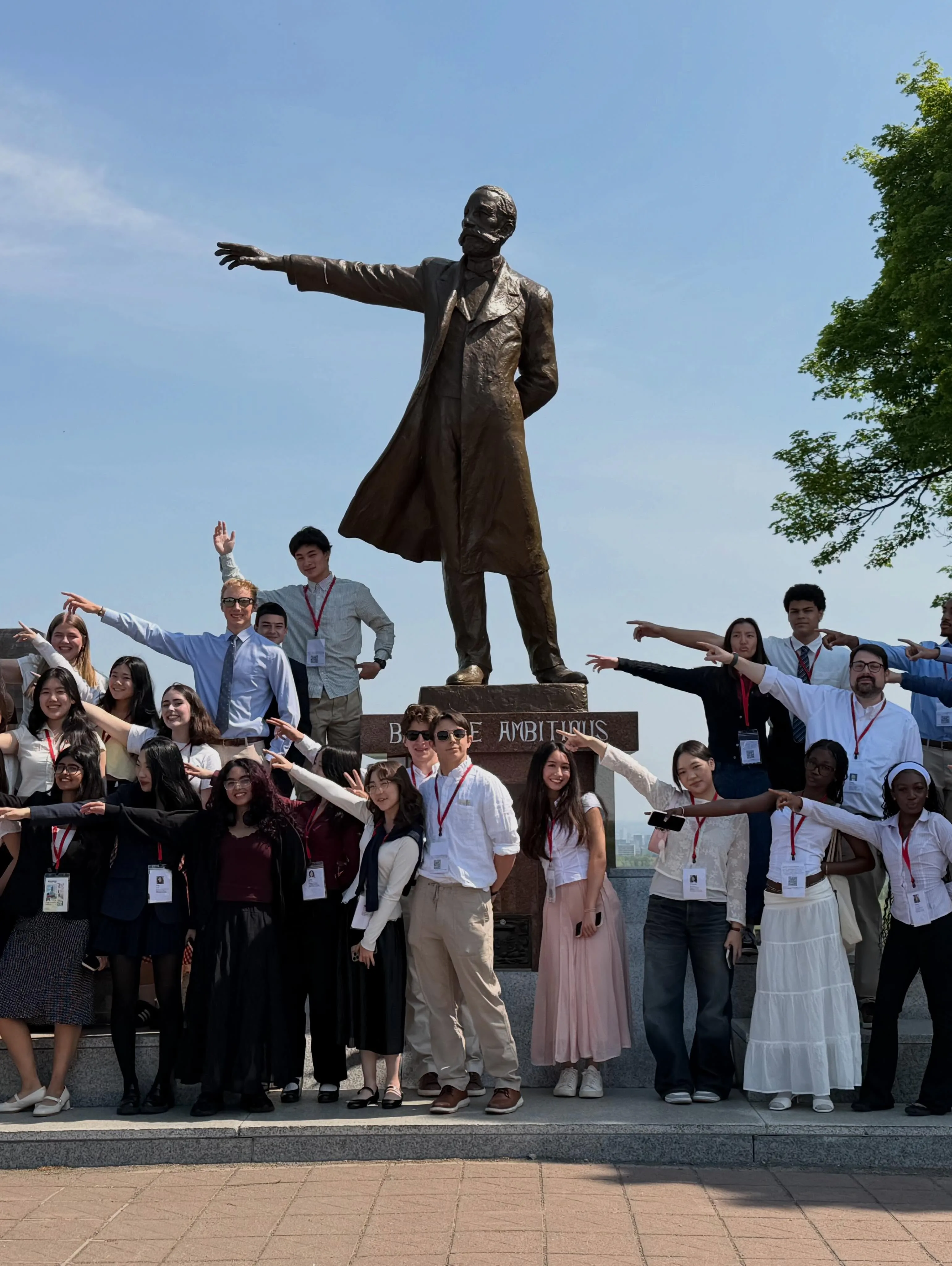
Head of School Alixe Callen ’88 indefinitely suspended the Japan Exchange Trip, effective this school year. The decision to end the roughly 35-person trip, the centerpiece of a partnership-based exchange between Milton and two Japanese schools, stemmed from Callen’s concerns about the trip’s lack of relevance to Milton's curriculum and its financial and personnel costs. “I never want to take away something that students love… [but] I feel like part of what I’m hired to do is to make tough decisions,” said Callen.
English Teacher David Nurenberg created the exchange with Meikei High School in 2022 as an expansion of a similar trip he had been coordinating since 2003 at his previous school. The trip was part of a larger partnership aimed at maintaining a connection between Massachusetts and Japan, with its origins during the Meiji Restoration in the 1870s, when Japan sought to Westernize through inviting foreign consultants, many from Massachusetts. The trip was part of a bilateral exchange, where students from Meikei would also come to Milton every March for one week; on each end, students would stay with local host families and attend classes at their sister-school, with the aim of deep immersion as opposed to a “tourist” experience. Nurenberg described how, when the exchange was first approved at Milton, “there was a push to deepen some of Milton’s international partnerships.”
Callen explained her decision: “The Japan Trip has obviously had a tremendous impact on the students who participated… [but] it's not actually tied to a group. We don’t teach Japanese. We don’t even really have a Japanese history course. It's always been sort of an extra on the side.” Instead, Callen wants “to teach an amazing curriculum and give students opportunities that are extensions [of the curriculum].”
Another of Callen’s concerns regarded the resources required for the trip. Nurenberg explained that he kept the trips tightly within planned budgets, but Callen added that, “even with families paying, the impact financially to Milton was pretty significant,” costing “tens of thousands of dollars… some of it [coming] out of our financial aid budget. I’d rather be able to give students opportunities to come to Milton. Honestly, there are so many more costs than there are buckets of money to pay for them.” She also worries about the burden the trip placed on Nurenberg, who was never given any stipend or workload credit for managing the exchange program: “On top of somebody who’s already doing the Measure, Jewish Student Union, teaching full-time, and now running the Penn Fellows program, it’s a lot to ask of him to do that, and it's not like anyone else can sub in for him. He’s the only one with the language skills and the cultural skills.” Nurenberg declined to comment on the trip’s time commitment and whether he had found a suitable co-leader.
Another crucial factor in the decision was the strain the trip placed on Milton’s faculty. Because of the misalignment between the U.S. and Japan’s academic year, the trip occurred in May as opposed to other exchange trips, which typically leave closer to graduation. History Teacher Joshua Emmott explained that the timing, coupled with the trip’s size, had “a real impact on the academic and athletic programs.” For Emmott’s Globalization of Islam class last year, his class shrank because of the trip from five students to three. “The curriculum is planned to last until June, and for those kids, it just ends prematurely.” The three faculty chaperones on the trip also need replacement teachers. Emmott said, “it's actually kind of complicated to find teachers who are going to cover Dr. Nurenberg’s class. When Mr. Deehan left, we needed to cover his psychology classes and his religion class, and he’s the only person who teaches religion.”
Despite understanding Callen’s point of view, some students disagreed with the decision, highlighting the trip’s unique value. Jackson Fava ’28 acknowledged that the trip did not tie into his core academic curriculum but felt that it improved his Milton experience in other ways: “We learned about Japanese history, we talked about the customs, their religion, their language… knowledge that we brought back.” He also felt that it had helped him form new connections within Milton, stating “[the Milton students] came up with a nickname for me on the trip, and they’ll call that out to me when they see me, even though we weren’t great friends before the trip.” For Harris Felix ’27, the exchange showed him “how World War II is taught in Japan,” including the fire bombings “that are not really taught in the U.S. at all, so [he] was able to bring that up in [his] U.S. history class.” Felix also mentioned building an extremely close connection with his Meikei exchange student and “[sending him snaps] basically every day.” Charles He ’26, a 2024 student trip leader, reacted in shock to the decision. He commented, “From my experience, the program was really successful. All the students had great feedback.” For him, learning to manage his complex administrative duties and act as a “diplomat” taught him a “sense of accountability” that fostered his leadership skills in his other positions at Milton. Even so, he says he understood Callen’s rationale.
Mr. Jun Miyazaki, Principal of Meikei High School, wrote to Callen on September 9th to say that, “over the years, the exchange between our two schools has been an extremely rich and truly invaluable experience” that had a “wonderful, positive impact on our students. For some, this experience was even the catalyst that led them to pursue university studies abroad.” Miyazaki expressed his hope that the exchanges might return when and if “circumstances allow.”
Callen stated that the cancellation “is not a larger effort to remove travel” and future exchange trips. In fact, she mentioned that there could be a possible expansion to the number of trips and international opportunities for students in future years.
Callen’s decision suspends only Milton-sponsored travel to and from Japan, not the Japan partnership relationship itself. Nurenberg says he is open to alternate models, and hopes that the Milton community “can still, through technologies like Zoom, be able to communicate with our partners over there.” Additionally, “if students or faculty want to independently travel [to Japan], they can leverage those relationships that we’ve built.”