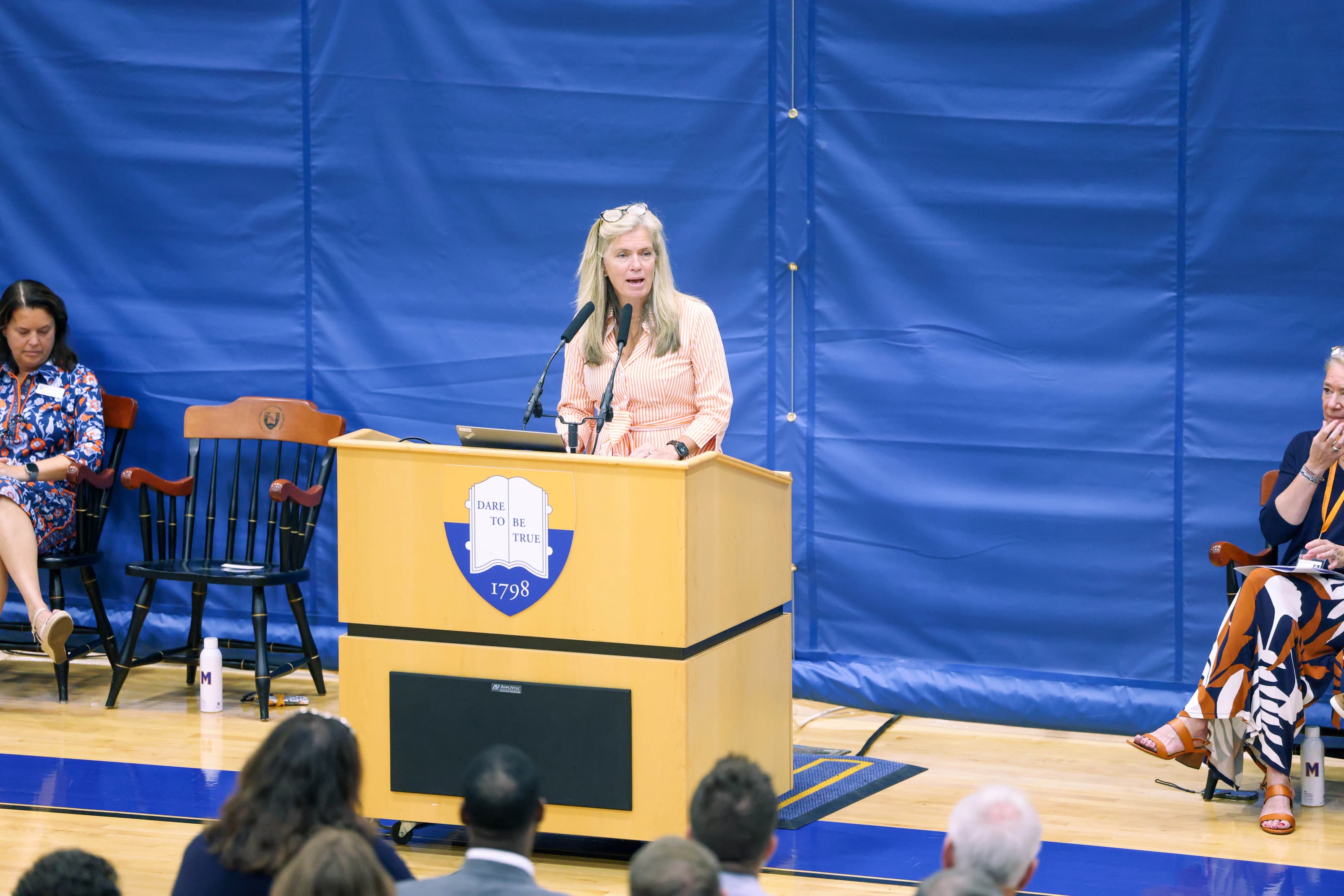
During Upper School Meeting on October 13, Head of School Alixe Callen ’88 addressed an opinion article in The Milton Measure suggesting that artificial intelligence entered the writing process for a speech she delivered during the Prize Assembly last spring. Callen acknowledged the lack of policies governing faculty use of AI and announced a working group that she hopes will create an AI policy for adults by the end of the calendar year. Callen did not explicitly say whether AI was used to write the award speech.
In a Measure survey of 161 Upper School students, 72.7% of respondents said they appreciated Callen addressing the issue in front of the school. However, 72.0% also said her remarks addressed concerns about adults’ AI use “not very well” or “not at all.” 50.3% said the remarks lowered their trust in the administration, compared with 9.9% who said they raised it. These results highlight a gap between how students received the gesture and how they judged its contents.
The article Callen spoke about, “To Make Meetings Human, Cut Robotism,” was written by The Milton Paper Sports Writer Samuel Breyer-Essiam ’28 and Measure Opinion Editor Isaac Wu ’28. Their article, published on September 25, reported that the AI detector Pangram flagged “100% of the text” of the Talbot Baker Award speech—honoring Science Teacher Tom Gagnon at the 2026 Prize Assembly—as AI-generated. Director of Communication and Media Relations Esten Pérez told The Milton Measure that AI was used “to organize all the source material from multiple nominators.” Wu clarified, though, that his “article explicitly said that Callen had not written the speech.”
At USM, Callen noted that she had read the speech aloud but had not written it. She recognized that “this incident serves as a clear indicator that [she had] not done enough to provide guidance in the form of expectations or a policy.” She pointed out the inconsistency of students being bound by an academic integrity policy that prohibits them from turning in work that is not their own while such a policy “does not actually exist” for adults, even if it “might be assumed.”
As the committee is being formed to create the policy, Callen asked adults “to be mindful in their professional use of AI.” In her speech, she also framed the controversy in a wider context, describing the “collective confusion and frustration” over AI “at every institution in the world.” She noted that attitudes towards AI vary widely, recounting one parent who, after reading the original article, actually told Callen that “with everything on [Callen’s] plate, [the parent] hoped [Callen] was using AI.”
When asked by The Measure the next day, Callen declined to comment further on the speech, writing that she thinks she covered the issue in her remarks to the student body. She added that she had told faculty that AI “should not be used when providing narrative feedback to students” and that “if they received the gesture and how they judged its contents.”
For Jiner Huang ’28, Callen’s USM speech did not settle the matter. Huang said that Callen’s explanation that she did not directly author the speech does not “suffice because she is, after all, the one giving the speech.” Huang added that responsibility should not be redirected because Callen is “the spokesperson for the school.”
Luka Buchheim ’27 called the response “very evasive” and added that “some things are supposed to be genuine and sincere, especially awards meant to celebrate people.” He asked, “What happened to ‘Dare to be True’?”
Sharing similar sentiments, Levy Gomez ’30 said that Callen’s response felt “rushed” and that Callen “was kind of defending herself immediately,” so addressing the entire school “kind of brought [the controversy] out more and made a more negative impact.” Jasper Brun ’29 thought Callen should have apologized.
Inés Velazquez Correa ’27 said, “Even if [other institutions] use [AI], that doesn’t mean you can use it.” To some, Callen’s reference to the wider world’s adoption of AI sounded more like an excuse than context.
Beneath the debate over Callen’s speech, a notable imbalance exists between the standards and rules for students and teachers. For reference, the Upper School Student Handbook lists “use of artificial intelligence without permission of the instructor and/or proper citation” as a form of dishonesty. Expressing her discontent, Liv Georges ’30 said, “We get DC’d and get in a ton of trouble for even using a little bit of AI for a little bit of help on something,” a complaint referring to the Discipline Committee and its formal procedures for responding to student AI use.
In contrast, for Milton’s adults, the interim guidance has come up only “briefly in some faculty meetings,” according to Math Teacher Anthony Dolcimascolo, who did not know if there is a formal written policy yet governing adult AI use at the school. In the Measure survey, 65.8% of students said adults should be held to the same AI standards as students, and for some, like Velazquez Correa, this policy may mean adults “shouldn’t be using it at all.”
However, Associate Dean of Students André Heard argues against this position, as he believes that “AI is a tool, and we should all use tools responsibly and transparently.” Adults’ work differs, says Heard, because they are “not actually here to learn in the same way that [students] are here to learn.”
The original article’s authors were more positive than most students, as both Breyer-Essiam and Wu called Callen’s speech “a win.” “Honestly, I’m pretty happy,” said Breyer-Essiam. Wu explained that an apology would have pre-empted the new working group’s decisions: “The committee still needs to decide whether using AI for the Talbot Baker Award speech was wrong,” he said.
According to Callen, the 10-member Adult Use of AI Working Group includes adults from the Lower, Middle, and Upper Schools in areas including technology, advancement, and legal affairs. Its members include Callen herself, Chief Information Officer Bryan Price, Chief Legal Counsel Susika Wylie, and Upper School Computer Science Department Chair Chris Hales. No students are in the group. In an email to The Measure, Callen said that she would like “to have a working policy in place by January 1.”
Director of Library Services Molly Wong of the new working group creating adult policies, said that she does not even know when it will meet yet. Amending what Callen said about adults having no concrete policy, Wong noted that at least one expectation predates it: “We already are not allowed to use AI [in] comments.” She called it “a standing policy that already exists.”
Looking forward, students also want a say in what comes next. “If [the faculty are] following a policy, [students] should know what [they are] following,” said Kamali Reddy ’29, who believes the group “should include some students.”
For Huang, the test of Callen’s response is simple: “The first step is to set a collective standard that will actually be followed.”