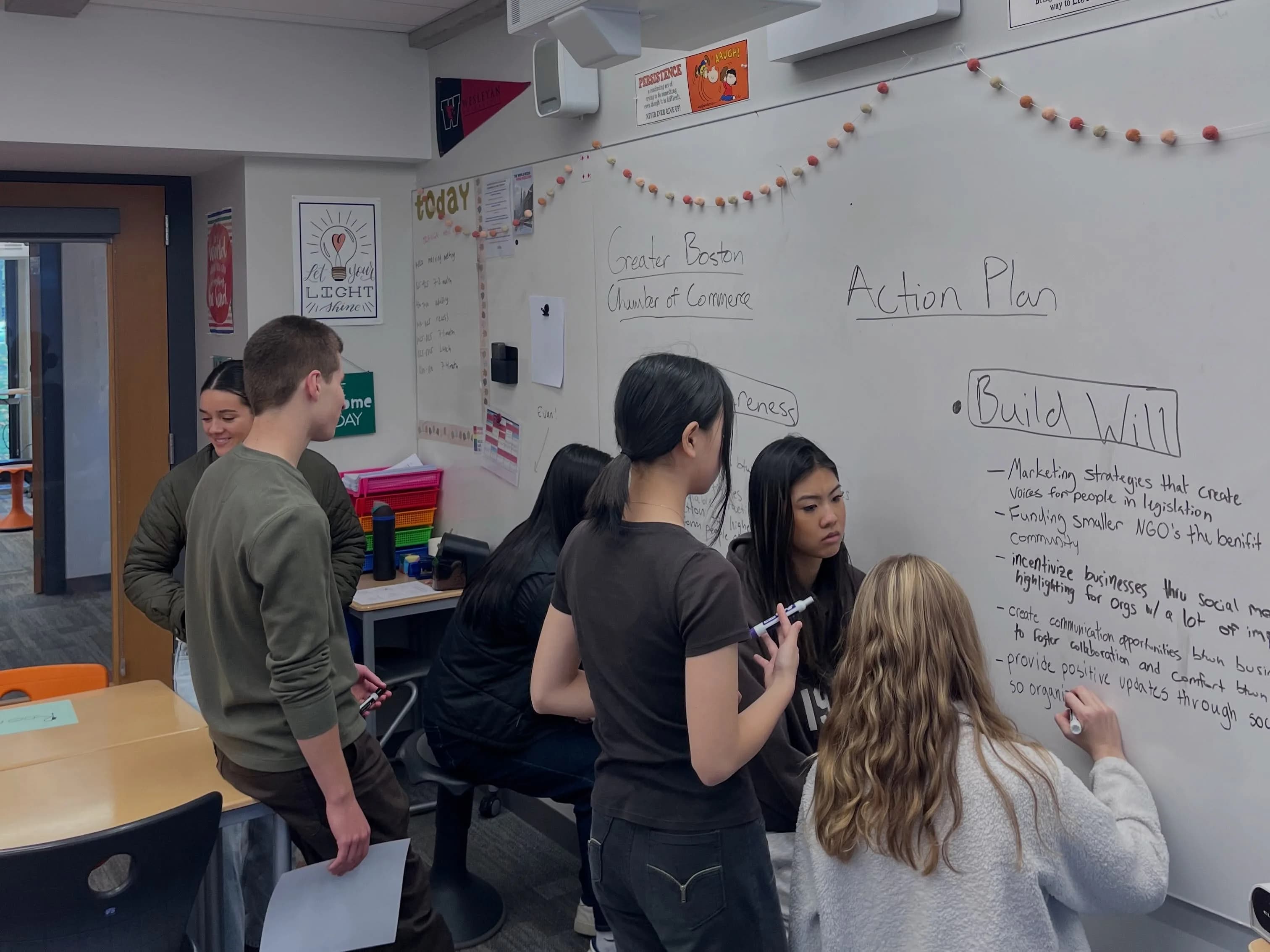
On Sunday, November 15, the Sustainability Board hosted its annual interscholastic Sustainability Conference, with the theme of “Sustainability in Healthcare.” 29 Milton students welcomed 13 students from other schools, including Deerfield Academy, St. Mark’s School, and Noble and Greenough School. The event featured workshops, a keynote speaker, and spaces for collaboration among like-minded individuals across schools.
Sustainability Board Co-Head William Lara McCannon ’28 explained the event’s theme: “We decided to do sustainability and healthcare because it seemed like a nice way to connect with some of the other boards [such as Future Health Professionals Club] to get people interested in the event versus just making it purely sustainability-themed.” Fellow Co-Head Emlyn Joseph ’27 said the event was intended for students to realize that “sustainability is interconnected with so many other disciplines.”
Board member Samuel Breyer Essiam ’28 felt that the event successfully executed on its theme. “I thought it went really well because I was able to see actual impacts [between sustainability and healthcare]. For example, in one of the case studies, I was able to see how global warming has created an uprising in Dengue [Fever], which is carried by mosquitoes.”
The conference’s interscholastic element enabled students to learn from and to collaborate with members of other schools. Breyer Essiam said, “One cool thing that I learned about Deerfield was that they won a sustainability award for their kitchen.”
Board member Sienna King ’29 was inspired by the idea of adopting Deerfield dining hall’s assigned seating: “It’s interesting because I’d get to meet a lot of different people every day,” and “I think it would be fine to have a couple times a week.”
Breyer Essiam also planned future events with members of other schools’ sustainability groups: “One idea that we had was that, instead of always doing these well-planned-out events to congregate the schools, we could instead send representatives. Like one representative from Milton could go on a weekday or a weekend to a school like Nobles to check out…certain things we could take from Nobles and apply to Milton.”
The board selected McCannon’s uncle, Joe McCannon, the Former Director for Sustainability at the White House Council of Environmental Quality, as the keynote speaker. McCannon had also worked under the Obama administration as Senior Advisor to the Administrator at the Centers for Medicare and Medicaid Services. Future Health Professionals Board member Timothy Baelee ’29 called McCannon’s speech his “favorite part” of the event. “I’m personally interested in an intersection between healthcare and health policy. So, it was really cool to see someone who has that much experience talk to us.”
Lucas Xia ’28 praised how “qualified” McCannon was and appreciated both his discussion about “how the Trump administration laid off a lot of health and sustainability workers and his breakdown of the ‘three types of contributions to carbon emissions.’”
The event also featured an array of workshops. In one, students performed a case study examining a fictional patient with a climate change-related illness. In another, attendees role-played as health-related organizations. Baelee found the workshop “really interesting” and appreciated how “the case study format of the first workshop was pretty similar to what [he does] in Partners in Health.”
Some attendees criticized this year’s event’s early start. For Baelee, “the starting time was a little bit early for it being on the weekend and especially as a day student, [he found it] kind of rough to get up in the morning and have to remind [his] dad to drive him to Milton.” Scheduling was a factor in students’ decisions not to attend the conference this year. In a poll of eight Milton students who did not attend the conference, six of the eight students said their interest in sustainability on a scale from one to ten was a seven or above. However, some of the eight students cited that they did not have enough time to participate.
“There are things that we as students can do, and then also measures that communities and groups of people can come and come together to make change,” McCannon said. “Sustainability is connected to many aspects of our daily lives, and we can all come together to make a difference.”