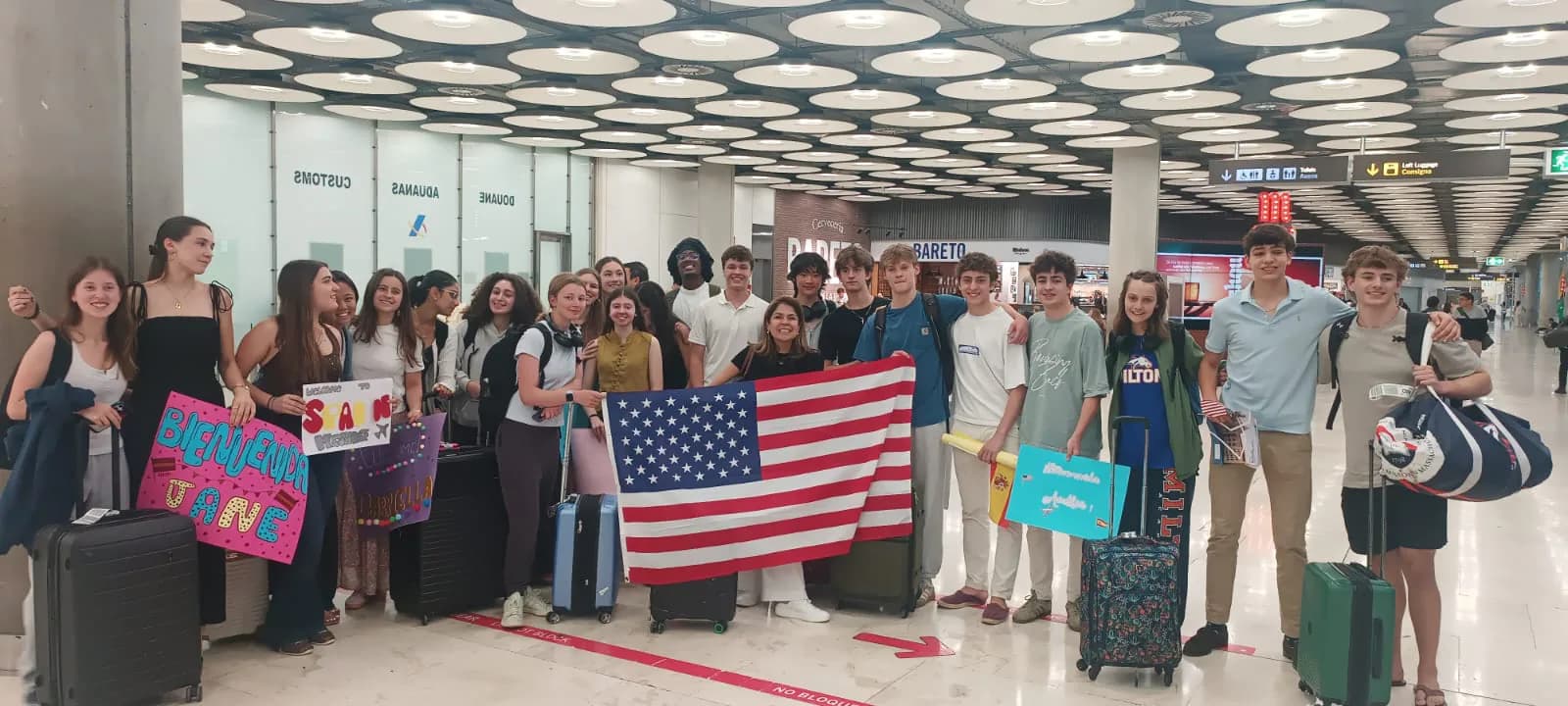
For students who traveled on one of the three exchange programs this month, learning does not have to live in the classroom. On May 19, 21, and 27, students traveled to Spain, France, and Japan, to solidify modern language skills developed at Milton, to explore new cultures, and to deepen connections between Milton and other schools around the world. All programs partnered with local high schools and host families and featured programming that familiarized with local cultures.
Spanish Exchange
Spanish Teacher Bill Hamel described how the Spanish exchange brought eleven students to the school El Pinar de Nuestra Señora in Barcelona as an opportunity to burst the “Milton bubble” and “get as far as possible from [students’] current circumstances.” Often on the trip, Hamel says, students have to “[dive] into the deep end and [figure] out how to swim.” He described a phone call he had with a student on a prior trip: “'Señor Hamel?... I got lost, and I got in a taxi. It was so awesome.'” Hamel also praised the immersive nature for allowing students to learn languages swiftly and seamlessly. In a typical Milton language classroom, he says, “you walk away with 85 [hours of Spanish practice.] We get that in the first week of the exchange in terms of contact time, so you can triple your exposure to the language in three weeks of the exchange.” Meshva Patel ’28 explained her decision to join this year’s trip: “I have [at my home] Indian culture and my American culture, and I think it’s cool living a dual life… so I thought to expand my horizons and explore a third culture.” She strives “to be fluent in Spanish, because [she wants] to work as an immigration lawyer… and a large part of the immigrant population in the United States is people of Hispanic background.” Ime Ebong ’28 had other motivators. For him, “learning [Spanish] isn’t really that big of an interest. It’s more about the culture… The way people come up with different art styles and have different traditions, it’s really interesting.”
French Exchange
Eleven French exchange students of French 2 level or greater traveled to Lycée International Georges Duby High School in Luynes, France. Similar to Hamel, the French teachers chaperoning the trip appreciate that the trip forces students out of their comfort zone. “Seeing all the students pretty nervous at the beginning [of the trip]… in their speaking capabilities, as a group, and with their host families, and then seeing that comfort grow” is Language Teacher Cecilia Menendez’s favorite part of the trip. “You’re just immersed in the language all the time…from reading signs and trying to figure out where to go,” she added. To Isabella Vander Elst ’28, the exchange seemed like a shorter “version of School Year Abroad (SYA)” and offered an opportunity to “fully master a language.” In addition to learning more about French, Vander Elst also looked forward to visiting the program’s partner high school. “The kids go to a public school and public schools are very different in France than the U.S,” she said. The possibility for new connections can also motivate students. Rowan Collins ’27, who participated in last year’s trip, bonded with her exchange student over playing musical instruments, and the two are still in contact.
Japanese Exchange
While there are many parallels between the French and Spanish exchanges, the third exchange program is very different because it does not center around foreign language study (Japanese is not offered as a class at Milton). The Japan trip, which included 27 Milton students this year and ran for the first time in 2024, according to English Teacher and Co-ordinator of the trip David Nurenberg, “is a part of a larger, long-term partnership between Milton Academy and two Japanese High schools... The exchange involves not only a biannual trip of Milton students to visit our two partner schools in Japan but also yearly visits of delegations from those Japanese partner schools to Milton Academy.” Because the trip, designed by Milton faculty, is designed to often avoid touristy spots, Ren Hirose ’28, a participant in this year’s trip, appreciated the exchange’s authenticity: “Experiencing culture shock is an important thing in life because not everyone lives the same way as you do.” Nurenberg recounted how students are typically surprised by the “culture of cleanliness, politeness, and responsibility that permeates all parts of Japan, including the schools. Japanese schools don’t employ janitors or lunch ladies; the students take care of cleaning, maintenance, [and] food prep… It’s actually not long before our students start adjusting their own behavior to match,” and “they never quite look at the habitual mess in the [Student Center] the same way.” Jessiah Akewright ’28, another participant, looks forward to “try[ing] more foods to really understand the culinary diversity and… visit[ing] Japanese shrines and temples,” and he highlighted a uniquely different aspect of the educational immersion. Students also get to meet with education officials from the Japanese government and learn about US/Japan relations by being actual ambassadors, and contributing to cooperative activities between the two nations that have been in place for over a century.
If you weren’t able to sign up for a trip this spring but are interested, don’t worry. Information sessions and applications for the three trips will be released again in the fall, and Chinese Teacher Xiaolu Shi is “excited about the possibility” of even resurrecting an exchange trip to China in 2027.