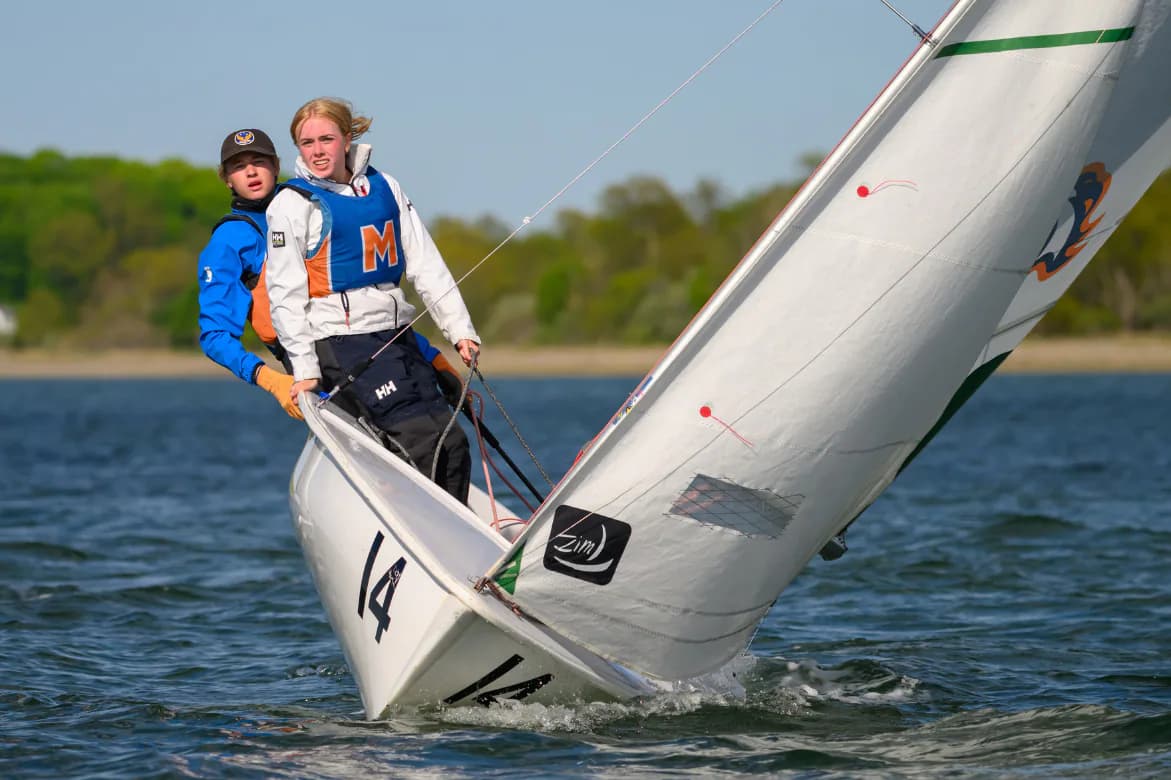
This weekend, on May 16 and 17, Varsity Sailing will be heading to the National Invitational Tournament (N.I.T.), in which the team earned an opportunity to attend through an at-large qualifying bid after competing in the NESSA Championship, otherwise known as the President’s Trophy. This regatta was held at The St. George’s School in Rhode Island, where eight teams qualified through their performances during the regular season.
At the President’s Trophy, Milton sailed shorthanded, missing key skippers such as Enzo Peabody ’28, who spent the prior week sidelined with a concussion and "wishing [he] could have been there” to support the team.
The first day of the regatta brought light winds and significant shifts across the course, creating a highly agile day of racing. The second day featured twenty-knot winds from the southeast, presenting sailors with much more demanding conditions. Yet, contrary to what one may think, Owen West ’26 explained that the conditions actually “played in our favor.”
Tactically, the team had to adapt constantly throughout the regatta to keep pace with changing weather conditions and strong competition. Historically dominant programs, such as St. George’s and Tabor, controlled much of the racing throughout the event, leaving the remaining teams battling intensely for the final qualifying positions.
Both the President’s Trophy and N.I.T. entailed team racing, where three double-handed boats from each school compete against one another simultaneously, with the team earning the lower cumulative score winning the race. The structure of team racing makes the sailing especially tactical and creates opportunities for coordinated strategy throughout each race.
Although Milton competed with a reduced roster, the smaller lineup did not translate into the effort the team brought into the regatta. With a less defined structure, the sailing team experimented with untested combinations while each competitor carried a heavier workload. Despite these challenges, Milton’s boat handling in heavy winds remained sharp, and the team’s tactical decision-making consistently provided an advantage over younger, less experienced programs.
Moreover, sailors new to the varsity team gained firsthand experience competing against some of the strongest schools in the country. Madeleine Stuart ’29 described her first varsity regatta of the season as “crucial experience,” describing it as "transformational to see high quality programs like Tabor and St. George’s sail.” Her experience highlights the vitality of these opportunities and regattas are to the development of young sailors.
On the other hand, Emmett Burghardt ’27, an experienced sailor, reflected that “I honestly think that sailing shorthanded lets us take more risks.” He added, “Everyone on the water knew their job, and there was less pressure on any one person to carry the team to victory.”
At the end of the second day, the team’s performance highlighted the sailors’ resilience and composure despite being faced with tough results. After dropping a race to Greenwich High on the first day, Milton persevered, winning the rematch in difficult conditions the following day.
With a National Invitational Tournament bid already secured and heading into the final stretch of the season, the team had an unusual level of freedom to experiment at a high-level event. Head Coach Patrick Broome noted that “because we already were going to the N.I.T., we could sail free from the pressure of qualifying, allowing us to try more new things.”
The team's berth at the N.I.T. for the first time since 2014 highlights the emerging possibilities the team’s talent has granted and the momentum the program has built, gearing up for the next generation of sailors. With a full roster expected for the N.I.T., Milton will step onto the national stage ready to compete for the win.